
Bionics / Research
Soft mini-robot could place medication in a targeted manner
One day, the millimeter-sized robot could deliver drugs exactly where they are needed in the body. Researchers at the Max Planck Institute have based their development on nature: the locomotion of larvae, caterpillars and jellyfish.
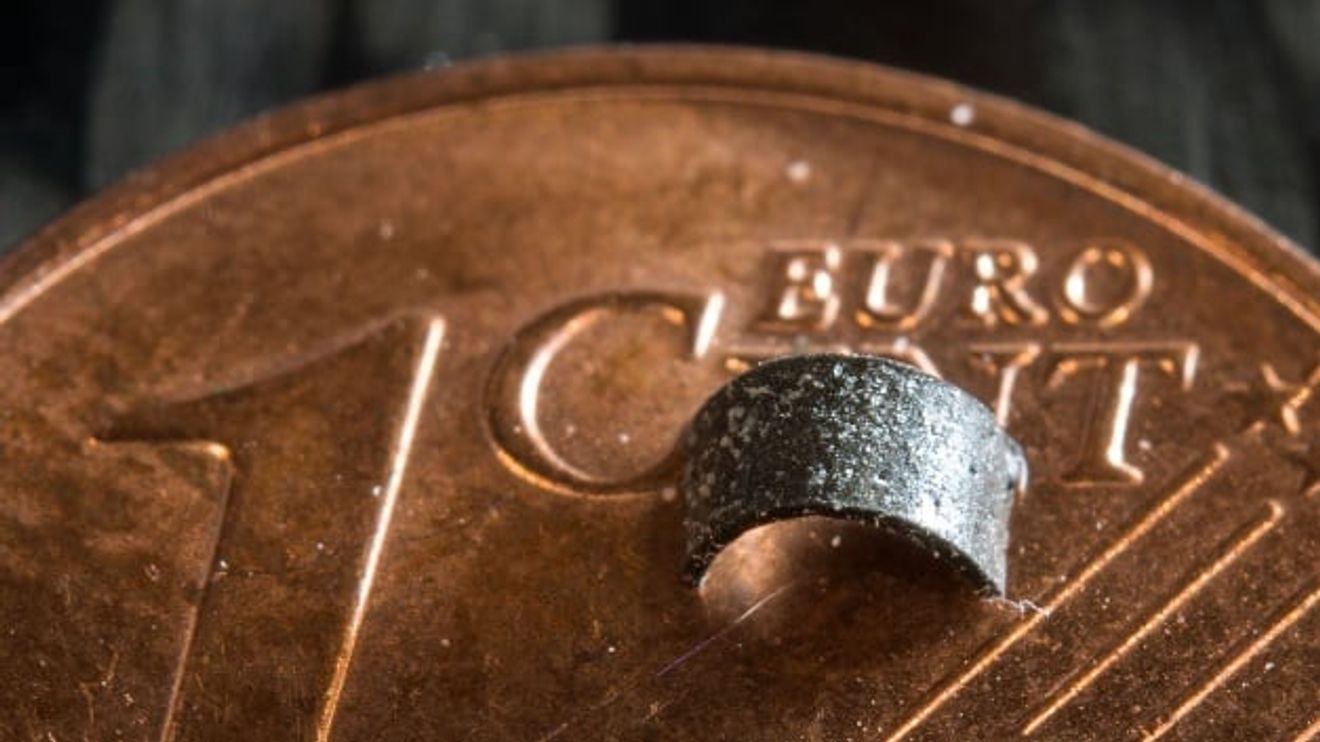
Its mobility makes this soft mini-robot unique: scientists at the Max Planck Institute for Intelligent Systems in Stuttgart have developed a magnetically controlled miniature robot that can crawl, swim, jump and carry loads. The research team reports in the journal 'Nature' that it may one day be able to wirelessly place medication in the human body exactly where it is needed.
According to the experts, they drew inspiration from nature, from beetle larvae, caterpillars and even jellyfish. While other miniature robots quickly reach their limits on rough terrain, the Stuttgart model can easily change its mode of locomotion: first crawling, then rolling or swimming. It is four millimetres small, as flat as a rectangular sheet of paper and made of soft, elastic polymer.
The robot is controlled by an external magnetic field. Magnetic particles are embedded in the polymer layer of the robot, similar to raisins in cake batter. This allows the researchers to change the shape from the outside and move the robot. It can walk or roll, jump over obstacles, crawl through narrow tubes and swim on or in a liquid, as the researchers reported.
It can also grasp and transport objects and place them in a targeted manner. "We want to use it for minimally invasive procedures on patients," says Metin Sitti, Director of the Department of Physical Intelligence, "either by the patient swallowing the robot or by us inserting it into the body through a small opening in the skin." From there, the robot can then move through the digestive tract or through the bladder, or up to the heart.


You might also be interested in
Research: Soft mini robot for targeted drug transportation
Scientists at the Max Planck Institute for Intelligent Systems have developed a magnetically controlled, four-millimeter small bendable robot.
 read more...
Robot moves like a fish
American researchers have developed an underwater robot that is designed to provide insights into marine ecosystems - without disturbing marine animals in their habitat. The robotic fish's natural way of moving makes this possible.
read more...Artificial intelligence on the ISS
With 'CIMON' - the world's first flying and autonomously operating astronaut assistant - scientists are sending artificial intelligence to the International Space Station ISS in summer 2018. The details of the project by DLR, Airbus, IBM and LMU.
read more...Record sales - profit shrinks
Kuka has published preliminary figures for the 2017 financial year. In terms of turnover, the Group achieved significant double-digit growth. However, profits were in the red due to high investments and acquisitions.
read more...SDK for research and universities announced
Rethink Robotics has announced a new software development kit (SDK) for its collaborative robot for March. The software upgrade has been specially developed for scientists and students to test programs on the 'Sawyer'.
read more...MTCON and Sensor-Technik Wiedemann combine expertise
MTConnectivity power2pcb (MTCON) has a new shareholder: Sensor-Technik Wiedemann (STW) has held a stake in the power element manufacturer since the end of 2019.
read more...Electromobility / green electricity
Intelligent charging saves fossil fuels
Charging electric cars can overload the electricity grid and lead to fossil fuel power plants having to step in. This is unnecessary and leads to high costs for grid operators. BMW and Tennet want to change this.
read more...Service robotics at Conrad Electronic
Sales robots in use around the clock
To provide its customers with a 24/7 shopping experience in Berlin Schöneberg, Conrad Electronic has now deployed a sales robot. The robot 'Alex' is designed to provide a high-tech shopping experience. It comes from the manufacturer pi4_robotics.
read more...Ridesharing field test in Paris
Renault tests Zoe as a robo-taxi
Renault launches a ridesharing field trial in Paris with two autonomous Zoe robo-taxis. The two prototypes have been specially modified. In addition to the technology for automated driving, they have a modified interior with multimedia and on-board...
read more...