
Human-robot cooperation (HRC)
Schunk increases gripping force to 450 N
The series grippers previously certified for collaborative applications were usually limited in their gripping force. This is now a thing of the past: Schunk is now launching a large stroke gripper on the market that can achieve gripping forces of up to 450 N and handle weights of up to 2.25 kg.
Human-robot collaboration (HRC) in shared workspaces is on the verge of a breakthrough. The main concerns are improving ergonomics, making work processes more flexible, increasing efficiency and optimizing logistics, handling and loading processes. Two main directions can currently be identified in the context of HRC:
On the one hand, lightweight robotics is booming. A number of companies have started application demonstrations and tests in the pre-series environment and are currently gathering experience. At the same time, new suppliers of robot technology are entering the market and creating intense competition. Assembly assistance, the 3C market (Computer, Communications, Consumer) and the Asian economic area are driving the current debate. As a result, all suppliers are working on optimizing weight, costs and performance.
On the other hand, the shortage of skilled workers and demographic trends mean that there is an increasing focus on ergonomic relief for workers. This applies in particular to demanding assembly environments, for example in gear manufacturing. In the collaborative partial automation of process chains, humans continue to take on the central joining and guidance tasks. At the same time, they are supported by robots that pick up the loads that occur. This primarily involves handling weights in the medium load range. This requires collaborative end-of-arm tools that are capable of handling different loads in the range of up to 2 kg in direct interaction with humans. However, common solution strategies for inherently safe HRC grippers - such as harmoniously shaped protective covers without sharp corners and edges and limiting the gripping force to 140 N - reach their limits in such scenarios: Firstly, they do not have the appropriate gripping force, and secondly, they lack flexibility in terms of stroke.
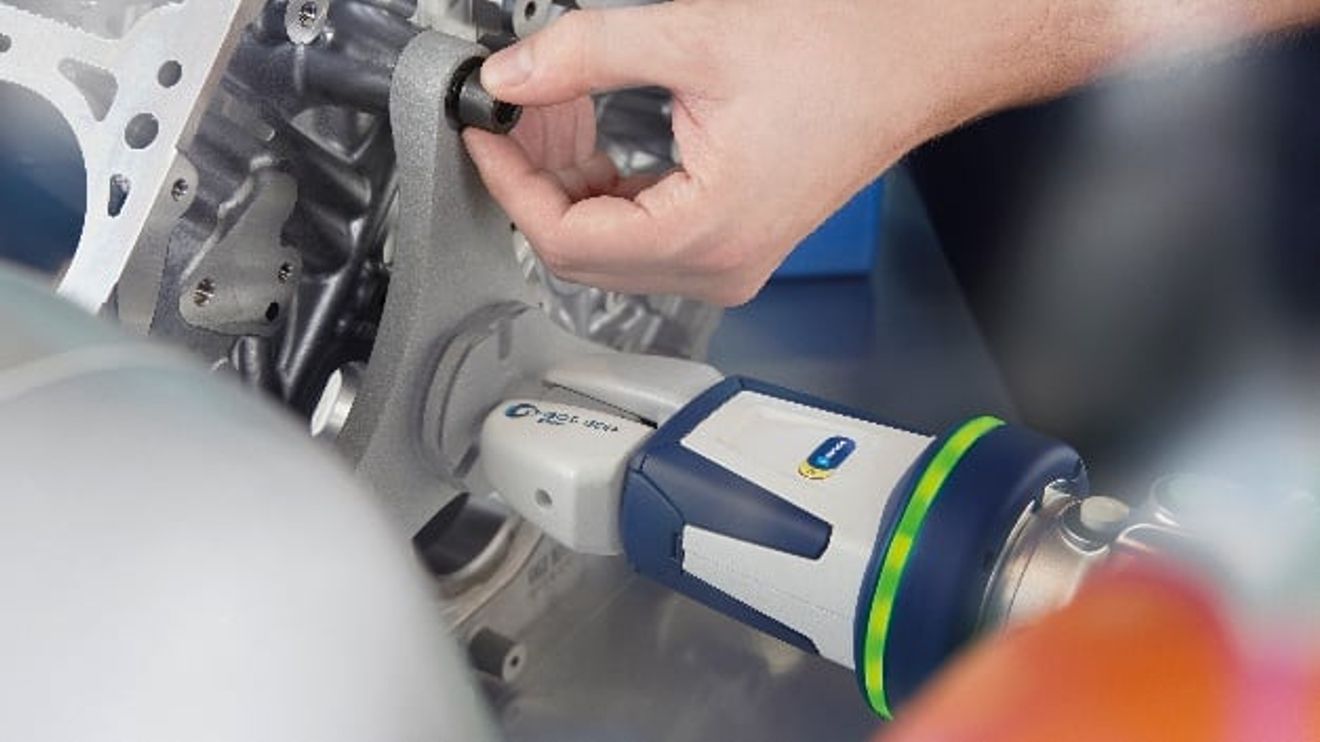
This is precisely where the 'Co-act EGL-C' large stroke gripper, which Schunk is presenting at the Hannover Messe, comes in. It achieves gripping forces of up to 450 N and combines this with a stroke of 42.5 mm per finger. The intelligent 24 V power pack thus opens up new scope for collaborative handling of workpiece weights of up to 2.25 kg. By the end of 2019, it will be launched in series production with a DGUV certificate for collaborative operation and interfaces for HRC robots from Kuka, Yaskawa, Fanuc, Universal Robots and Nachi, among others.
Combined force and displacement measurement
In order to comply with the biomechanical limit values defined in ISO/TS 15066 despite the high gripping force, the gripper is equipped with combined force and displacement measurement: Force measuring jaws integrated into the base jaws and incremental encoders permanently monitor the respective gripping force as well as the position of the gripper fingers. The gripping procedure on the gripper is divided into several phases: The gripping force is limited to 30 N up to a theoretical distance of 4 mm from the taught workpiece - significantly less than the thickness of a finger. If a collision occurs during this approach phase, for example with the operator's hand, the gripper immediately comes to a safe stop without the risk of injury.

Powerful gripping in human-robot collaboration: the Co-act EGL-C is the first large lifting gripper for collaborative applications.
© SchunkOnly in the second phase - i.e. when the workpiece distance is <4 mm - do the fingers close with a freely definable maximum force of up to 450 N. If the system detects yielding in this closing phase, for example because a workpiece is gripped that is too small and the operator is about to remove it by hand, this movement also stops automatically. The same applies if the expected workpiece dimensions are exceeded by 2 mm, for example because no part is present. Finally, in the third phase, the gripper detects whether the part is securely gripped and activates the integrated gripping force maintenance by applying the brake. This means that the gripped part cannot be lost even in the event of an emergency stop. In addition, no re-referencing is required in the event of a power failure.
The safety architecture on which the new generation of grippers is based was developed in close cooperation with the DGUV. It is based on several integrated processor cores that monitor each other and at the same time safely control the gripping process via the force and displacement sensors used. This ultimately makes it possible to realize gripping forces beyond the 140 N limit that has been common up to now.
In addition, the Co-act EGL-C concept was designed from the outset with a high level of practicality in mind. The gripper can be controlled and regulated via Profinet, Ethercat, Ethernet/IP, Modbus/TCP or TCP/IP. A commissioning wizard simplifies programming. In addition, a diagnostic interface enables access to the gripper's most important process and status data during operation. In order to make cooperation with the operator fluid and intuitive, the gripper is equipped with LED lighting in traffic light colors, which can be used to signal the current status of the module.
Next step: Autonomous gripping
In the context of human-robot collaboration, the use of artificial intelligence (AI) is also becoming increasingly important. The first applications of cognitive intelligence in the gripper environment have already been implemented in conjunction with cameras, enabling intuitive training by workers and independent completion of gripping tasks by the robot.

Thanks to artificial intelligence, this 5-fingered hand is able to identify any object in any position and autonomously develop and apply appropriate gripping strategies.
© SchunkAn initial use case at Schunk, which uses machine learning approaches for workpiece and gripping process classification, shows how pluggable building blocks can be combined as required and presented to a lightweight robot in any arrangement on a work surface for removal. In combination with 2D or 3D cameras, the self-learning system achieves a rapid increase in access reliability after just a few learning cycles: with every grip, the gripper learns how the workpiece can be successfully picked up and transported. After just a few training rounds, the network classifies how to deal with the value pool of workpieces and the resulting possible combinations. In doing so, the gripper relies on learned empirical values on how to pick up and transport the workpiece. The intelligent performance of the algorithm is that future combinations and arrangements of the workpieces can be classified independently after just a short training period. This enables the system to handle parts independently and according to the situation. By continuously adapting the algorithms using AI methods, it is possible to identify previously unrecognized correlations and further refine the handling process.
Interaction - the be-all and end-all
The topic of human-robot collaboration (HRC) is challenging manufacturers and users alike to rethink their approach. Professor Dr. Markus Glück, Managing Director Research & Development at Schunk, takes a stand.
Mr. Glück, what trends are currently shaping the HRC market?
Prof. Dr. Markus Glück: We are currently seeing manufacturers of robot arms and the corresponding control technology developing into full-range suppliers of robot systems and handling processes. Following the example of Universal Robots' UR+ platform, highly interesting ecosystems and exchange forums are emerging. In addition to the robot arms, web-based sales and user platforms will offer customized components that can be ordered online and put into operation in a simple but reliable manner in the sense of efficient plug & work.

Prof. Dr. Glück, Schunk: "The topic of HRC means interaction - in the application as well as in marketing."
© SchunkThe underlying 'partnering' - a close partnership between end effector and robot manufacturers - makes it clear that an optimal handling solution is determined by the best possible interaction of all components involved with the robot. In addition, tried-and-tested use cases are marketed for direct adoption in these ecosystems. Experience is shared and interfaces are optimized so that productive results can be achieved as quickly as possible. As far as Schunk is concerned, we contribute our expertise both in the simplification of the components and in their use in the various fields of application.

The package consisting of the Mechatronics Concept Designer simulation software, a component library of digital twins and corresponding support makes it easy to get started with the simulation of handling solutions.
© SchunkHow does digitalization affect automation and collaborative scenarios in particular?
Digitalization has reached the manufacturing environment with force and is revolutionizing procurement, production and all product lifecycle management processes. It is shaping industrial automation and requires a radical rethink. For example, plant manufacturers and integrators in automation are increasingly demanding digital shadows or digital twins of components in order to develop applications on screen and simulate processes realistically. For this reason, we have made our gripper portfolio comprehensively accessible via digital platforms. We also support users in setting up corresponding simulation environments, for example in the form of attractive starter packages for the simulation software
'Mechatronics Concept Designer' from Siemens PLM Software. We still see a lot of scope for the simulation of HRC-capable robots and corresponding working environments in particular, which has not yet been exploited.
How do you assess the impact of collaborative solutions on workplaces?
In the 1980s, there were massive protests against the use of robots in car factories. Nevertheless, there was a radical change: dangerous, heavy and monotonous work, for example in the areas of pressing, welding, bodywork, painting and parts transportation, has been eliminated. As a result of robotics, far more new jobs have been created than ever before. With human-robot collaboration, a new generation of robots is now available that can provide direct support at the workplace, relieve physical strain and free workers from mentally stressful work steps. Human-robot collaboration is also an appropriate response to demographic change. Due to the ageing workforce, manufacturing companies in Germany will lose around two million employees by 2025. Their workforce can be at least partially replaced by collaborative robots without having to make colleagues who are able to work available.


You might also be interested in
Same cables for AC and DC?
Are alternating current cables also suitable for direct current? Not always, as a working group at the TU Ilmenau has proven.
 read more...
Programming via drag & drop
One of the biggest obstacles to the acquisition of industrial robots in medium-sized manufacturing companies is the lack of skilled workers. With this in mind, a new operating system was developed that allows programs to be created easily via drag...
read more...Reduce costs and throughput times with cobots
They carry out pick & place tasks, screw and assemble parts and, last but not least, are used for packaging - we are talking about the eight collaborative robot arms that A. Jung has now integrated into its production lines for electrical...
read more...What about 'Drive 4.0'?
Drives are the core component in industrial production. In combination with sensors and software, they enable the digitalization of the production process and thus the transparency of technical processes. In short: Industry 4.0 only works with...
read more...Project 'DC Industry' - Part 1
DC instead of AC in the production grid
Research and industry are working hard to redesign the power supply for industrial systems via a smart, open DC grid. The article describes the challenges of the 'DC Industry' project and the system specification developed so far.
read more...Artificial intelligence in the Simatic
Artificial intelligence (AI) - is opening a new chapter in the digital transformation of manufacturing. Implemented in the control system - and therefore directly on the machine - it helps to significantly reduce conventional programming and...
read more...A clear view thanks to the 19-inch IPC
Due to their great flexibility, industrial PCs in 19-inch format continue to enjoy great popularity - for example as the basis for pioneering testing technology applications.
read more...Engineering meets digital twin
Better planning with the digital twin: this is the principle that technology service provider Alexander Bürkle strives for in the engineering and assembly of switchgear. The prerequisite for this is a software platform that enables interdisciplinary...
read more...In real time without cables
Real-time communication without cables! - In order to increase the flexibility of production plants, this is a much cherished wish. But where exactly is this scenario still failing? What are the possible solutions? And what role do OPC UA and TSN...
read more...