
Industrial robotics
Programming via drag & drop
One of the biggest obstacles to the acquisition of industrial robots in medium-sized manufacturing companies is the lack of skilled workers. With this in mind, a new operating system was developed that allows programs to be created easily via drag & drop.

Germany ranks third worldwide in terms of the use of industrial robots. According to the International Federation of Robotics (IFR), there are 322 industrial robots per 10,000 employees. Only South Korea and Singapore are ahead of it. The high density of robots in industry is due in particular to the large German sectors such as the automotive industry, which orders a third of all industrial robots worldwide. However, the challenge lies in making automation interesting for small and medium-sized companies too. The biggest hurdles on this path are currently still the high acquisition costs and the lack of flexibility in application. The latter is partly due to the complex programming.
Robot programs are currently created using various methods - depending on the manufacturer, the planned application and the required flexibility of the industrial robot. Known methods include teaching with a hand-held programming device, specifying movements by showing or instructing or creating programs in a CAD-based simulation environment. The latter option in particular is quite complex and requires in-depth knowledge of the robot manufacturer's programming language. Programming and function expansion is therefore very time-consuming and cost-intensive, which prevents the flexible use of robots. Against this background, manufacturers and independent software companies and research institutes are working hard on various solutions to make the use of industrial robots more flexible.
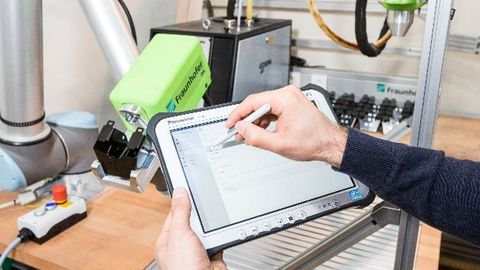
One of these has been created at Fraunhofer IPA - developed by a team led by Martin Naumann. The so-called drag&bot software is designed to make robot programming as easy as operating a smartphone. The aim is to enable production employees without robotics expertise to program industrial robots. To ensure that even untrained personnel can create new function sequences quickly and intuitively, they are supported by various operating and input aids - also known as wizards. This enables simple parameterization of the program sequences.
The program modules or function blocks are then combined into executable applications using the drag & drop principle. The advantage: the programmed sequences can be shared and reused with all company-internal robots via the cloud. The user also has the option of copying the existing programs and adapting them individually for their area of application.
Independent of manufacturer and hardware
One of the major advantages of drag&bot is that the user interface is not only easy to use, but also offers a uniform interface regardless of the robot used. The drag&bot software already supports Universal Robot, Kuka, Denso, Fanuc and ABB as well as various grippers, screwdriving tools, other tools that can be controlled via I/Os and various cameras and image processing libraries. The integration of further tools and peripheral devices is also continuing here. The modular structure of the software facilitates these integration processes.
The drag&bot software provides ready-made program modules that can be combined to create complex robot applications.
© drag&botThe drag&bot software consists of two parts: the cloud-based user interface and the execution environment running on an industrial PC, which communicates with the robot controller and other peripheral devices and controls the application process. The execution environment represents an abstraction layer and forms the basis of a standardized user interface for robots from different manufacturers.
Currently, drag&bot is already being used for various applications - for example for machine loading and unloading. Manufacturers of injection-molded plastic parts or metal parts, for example, are always faced with the task of inserting and removing parts from machines. Employees are often deployed for this purpose, who spend hours exclusively feeding parts from boxes or magazines into the machine and putting them back into the boxes or magazines once processing is complete. These tasks are ideally suited to robots. With drag&bot, company employees can instruct the robots themselves and adapt them to part- and system-specific conditions. The advantage over a purchased turnkey solution is that the customer can simply reprogram the robots themselves when changing this process or teaching other parts. In addition, up to 50% of the investment costs can be saved compared to a purchased complete solution, as many tasks - especially programming - can be carried out by the user.
Another typical application for the new software approach is the automation of quality inspections. Many products, assemblies or parts have to be checked for quality in a variety of ways after production. Often, selected or all parts are individually inserted into and removed from testing devices. This process is often very time-consuming and cost-intensive, as employees have to place parts in the testing machine by hand, close the door, start the test program manually and then remove the parts from the machine again. Until now, automation was not possible in a cost-efficient manner due to the many variants. With drag&bot, the customer is now able to instruct the robot itself for a wide range of variants and thus flexibly automate quality inspections.
Example number three: Assembly work in the automotive industry, the number one automation sector in Germany. Up to now, industrial robots have been used in large-scale production and have been performing the same tasks for several years without any changes to the processes. However, due to the shortage of skilled workers, suppliers in particular are increasingly looking to automate activities that were previously carried out manually due to their flexibility requirements - such as the assembly of components. At one automotive supplier, a previously manual pre-assembly line was supplemented with robots that take over joining and screwing processes and can be adapted to new tasks by the supplier itself in a short time using drag&bot.
Also suitable for HRC applications

Recently, there has been a trend in robotics to use robots without fences. Drag&bot can also be used for such applications to teach the robot collaborative applications intuitively and quickly. In such applications, human safety must continue to be ensured via the robot's safety functions, such as force and speed limitation and defined workspace limits. These safety functions still have to be configured in the robot's safety controller; however, drag&bot enables simple graphical application programming based on this.
In order to use industrial robots even more flexibly, they must become much more sensitive, networked and capable of learning. The programming approach described above already supports the sensitive functions of Kuka's LBR iiwa, for example, and makes them easy to use via the software's graphical user interface - without any knowledge of Java. There are also additional modules that enable functions such as image processing, force control and reach-into-the-box, thus enabling the robots to react flexibly to their environment.
In the future, developers will increasingly rely on technologies such as artificial intelligence, networking and deep learning, not least in industry. To this end, drag&bot offers open interfaces to enable developers to integrate new function blocks, new software modules - for example for machine learning - and new graphical user interfaces, making these functions easy to use.
Author: Martin Naumann is the founder and Managing Director of drag&bot.


You might also be interested in
Same cables for AC and DC?
Are alternating current cables also suitable for direct current? Not always, as a working group at the TU Ilmenau has proven.
 read more...
Reduce costs and throughput times with cobots
They carry out pick & place tasks, screw and assemble parts and, last but not least, are used for packaging - we are talking about the eight collaborative robot arms that A. Jung has now integrated into its production lines for electrical...
read more...Schunk increases gripping force to 450 N
The series grippers previously certified for collaborative applications were usually limited in their gripping force. This is now a thing of the past: Schunk is now launching a large stroke gripper on the market that can achieve gripping forces of...
read more...What about 'Drive 4.0'?
Drives are the core component in industrial production. In combination with sensors and software, they enable the digitalization of the production process and thus the transparency of technical processes. In short: Industry 4.0 only works with...
read more...Project 'DC Industry' - Part 1
DC instead of AC in the production grid
Research and industry are working hard to redesign the power supply for industrial systems via a smart, open DC grid. The article describes the challenges of the 'DC Industry' project and the system specification developed so far.
read more...Artificial intelligence in the Simatic
Artificial intelligence (AI) - is opening a new chapter in the digital transformation of manufacturing. Implemented in the control system - and therefore directly on the machine - it helps to significantly reduce conventional programming and...
read more...A clear view thanks to the 19-inch IPC
Due to their great flexibility, industrial PCs in 19-inch format continue to enjoy great popularity - for example as the basis for pioneering testing technology applications.
read more...Engineering meets digital twin
Better planning with the digital twin: this is the principle that technology service provider Alexander Bürkle strives for in the engineering and assembly of switchgear. The prerequisite for this is a software platform that enables interdisciplinary...
read more...In real time without cables
Real-time communication without cables! - In order to increase the flexibility of production plants, this is a much cherished wish. But where exactly is this scenario still failing? What are the possible solutions? And what role do OPC UA and TSN...
read more...