
Handling
Feeding the machining center - by robot
Many users have reservations about robotics and its complexity. A pilot project by Kösters Maschinenbau for the automatic loading of machining centers in the plastics processing environment shows how it can also be very simple.

The automatic loading of machining centers promises enormous savings potential: reduction of non-productive times, increase in flexibility and autonomy through to unmanned shifts - all facts that arouse desire in the development of the latest rationalization potential. Nevertheless, special robotics solutions are often not exactly user-friendly, expensive and not very flexible. What's more, they can introduce a level of complexity into processes that is not conducive to system availability and, in the worst case, can even have a negative impact on overall cost-effectiveness. It was precisely for this reason that Peter Kösters, Managing Director of Kösters Maschinenbau, came up with a very special solution: "We wanted a fully automatic feeding solution with a six-axis robot that can be operated without any knowledge of robotics. At the same time, the robot cell had to offer unprecedented flexibility, allowing even the smallest batch sizes to be processed, which in turn requires the shortest possible set-up times."
In order to put these requirements into practice, one thing was clear from the outset: the user must not come into contact with the robotics. Their tasks should be limited to the simplest operating steps and the provision of raw parts and the removal of finished parts. In other words, teaching and programming must be left out.
The first prototype cell, which is in use at plastics specialist ISO-Tech Kunststoff in Ahaus, shows how Kösters Maschinenbau has put these requirements into practice. The company is one of the leading manufacturers and processors of thermoplastics. Its product portfolio includes semi-finished and finished parts, including gear wheels, rollers, bushings, rings, sleeves and the like.


The robot is mounted on a stable base directly on the cell. With a reach of more than 1.7 meters, it can easily reach all working positions.
© Yaskawa EuropeThe robot cell installed at ISO-Tech takes over the fully automatic feeding of a spinner machining center on which various plastic parts are milled. The batch sizes here range from a dozen to small series with several thousand units - the number of variants is almost infinite. The process in the cell is as follows: The operator places the individual raw parts in one of three workpiece drawers and pushes them, fully loaded, into the robot's work area. From this point on, a six-axis Motoman MH24 from Yaskawa takes over the loading and unloading of the machining center fully automatically. The reason why this robot does not require any programming or teaching on the part of the user is located on the cell ceiling: a powerful 2D image processing system is mounted here, which communicates with the Yaskawa robot via the in-house developed process control system. In this way, the robot receives the exact position data of the raw parts and can automatically pick up the parts in sequence.
This solution approach was one of the decisive reasons for using a six-axis robot from Yaskawa: "To ensure smooth communication and data transfer between the image processing system and the robot, we had to intervene deeply in the MH24's control system. With robots from other manufacturers, this would either not have been possible at all or only with great difficulty. With the DX200 controller, Yaskawa offers all the possibilities to make our work much easier," says Kösters.
Back to the workflow: With a gripped plastic part, the robot moves through the open loading door of the machining center to the workpiece holder. Here it removes a completely machined part with its finished part gripper, rotates the gripper system by 180° and positions an unmachined workpiece in the holder with the unmachined part gripper. The six-axis gripper then places the finished part down and picks up another unmachined part from the workpiece drawer. During this processing cycle, the system operator can load the other two drawers of the loading cell in parallel with the machining cycle.
Conversion in less than ten minutes
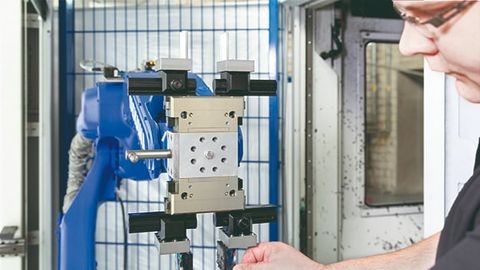
When converting, only the jaws of the raw and finished part gripper need to be adjusted to the new part dimensions.
© Yaskawa EuropeISO-Tech always demonstrates how quickly the system can be converted in practice when a variant change is due. "The operator simply has to enter the dimensions of the new part variant in the graphic display of the system control and mechanically adjust the gripper jaws of the raw and finished part gripper to the corresponding dimensions.
Thanks to a quick-clamping device, this adjustment can be carried out within a few minutes," emphasizes Kösters. This flexibility allows economical processing of batch sizes down to a dozen or even fewer parts.
What pleases both ISO-Tech as a user and Kösters as a manufacturer of the robot loading cell is the high availability of the prototype cell. There have been no failures so far, so there have been no expected improvements. Nevertheless, there will still be minor optimizations before this system is launched as a standard cell. For example, the Motoman MH24 is to be replaced by the newer Motoman GP25 in future standard cells. Thanks to its very slim design and the media lines routed inside the arm, the latter can cope perfectly even in confined spaces. In addition, the wrist is optimally protected against the ingress of chips.
Author:
Ralf Högel is a freelance author from Stadtbergen.


You might also be interested in
Development Collaboration for Humanoid Robotic Hands Launched
Schunk is entering into a new development partnership with Robert Bosch Robotics. Their shared goal is to develop an industrial-grade robotic hand that can be integrated into various humanoid robot systems.
 read more...
Nominations for Electrifying Ideas Award have been announced
An independent jury of top-class experts from business, research and society has nominated three companies for the Electrifying Ideas Award 2026: Ideas from Philips, Rittal and ZeMA - Center for Mechatronics and Automation Technology convinced the...
read more...Circular economy for flexible materials
With a budget of 7.5 million euros and twelve partners from six countries, the European research project 'FlexCycle' is pursuing the goal of making recycling processes for the reuse of flexible materials suitable for industrial use. To this end, it...
read more...Schunk founds tech spin-off for humanoid robot hands
Schunk is bundling its activities in humanoid robotics by founding its own spin-off at the beginning of January. The aim of the new company is to develop modular humanoid robot hands for industrial applications.
read more...Second generation of vacuum grippers
Coval has redeveloped the carbon face gripper 'CVGC'. The new generation also takes into account current and future trends in the market for collaborative robots.
read more...Schunk receives the Hermes Award 2024
Schunk was honored with the Hermes Award for its AI-based project during the opening ceremony of the Hannover Messe.
read more...Schunk at the Hannover Messe 2024
Digital and automated for healthy production
Schunk is focusing on two key topics in Hanover: 'The Healthy Factory' and 'Innovation through Collaboration'. The aim is to design a healthy and economically successful production for people and the environment.
read more...These are your winners!
We put 96 products in twelve categories to your vote in December, and now the winners have been chosen! The trophies were presented at a 'Winner's Dinner' at the Seehaus in Munich. These are your "Products of the Year 2024"!
read more...Robotics & Handling - The winners
They ensure fast and safe handling of components and get them reliably from A to B: the winning products in the 'Robotics & Handling' category.
read more...