
Robotics
Economical even with small batch sizes
How can robot systems also be used economically for smaller batch sizes? The recently completed 'ReApp' research project aims to provide answers to this question.
Equipment suppliers today have to deal with the fact that software in automation technology and robotics is characterized by manufacturer-specific interfaces and strong vendor lock-ins. Accordingly, in addition to expert knowledge in automation, they need in-depth knowledge of the manufacturer. At the same time, the time pressure for installation and commissioning at the customer's site is high. Although modular structuring of the software would significantly reduce the time required due to its reusability, this has not yet been possible in practice.
End users, and small and medium-sized enterprises (SMEs) in particular, increasingly require flexible production processes with which they can react to increasing product variants and shorter product life cycles. More standardization would allow automation solutions to be developed more quickly. It would also improve cost-effectiveness, as even minor changes to the system are currently associated with comparatively high costs.
With this in mind, the ReApp research project coordinated by the Fraunhofer Institute for Manufacturing Engineering and Automation IPA was launched at the beginning of 2014. The common goal of the partners involved: more efficient robot use with shorter set-up times and better reusability of production processes once they have been developed.
During the three-year term - ReApp officially ended on December 31, 2016 - an 'ecosystem' for robotics was created, which is somewhat comparable to the well-known Android system for smartphones. Android also integrates a wide variety of hardware - including sensors, HMIs, computer architectures, etc. - and offers reusable software as apps. Unlike Android, however, an ecosystem for robotics must take into account the structural diversity of production systems and also be able to map the different geometries of the robot used in each case. In this respect, monolithic apps are not expedient here. Instead, combinable and configurable software modules are required.
Model-based software development
A key result of the BMWi-funded project is the 'ReApp Engineering Workbench' development environment, which can be used to design, develop and model apps. The workbench consists of three main components: the 'Component Modeling Tool' (CMT), the 'Skill and Solution Modeling Tool' (SSMT) and the 'Deployment Environment', which considerably simplifies the process of installation, configuration and execution. In addition to Fraunhofer IPA, the FZI Research Center for Information Technology, the Karlsruhe Institute of Technology (KIT) and Fortiss were involved in the project.

The CMT is primarily aimed at hardware and software developers who can use it to develop new apps - for example hardware drivers - and place them in an app store after successfully passing an automated quality assurance process. The CMT ensures that the apps correspond to a standardized component model, the 'ReApp Ontology', which guarantees a uniform description of the properties and interfaces.
Like all other components of the workbench, the CMT follows a model-based approach: the apps are abstracted at interface level. The description of the apps is universally understandable because a standardized, machine-readable language is used. This enables automatic evaluation in all development phases. Accordingly, the CMT facilitates the design and development of the app: reuse is a given and different code can be used for one function. In addition, the interfaces are standardized. Last but not least, the tool guides the user through the creation of the app. These are based on the open source Robot Operating System - ROS for short - and can be software components for control or path planning, for example, which encapsulate the functionalities or algorithms.
So-called hardware access components in turn encapsulate hardware drivers for actuators or sensors, for example. Specifically, this means that the developer enters AML descriptions, their own manual modeling or modeling from the ReApp project and semantic information into the CMT. The graphical user interface supports modeling and model transformation from the AML descriptions. The result is an instance model in OWL (Ontology Web Language), i.e. an RDF graph (Resource Description Framework), as well as a graphical representation within the CMT. The ROS source code is automatically generated from the model.
Hardware easier to replace

With the 'Skill and Solution Modeling Tool', users can create a robot-specific application from the apps.
© FortissThe workbench also provides support for setting up, (re)configuring and commissioning the apps. This means that the Skill and Solution Modeling Tool (SSMT) can be used to orchestrate existing apps or 'skills' (for example a generic pick-and-place skill) into more complex applications. This turns a skill into a 'solution': While a skill is still open in terms of parameterization and component selection, the solution is configured for a specific robot cell, i.e. fully parameterized. A solution is created in a graphical skill editor that can display apps and graphical connections of ROS interfaces. The basic idea behind this is that all apps - from hardware drivers to complex sequence controls - correspond to the component model and its interface definition and can therefore be freely combined and nested.
In this way, hardware-independent capabilities or skills can be created that guarantee a high level of reusability. If the skill is to be used for specific hardware components, only the driver apps for the hardware need to be added. If the hardware changes later, for example because a robot with a higher payload is required, only the driver needs to be replaced and some configurations adjusted - the application itself does not change.
Simplified integration and testing
Finally, the solution created can be deployed on a specific system using the ReApp deployment environment. This is supported by a standardized runtime environment, the so-called 'integration platform'. This provides a continuous deployment chain for installation, configuration and execution, from the store to the controller. This means that the system integrator does not have to carry out the usual interface adaptations or modifications to the control architecture. They can rely on the fact that all apps in the store that have been installed on the integration platform via the ReApp deployment environment are also compatible and executable. It is also possible to switch between different apps so that development, set-up and productive operation are kept separate. Updates can be installed reliably because it is always possible to revert to the previous version.

In the virtual test environment, applications can already be tested without an existing hardware setup.
© Fraunhofer IPAFinally, a cloud-based simulation environment from ISG makes it possible to carry out component, integration and application tests systematically, safely and in a resource-saving manner. The tools are immediately available and can be used as a service - 'simulation as a service'. The underlying library contains around 200 robot models from different manufacturers, 3D geometry and kinematics models as well as virtual control panels for testing. The simulation environment is supplemented by models for automated material flow, such as belt and track-guided conveyor technology, handling, assembly and storage technology. The developed technologies have already been tested using a virtual demonstrator. In addition, access to the simulation environment is secured so that shared system use is not possible. This single-user connection is realized via VPN access.
All apps developed in ReApp will in future be available in an online store developed by FluidOps. An in-house solution can also be implemented for specific companies. This is in line with the project goal of providing a common repository for robotics applications. In short, users can search for apps in the store, download them and rate them. The store also offers developers the opportunity to upload their own apps.
Intelligent semantic classification
All developments for this ecosystem are based on the 'ReApp ontology'. This model - another key result of the project - provides a systematic classification of a wide variety of software components for robot applications and describes their properties, capabilities and interfaces. The semantic description of the components ensures the compatibility of apps from different providers so that they can be combined with each other and components with similar functions can be interchanged. Another advantage is that the apps are formally checked in the development environment as soon as they are created thanks to the semantic markup. Last but not least, the ontology enables a semantic search in the app store and users can find apps based on the capabilities of the app and the classification as a software component or hardware driver.

ReApp presented the demonstrator for door module assembly at the Automatica 2016 trade fair.
© Fraunhofer IPAOverall, the ecosystem developed in ReApp reduces programming effort because, for example, program structures and input/output interfaces of components are automatically created based on the classification of a component. This means that ROS software components can also be used without significant ROS knowledge. Once developed, capabilities up to and including complete process sequences can be used repeatedly and combined to create new applications. For example, a system integrator could enter the semantic problem 'picking from the conveyor belt' in the app store and then receive suitable apps for this application. They can also use the workbench to adapt, expand or parameterize the apps for their application. In addition to apps for picking from the belt, a 'Line Tracking' component can also be selected, which determines the speed of the belt.
Utilization of the technologies
The technologies developed as part of ReApp are currently being used or evaluated in three pilot demonstrators from different industries. The system integrators Ruhrbotics, Insystems, the component manufacturer Sick and the end users BMW, Fischer and Dresden Elektronik were involved in the implementation of the demonstrators.

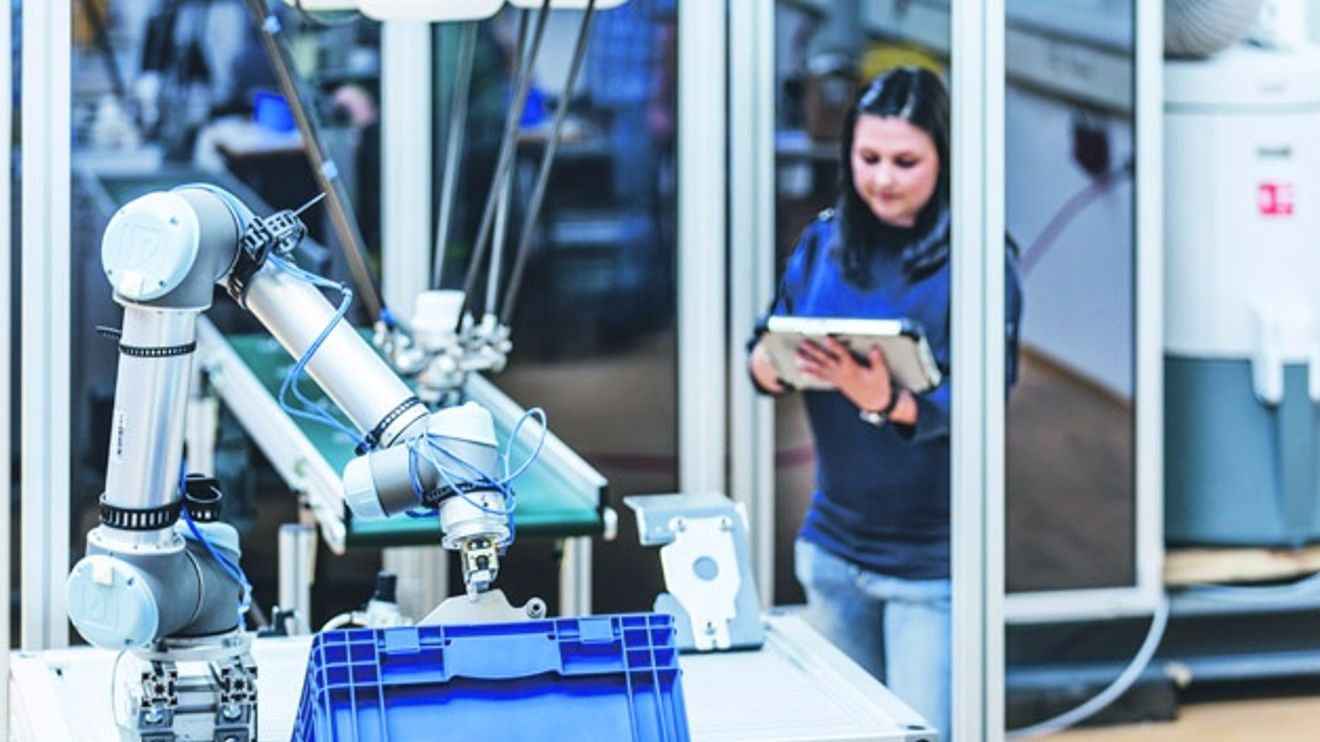
The pick-and-place demonstrator recognizes punched parts on a conveyor belt, a delta robot places them in a storage area, from where another robot removes them and sorts them into a box.
© Fraunhofer IPA/Rainer BezTogether with BMW, the scenario of automated roll-on of a sound insulation mat was realized for the automotive industry. The main focus here was to compare the set-up effort with ReApp compared to the previous automation solution and to test the interchangeability of hardware and software components. The ReApp solution showed an improvement, as the scenario could be implemented more efficiently and reconfigured more easily.
The second demonstrator shows the picking and insertion of punched parts. The focus here was on automation for small quantities. The aim here was to analyze the cost-benefit ratio and to check the extent to which the automated solutions result in fewer errors than the previous manual and monotonous work. The third demonstrator involves the automatic soldering of LED strips for the electrical industry. Here, too, the aim is to analyze the efficiency of the application and reduce rejects during manual soldering due to the high quality requirements.
So much for the status quo. As a continuation of the ReApp results, the ontology is to be further developed by the ROS Industrial community and the user-friendliness of the development environment is to be optimized by a professional software provider. As the project uses open source software, the workbench is accessible via the project homepage(http://www.reapp-projekt.de) and will soon also be available via a public repository on the online platform for open source software 'GitHub'.
Author: Dr. Ulrich Reiser is Head of the Software Engineering and System Integration Group at Fraunhofer IPA.


You might also be interested in
Robotics Institute Germany co-founded
Fraunhofer IPA is a co-founder of the Robotics Institute Germany, which aims to bundle Germany's cutting-edge research into AI-based robotics.
 read more...
"Manufacturing-X data room preliminary study" presented
Manufacturing-X is seen as the next step on the road to Industry 4.0, but how could a data room be designed for the data ecosystem? A study presented by VDMA and ZVEI gets to the bottom of this question.
read more...How companies use data for product development
Where do companies stand when it comes to collecting data from products and using it to develop new products? Researchers from the Fraunhofer Institute for Manufacturing Engineering and Automation IPA have investigated this in a study.
read more...Fraunhofer project determines properties of coatings virtually
In the "PaintVisco" project, researchers at Fraunhofer IPA are modeling the development and processing of paints. The bat was the model for the development of a new simulation program that can be used to virtually determine the exact properties of...
read more...The digital value stream analysis
A research team from Fraunhofer IPA is digitizing value stream analysis together with the Stuttgart-based software provider Ifakt. This should enable this optimization method to be carried out in the future with significantly less effort and almost...
read more...The top articles in January 2022
Obstacles and opportunities characterize the top 10 most-read articles in January. Click through the obstacles in companies and find out what opportunities the year 2022 has in store.
read more...Intelligent sensor detects leaks
To simplify the search for leaks in compressed air systems, a researcher from Fraunhofer IPA is working with Sick to develop an additional leakage service for an intelligent flow sensor. Self-learning algorithms evaluate the measurement data.
read more...Improved safety for service robots
In the S³ research project, researchers from Fraunhofer IPA worked with project partners to develop safety technologies and recognition algorithms for service robots. They were tested on the Care-O-bot 4 service robot in a nursing home application.
read more...Improved safety for service robots
In the S³ research project, researchers at Fraunhofer IPA and their project partners have developed safety technologies and recognition algorithms for service robots. They were tested on the Care-O-bot 4 service robot in a nursing home application.
read more...