
Bonding in automotive engineering
Dürr relies on lightweight robots
Gluing is a common process in the automotive industry. In the area of final assembly, Dürr has recently started using sensitive lightweight robots that work hand in hand with the workers.
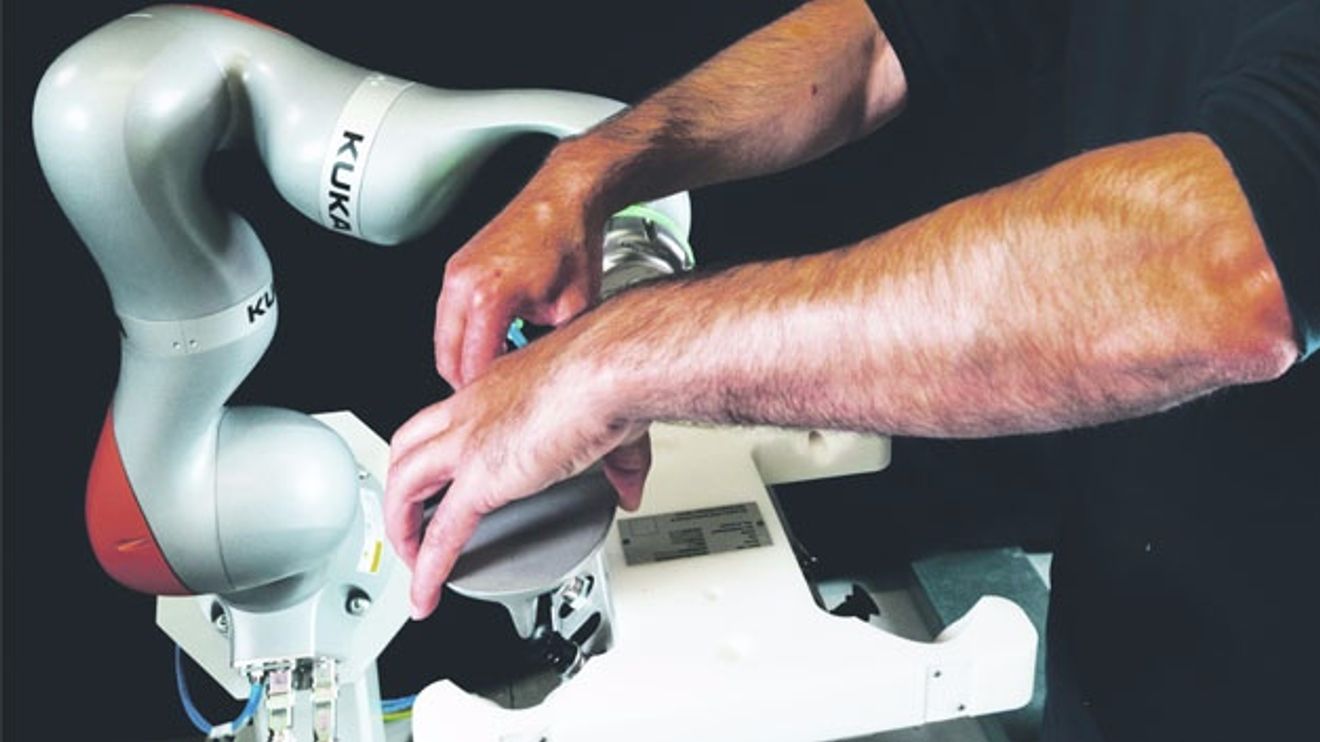
Integrated overall concepts for highly efficient manufacturing processes - this is Dürr's field of activity. The mechanical and plant engineering company, headquartered in Bietigheim-Bissingen, Baden-Württemberg, generates around 60% of its sales with automotive manufacturers and their suppliers - including turnkey systems for automated gluing processes.

When gluing the fin, the operator manually places the workpiece in the gripper of the LBR iiwa, which sucks it in and guides it to the gluing nozzle on the application tower.
© KukaDürr is currently working on enabling humans and robots to work together in final assembly without the need for safety guards. In a corresponding robot cell, sensitive lightweight robots of the type LBR iiwa from Kuka are used both for gluing fins - i.e. superstructure roof antennas - and for gluing tanks into the body. According to Dürr, they increase the quality of the gluing result, save time and reduce unit costs. In addition, such a solution requires less space than previous concepts due to the compact design of the corresponding robots and is easier for the worker to handle.

When gluing the tank in the final assembly, the skilled worker guides the tank to a turntable with the help of a manipulator, cleans it, brings it into the correct position and ...
© KukaSpecifically, when gluing the fin, the worker manually places the workpiece in the robot's gripper, which sucks it in and guides it to the gluing nozzle on the application tower. The lightweight robot then slowly moves the fin up to the gluing nozzle from below. "If it encounters an obstacle, it moves back a little thanks to its collision detection capability and starts the movement again from the beginning," says Dieter Ahlborn, Director APT/Gluing Final Assembly at Dürr Systems, explaining the HRC capability of the LBR iiwa. It only returns to its starting position after three attempts. Otherwise, the gluing process is started and the adhesive bead is applied while the robot moves along the path. The worker then removes the fin from the starting point and installs it on the vehicle.
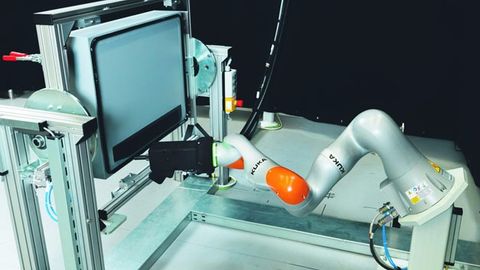
The system concept for automated tank gluing with the sensitive robot is as follows: In final assembly, the skilled worker guides the tank to a turntable with the aid of a manipulator, cleans it, brings it into the correct position and transfers it to the robot for further processing. To prevent the adhesive nozzle from drying out, the application nozzle is located in a sealing agent container. After a signal, the robot moves out of the container to the home position. There, adhesive flows into a collecting container and the adhesive nozzle is cleaned manually. When the starting point at the stationary tank is reached, the nozzle opens under pressure so that no air bubbles are created. The robot then applies the adhesive seam evenly to the tank and uses sensors on the application head to monitor the precise height of the seam.
"Although an adhesive bead can be applied by hand, the result does not come close to the precision of a robot," explains Ahlborn. In contrast to a linear gantry, a robot-based solution can map the three-dimensional complexity of the bead geometry. Thanks to its seventh, co-rotating axis, an HRC-capable robot sticks in a 360° radius without having to reorient itself - and without having to set down. When it has finished its work, the skilled worker takes center stage again by fitting the tank into the vehicle body at the specified position. This complex process still requires the individual skills of the person. The manipulator supports him in ergonomically unfavorable movement sequences.
As there are no fences or enclosures in either bonding process, the safety requirements are high. The entire safety concept must meet strict specifications and standards based on a risk assessment. Among other things, the robot is positioned in such a way that direct contact with humans is minimized as far as possible. In addition, the robot must switch off within milliseconds as soon as contact is detected. The concept for the gluing cells is designed so that the robot always operates below the worker's head and chest area. The application technology - consisting of the lightweight applicator and the lightweight robot - has a large, soft and rounded design so that only low forces are generated when the robot touches the surface.
The first system with the tank application went into operation in March 2016. "Since then, ten systems have already been sold in the bonding area," reveals Ahlborn. Dürr in Bietigheim-Bissingen is therefore optimistic about the future of HRC-capable solutions and is already working on comparable concepts for robot-based gluing of small panes and other components.
Painting together
Dürr and Kuka signed a cooperation agreement at the beginning of May: Together, the two companies want to launch an integrated solution - called 'ready2_spray' - for automated paint application.
Kuka will contribute a small robot from the KR Agilus series to the new system solution, while Dürr will provide the technology for paint application. "The unique selling point is the coordinated and proven components that have been integrated and brought together in an automated painting solution. This is unique on the market," Stefan Lampa, CEO of Kuka Roboter, is convinced.
The paint application technology is available in various equipment versions. The system and its components will be completed at Dürr and put into operation in advance. Among other things, the cooperation agreement regulates development, series production, marketing strategy and the delivery and after-sales processes. The sales concept provides for the robot to be offered on the market by both Kuka and Dürr.


You might also be interested in
Division for software and digital business established
Kuka has founded a new business division. With 'Kuka Digital', the Augsburg-based company known for its orange industrial robots and automation solutions is expanding its software and digital business.
 read more...
Finalists for the Innovation Award 2025 have been announced
The motto of the Kuka Innovation Award 2025 is 'Medical Robotics Challenge 2.0'. Five international teams have made it to the final with their robotics ideas for the future of medicine. The winner will receive 20,000 euros in prize money.
read more...Great career opportunities for women in robotics
The IFR supports the career advancement of women in the robotics industry because, according to a World Bank forecast, the gross domestic product per capita would increase by almost 20 percent worldwide if the employment of women reached the same...
read more...Cobot assistant for SMEs
A user-friendly cobot application for small and medium-sized companies that can be used without programming - a team of researchers from Belgium received the Kuka Innovation Award 2024 for this concept.
read more...Handles handling and spot welding
The 'KR Fortec' from Kuka is an energy-efficient and dynamic heavy-duty robot that can be used in particular for tasks such as handling and spot welding.
read more...The top articles in March 2024
New technological developments lead the most-read articles in March. Motors that redefine energy saving, a plastic wheel that discovers the road, a new Ecolabel and, last but not least, the arrival of ChatGPT in the industry. Read for yourself.
read more...Cobot in quality assurance
The 'Ligre' brand is conquering the consumer sector with the function of grinding coffee to the exact gram, which was previously reserved for coffee machines for the catering trade. Gronbach relied on Cobot support in the test setup for quality...
read more...The partner world is growing
Bosch Rexroth launched the automation platform ctrlX and the associated App Store in 2019. The App Store now has 90 partners with over 60 apps. The partner companies currently cover more than 150 use cases.
read more..."From product manufacturer to provider of solutions and software"
Robot systems play a decisive role in overcoming current challenges such as demographic change and the shortage of skilled workers, says Andreas Röhring from Kuka. He talks about this and about resilience and adaptability as a recipe for success in...
read more...