
DLR
Swarm navigation system consisting of sensors, rovers and astronauts
In the Luna hall, the German Aerospace Center (DLR) has researched how payload boxes, sensors, rovers and astronauts connect to form a network. They exchange signals that can be used for communication and navigation at the same time.

The swarm navigation system developed at the institute makes it possible to explore the surface of the moon and Mars, for example. However, it also works in lava caves or complex environments on Earth where conventional systems such as satellite navigation are not available.
"Every robot, sensor or astronaut becomes a participant in a network and passes on information to its neighbors. We use the propagation time of the radio signal between the participants to determine the distances between them. With our method, we determine the exact position of the participants within the network," explains project manager Dr. Emanuel Staudinger from the DLR Institute of Communications and Navigation. "The system is decentralized, requires no infrastructure and is designed for a large number of participants, among other things."
Test in a realistic lunar environment
In recent years, Emanuel Staudinger and his team have tested the swarm navigation system on the Etna volcano (Italy) and in a lava cave on Lanzarote (Spain). Now the swarm navigation system has been successfully tested for the first time in the Luna Hall in a realistic lunar environment. The Luna Hall, which was opened at the DLR site in Cologne in September 2024, simulates conditions on the surface of the moon. "The research center - a joint project between DLR and the European Space Agency ESA - can prepare astronauts or robots for use on the moon," explains Dr Thomas Uhlig from the Luna project management team. "Our colleagues at the DLR Institute of Communications and Navigation were among the first to conduct research in our facility. We now have many requests for Luna from a wide variety of fields. The future will be exciting."
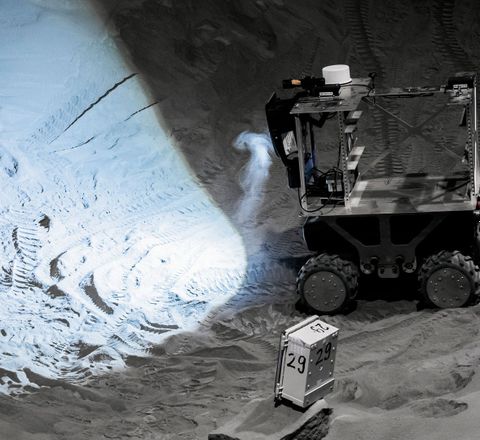
The scientists have presented several scenarios in the Luna Hall, including this one: A lander arrives on the surface of the moon and initially deploys two rovers. The first rover has the task of placing so-called radio beacons around the lander. These sensor units immediately take over the first navigation tasks. During its reconnaissance trips, the rover discovers a crater and realizes that it cannot drive down into it. It has to call the second rover for help. The crater is in an area of the Luna hall where the floor has been lowered by 3 meters. The second rover uses the navigation system to find the crater on its own and carries out its scientific investigations. During the journey into the crater, the first rover assists the second rover with orientation from the edge of the crater
Another scenario involved the deployment of sensor units in an area that is too steep for rovers. Up to 50 sensors were distributed and connected to form a network for navigation. Flying units or dropping the sensors into an inaccessible crater were also tested.
3D model of the regolith surface created
In addition to the navigation experiments, the team has created a 3D model of the hall and the floor for simulations and the verification of measurement data. A large part of the Luna hall is covered with a layer of regolith simulant ('moon dust'). The mixture has similar chemical, physical and geotechnical properties to the regolith that was brought to Earth on the Apollo missions.
The DLR research team will now evaluate the data in detail and further develop the swarm navigation system. The aim is for this type of robust, decentralized navigation and communication to be available to astronauts and robots exploring the moon in the future - and at the same time to help with the exploration of difficult terrain on Earth.


You might also be interested in
Michael Ardelt becomes first COO at Robco
Robco, a company for autonomous industrial robotics, is further expanding its management team. As the company's first Chief Operating Officer, Michael Ardelt will assume responsibility for structuring and scaling Robco's growth in operational terms.
 read more...
automatica to be held in China for the first time in 2027
automatica is expanding its global brand strategy and will take place in China for the first time in 2027. automatica Shanghai 2027, organized by Messe München Shanghai and the VDMA Representative Office in Shanghai, will celebrate its premiere from...
read more...Sales forecast of minus 5 percent
According to the VDMA Robotics + Automation trade association, the robotics and automation industry in Germany expects sales to fall by 5% to EUR 14.1 billion in 2026. The main reasons for this are weak demand from key customer industries,...
read more...Dr. Olaf Munkelt becomes new Chairman
Dr. Olaf Munkelt, co-founder and Managing Director of MVTec Software, is the new Chairman of the VDMA Robotics + Automation Association. He succeeds Dr. Dietmar Ley, former CEO of Basler, who stepped down from the board for statutory reasons.
read more...Technical University of Munich
New assistance robot for care
The Technical University of Munich (TUM) has developed a new assistant robot. Robotics researchers from the Munich Institute of Robotics and Machine Intelligence (MIRMI) and designers from the Munich Design Institute (MDI) worked closely together to...
read more...Humanoid robot head with all-round vision
Infineon Technologies and HTEC have presented the jointly developed '360° Awareness Humanoid Robotic Head'. The technology is the result of close cooperation in the fields of embedded engineering, sensor fusion and AI integration.
read more...Change in the VDMA Robotics + Automation Board
Dr. Michael Jürgens, CEO of Kuka Robotics, is a new member of the board of the VDMA Robotics + Automation Association.
read more...Robots and drones at the European Robotics Hackathon 2025
These were probably the most difficult scenarios by far since the premiere of the European Robotics Hackathon (EnRicH) in 2017: at the beginning of July, more than 120 robotics experts from all over Europe and Canada met at the never-commissioned...
read more...Application phase for Innovation Award 2026 begins
How can robotics help to make packaging more sustainable? Kuka is looking for creative and innovative ideas in the new round of the Innovation Award.
read more...