
Packaging technology
Delta robot assembles 'traffic lights' for peppers
Who hasn't seen them in the supermarket - the packs of red, yellow and green peppers. Until now, packing them was laborious manual work. At a Dutch vegetable supplier, this has recently been done by a Delta robot with the support of a vision system.

The trading company Combilo in Waddinxveen specializes in the import, export, packaging, storage, transport and distribution of fruit and fresh vegetables. A large proportion of these - especially greenhouse vegetables and hard fruit - are packaged by the company before delivery to the retail trade.
In particular, the assembly of so-called 'bell pepper traffic lights', each containing a red, yellow and green bell pepper, is a particularly labor-intensive process. According to Production Manager Marcel Villerius, who is also responsible for Combilo's packaging department in this role, a number of measures have been taken in recent years to optimize plant performance: "We are constantly looking for new ways to improve our efficiency and try to automate our operating processes as much as possible."
The hall houses a total of five packaging lines, which produce several million packages per year. Villerius explains the process: "A conventional packaging line is operated by seven employees. One person fills the baskets with peppers in the respective color. Three employees place the peppers on the conveyor belt by hand in the correct arrangement and color sequence. The peppers then pass through a flow-wrapping machine in groups of three, where they are wrapped in film. Another operator stands next to the packaging machine to check the feed to the machine and correct any errors. Once the peppers have been packed, the weight of the packaging is checked on a checkweigher. If the weight is too low, the packaging is rejected."
According to Villerius, this is where the problem often lies: "If the fruit is picked up by hand, we often receive packaging that is too heavy and contains too much product or is too light and has to be sorted out. Rejected packaging must in turn be manually unpacked and the peppers transported back to the starting point of the packaging line. This is a time-consuming process and the additional handling of the peppers is detrimental to their quality. Finally, at the end of the line, two other employees are responsible for placing the peppers in boxes and stacking them on pallets."
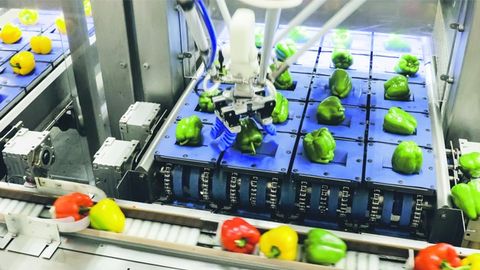
In 2015, Combilo decided to purchase a robot-assisted line developed by EasyPack Technologies to make the packaging of the three-packs of peppers more efficient. This basically performs the same steps as a conventional line. This means that an employee still fills the baskets with peppers in the respective color. However, three robots then take over the role of the employees who previously placed the fruit on the conveyor belt. In other words, the robots pick up the peppers and place them on the conveyor belt in the correct order and color sequence. They then pass through the flow-wrapping machine. After the packaging machine, the procedure remains the same.
As close as possible to 500 grams
Although the role of the robots appears to be limited when viewed in isolation, their control system is based on an intelligent concept. The starting point for the robots is a target weight of 500 grams per pack. The peppers are first sorted and then delivered in weight classes of 140 to 160, 160 to 180 and 180 to 220 grams. Villerius explains the rest of the process: "Weighing cells are integrated into the conveyor belts on which the peppers are transported to the robots. These transmit the weight of the individual fruits to the weight converter. When the first two robots pick up a bell pepper, they have two conveyor belts to choose from. For the last color, there are four conveyor belts. The robot therefore has a larger selection to bring the total weight of the three peppers as close as possible to 500 grams."

An intelligent control system ensures that each 'bell pepper traffic light' reaches the target weight of 500 grams as precisely as possible.
© OmronBut that's not all: once the peppers have been weighed, the image processing system equipped with three cameras transmits the position and arrangement of the peppers and the shape of the stems to the control system. This enables the control system to calculate exactly how to pick up and turn each bell pepper so that it is placed in the correct position on the conveyor belt. According to Villerius, processing peppers is particularly difficult because their shape varies so much. The stems are also very hard. They must therefore be positioned facing inwards to avoid damaging the packaging.
In addition to the contractor EasyPack Technologies, its long-standing partner Rons Electronics Supplies, which was responsible for the electronics and control system, was also involved in the project. Almost the entire control system for the robot application - with the exception of the load cells and the weight converter - was supplied by Omron. Easypack Managing Director Jeroen Bugter explains which components were specifically used for the installation: "We used three Delta 3 robots of type R6Y from Omron. These are waterproof versions that can be thoroughly cleaned. This is important in the food industry, as there are high hygiene requirements here. Each robot has four servo drives that control the three robot arms and the rotary axis. Omron also supplied the image processing system with three cameras and the controls for the conveyor belts."
Each robot has its own control cabinet for the servo drives, and the central control cabinet contains no fewer than 27 frequency converters for the conveyor belts and the robot controller. The latter processes the information about the weight, position and belt speed and uses it to control the three delta robots. An incremental encoder is attached to the flow-wrapping machine to control the speed of the robots. This ensures that they run at exactly the same speed as the packaging machine.
The major advantage of the Sysmac platform from Omron used in the project is that all devices - i.e. inverters, servos, I/Os, sensors and safety, image processing or robotics modules - can be connected to each other via Ethercat. In this way, up to eight robots can be controlled simultaneously within one millisecond, which ultimately ensures extremely smooth motion control. Omron has developed nine function blocks with different kinematic functions for easy implementation of pick & place applications. This means that users do not need to be robotics experts to program the application.
Finally, all devices can be programmed via the Sysmac NJ controller using one connection, one program and one software (Sysmac Studio). In the specific case of Combilo, the controller is responsible for obtaining all the information from the transport cells via Ethercat I/Os and then deciding which peppers to pick up. At the same time, it receives information from the vision system and then decides how and where the peppers are placed by the robot. It also controls the infeed conveyor belts and - if necessary - influences the outfeed conveyor and the packaging machine, which can be connected downstream of the robot. In short: a special robotics controller is therefore not necessary. And because the machine is programmed from a single interface, the system is much more efficient and commissioning is faster. The same applies to troubleshooting in the event of a failure.
In addition to the Ethercat connection, the NJ controller has an Ethernet/IP connection. This makes it easy to program a function block for communication with an SQL database and all data can be shared with an MES/ERP system in the factory - an important aspect in terms of traceability, among other things. The robots and the packaging line are operated via a touchscreen. Parameters such as weight, position and belt speed can be configured and controlled using simple pictograms. Error messages are also shown on the display.
Villerius is satisfied with the new robot-assisted solution, literally 'all along the line': "The load cells and the weight converter control the robots in such a way that the majority of the packaging now has the desired weight. The robots save us time, reduce the number of rejected packaged products and use less packaging material." In short: after a one-year trial run and a few adjustments, the productivity of the robot-assisted line per full-time equivalent is now 30% higher than that of a conventional line.


You might also be interested in
Development Collaboration for Humanoid Robotic Hands Launched
Schunk is entering into a new development partnership with Robert Bosch Robotics. Their shared goal is to develop an industrial-grade robotic hand that can be integrated into various humanoid robot systems.
 read more...
Nominations for Electrifying Ideas Award have been announced
An independent jury of top-class experts from business, research and society has nominated three companies for the Electrifying Ideas Award 2026: Ideas from Philips, Rittal and ZeMA - Center for Mechatronics and Automation Technology convinced the...
read more...Circular economy for flexible materials
With a budget of 7.5 million euros and twelve partners from six countries, the European research project 'FlexCycle' is pursuing the goal of making recycling processes for the reuse of flexible materials suitable for industrial use. To this end, it...
read more...Schunk founds tech spin-off for humanoid robot hands
Schunk is bundling its activities in humanoid robotics by founding its own spin-off at the beginning of January. The aim of the new company is to develop modular humanoid robot hands for industrial applications.
read more...Second generation of vacuum grippers
Coval has redeveloped the carbon face gripper 'CVGC'. The new generation also takes into account current and future trends in the market for collaborative robots.
read more...Schunk receives the Hermes Award 2024
Schunk was honored with the Hermes Award for its AI-based project during the opening ceremony of the Hannover Messe.
read more...Schunk at the Hannover Messe 2024
Digital and automated for healthy production
Schunk is focusing on two key topics in Hanover: 'The Healthy Factory' and 'Innovation through Collaboration'. The aim is to design a healthy and economically successful production for people and the environment.
read more...These are your winners!
We put 96 products in twelve categories to your vote in December, and now the winners have been chosen! The trophies were presented at a 'Winner's Dinner' at the Seehaus in Munich. These are your "Products of the Year 2024"!
read more...Robotics & Handling - The winners
They ensure fast and safe handling of components and get them reliably from A to B: the winning products in the 'Robotics & Handling' category.
read more...