
Human-robot collaboration
Cobots - sensitive yet powerful
Designed for direct collaboration with humans, so-called 'cobots' can be used in a wide variety of applications and industries to optimize production processes - two examples.
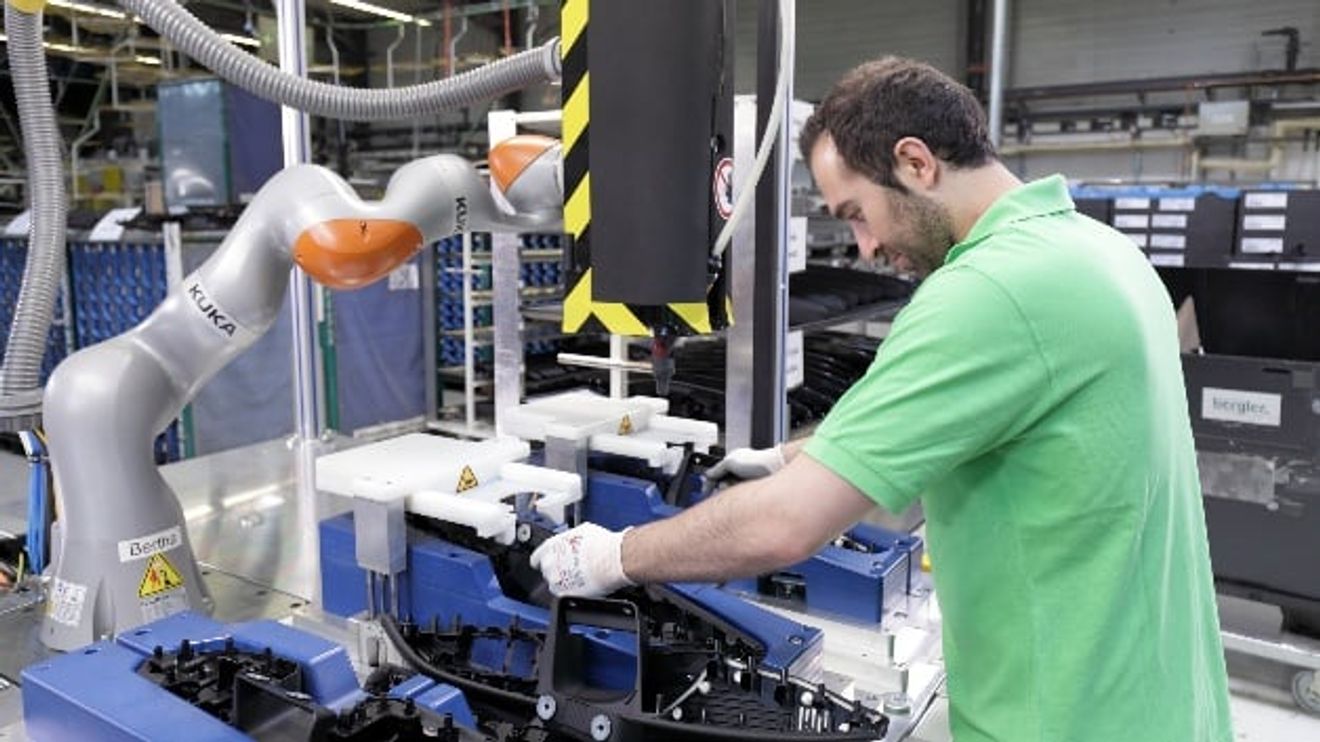
The automotive supplier Yanfeng Automotive Interiors (YFAI) is a global provider of automotive interior solutions. Headquartered in Shanghai, the company has over 110 locations worldwide, including a production facility in Lüneburg, Lower Saxony. Numerous components such as instrument panels, door panels and armrests are manufactured there. Plant manager Michael Oji: "The automotive industry is undergoing a profound transformation. Against this backdrop, we want to convert our production processes step by step towards Industry 4.0 as part of the future-oriented alignment of our sites."
As a first step, the company decided to integrate a cobot into the production line, which supports employees in screwing together armrests. Specifically, this is an LBR iiwa from Kuka, which was put into operation together with the system integrator Schulz Systemtechnik. In contrast to conventional industrial robots, which are usually not sensitive and therefore stand behind protective fences for safety reasons, cobots do not require complex structural measures. The safety of employees is ensured by joint torque sensors integrated in each of the robot's seven axes. If even one of these sensors senses a vibration, the cobot stops moving immediately. In addition, the robot only has smooth shapes, thus reducing potential hazards for humans.
The safety devices eliminate the rigid separation between fully automated and manual work - the two areas merge. The resulting direct cooperation between humans and robots offers numerous advantages: While humans are very flexible and can adapt quickly to new situations, the robot works with consistent precision. "This enables us to make production processes even more efficient," says Michael Oji. As safety devices such as fences are no longer required, the installation space is correspondingly smaller and flexible production islands are created that can also manufacture different products. Last but not least, the cobot relieves humans of both strenuous and monotonous, repetitive tasks.
Specifically, the task of the HRC robot at Yanfeng is to screw together the armrests of all four doors of the Opel Insigna. To do this, it shares the workspace with two employees. In the first step, the worker prepares the component. To do this, he inserts an injection-molded component together with the leather pad into a machine tool that laminates the two components. The worker then takes the laminated component and clips it to another injection-molded component to complete the arm rests. The next step is carried out by the cobot. To do this, the worker places the component in a holder. By pressing a button, the robot is informed that the machining process can be started. The robot then moves to the holder and screws the two components together. The screws are fed automatically via a hose attached to the protective sleeve. The worker then takes the finished arm supports and stacks them for removal.
Two workers each work on one machine tool in the system. They 'share' the cobot. There are a total of four holders for screwing. This eliminates waiting times.
High load capacity is crucial

The robot at Yanfeng is programmed so that it always chooses the most efficient way to screw the components together as quickly as possible.
© KukaOne of the decisive factors in Yanfeng's choice of the LBR iiwa lightweight robot was that it can move payloads of up to 14 kilograms. Dennis Rittmann explains: "The robot must be able to guide a screwdriving head weighing 13 kilograms. The robot also has the CE marking required in Europe." An important challenge during commissioning was to ensure the safety of the workers at all times. In addition to the safety devices already provided by the robot, an automatic screwdriving machine from Stöger Automation specially designed for HRC systems ensures safe collaboration. The screwdriving head is mounted behind a protective sleeve. If the sleeve hits an obstacle, the robot switches off immediately.
The system with the cobot has been in operation since December 2017. Initial experiences have been consistently positive, as Michael Oji confirms: "The robot has now paid for itself. What's more, our colleagues have quickly familiarized themselves with it. They are able to operate the robot themselves in the event of an error message and rectify the fault. No separate training was required for the employees to operate the robot." The two workers and the robot complete 45 vehicle sets in one hour. That corresponds to 180 bolted armrests. In the medium term, the company plans to use more cobots in its plants.
The sensitive cobot
Another example of the use of sensitive cobots is the automation of the calibration process for measuring equipment of different sizes at Perschmann Calibration. The calibration service provider from Braunschweig specializes in the calibration of manual measuring equipment, including high-precision testing of gauges such as mandrels and setting rings. According to the ISO 9001 standard, measuring equipment must be calibrated at regular intervals. The company's customer base consists primarily of customers from the classic mechanical engineering, automotive and aircraft construction sectors.

The Cobot from Perschmann Calibration sensitively picks up various measuring devices from a material supply trolley and feeds them to the coordinate measuring machine for calibration. Once the system has recognized which measuring equipment is involved ...
© Kuka"A human hair is about 50 µm thick, the threads of a spider about 5 µm. The accuracy with which we calibrate measuring equipment is around 0.5 µm," explains Dr. Detlef Rübesame, Head of Technology at Perschmann Calibration. In other words: The only thing that counts in measurement technology is maximum precision. In itself, these are ideal conditions for the use of robots. However, for efficient utilization, they must be able to grip objects of different sizes without damaging them.
Since 2017, Perschmann Calibration has also been using a sensitive LBR iiwa robot, which is installed on a flexible mobile platform, to load a coordinate measuring machine (CMM) from Hexagon with the corresponding measuring equipment in three-shift operation, thereby automating the calibration process. An important question in the planning of the production changeover was initially how the CMM and the cobot could recognize and assign the many different geometries of the measuring equipment.

The measuring device itself solves this challenge by controlling the measuring process. Equipped with a data matrix code, it forwards all important information, such as measuring equipment type or diameter, to the CMM. Using this special data matrix code, the CMM can initiate the measurement independently, eliminating the need for employee intervention.
In the first work step, the LBR iiwa moves to the first of two available transport units and checks whether there is measuring equipment in the individual chutes. It then removes them and feeds them to the reader in the correct position. In addition to scanning, the measuring equipment is blown off with air to remove any dust and prevent the measurement from being distorted. Once the system has recognized which measuring device is involved, the cobot clamps it in the clamping device. The CMM then begins the calibration process. As soon as this process is complete, the robot picks up the measuring device again and places it in the second transport unit. Meanwhile, the information about the calibration process is transmitted to a computer, where the certificate for each component is created.
A major advantage of the system is that the robot recognizes when a compartment is empty and then independently moves to the next full one. This is a real added value, as the robot can work autonomously through the night shift. The next morning, the employees find a fully calibrated unloading system. The use of the cobot now enables the company to calibrate around the clock - and even in two different modes. While production runs in safe, slower MRK mode during the day, it can be switched to fully automatic mode overnight when there are no people in the robot's work area. The robot then works at ten times the speed. This is possible because different safety regulations apply in unmanned operation.
In short, the additional, fully automatic calibration during the night shift enabled Perschmann Calibration to open up further testing capacities.


You might also be interested in
Division for software and digital business established
Kuka has founded a new business division. With 'Kuka Digital', the Augsburg-based company known for its orange industrial robots and automation solutions is expanding its software and digital business.
 read more...
Finalists for the Innovation Award 2025 have been announced
The motto of the Kuka Innovation Award 2025 is 'Medical Robotics Challenge 2.0'. Five international teams have made it to the final with their robotics ideas for the future of medicine. The winner will receive 20,000 euros in prize money.
read more...Great career opportunities for women in robotics
The IFR supports the career advancement of women in the robotics industry because, according to a World Bank forecast, the gross domestic product per capita would increase by almost 20 percent worldwide if the employment of women reached the same...
read more...Cobot assistant for SMEs
A user-friendly cobot application for small and medium-sized companies that can be used without programming - a team of researchers from Belgium received the Kuka Innovation Award 2024 for this concept.
read more...Handles handling and spot welding
The 'KR Fortec' from Kuka is an energy-efficient and dynamic heavy-duty robot that can be used in particular for tasks such as handling and spot welding.
read more...The top articles in March 2024
New technological developments lead the most-read articles in March. Motors that redefine energy saving, a plastic wheel that discovers the road, a new Ecolabel and, last but not least, the arrival of ChatGPT in the industry. Read for yourself.
read more...Cobot in quality assurance
The 'Ligre' brand is conquering the consumer sector with the function of grinding coffee to the exact gram, which was previously reserved for coffee machines for the catering trade. Gronbach relied on Cobot support in the test setup for quality...
read more...The partner world is growing
Bosch Rexroth launched the automation platform ctrlX and the associated App Store in 2019. The App Store now has 90 partners with over 60 apps. The partner companies currently cover more than 150 use cases.
read more..."From product manufacturer to provider of solutions and software"
Robot systems play a decisive role in overcoming current challenges such as demographic change and the shortage of skilled workers, says Andreas Röhring from Kuka. He talks about this and about resilience and adaptability as a recipe for success in...
read more...