

Robocup
B-Human wins another world championship
For the eighth time now, B-Human, the team from the University of Bremen and the German Research Center for Artificial Intelligence (DFKI), has won the World Robot Soccer Championship.
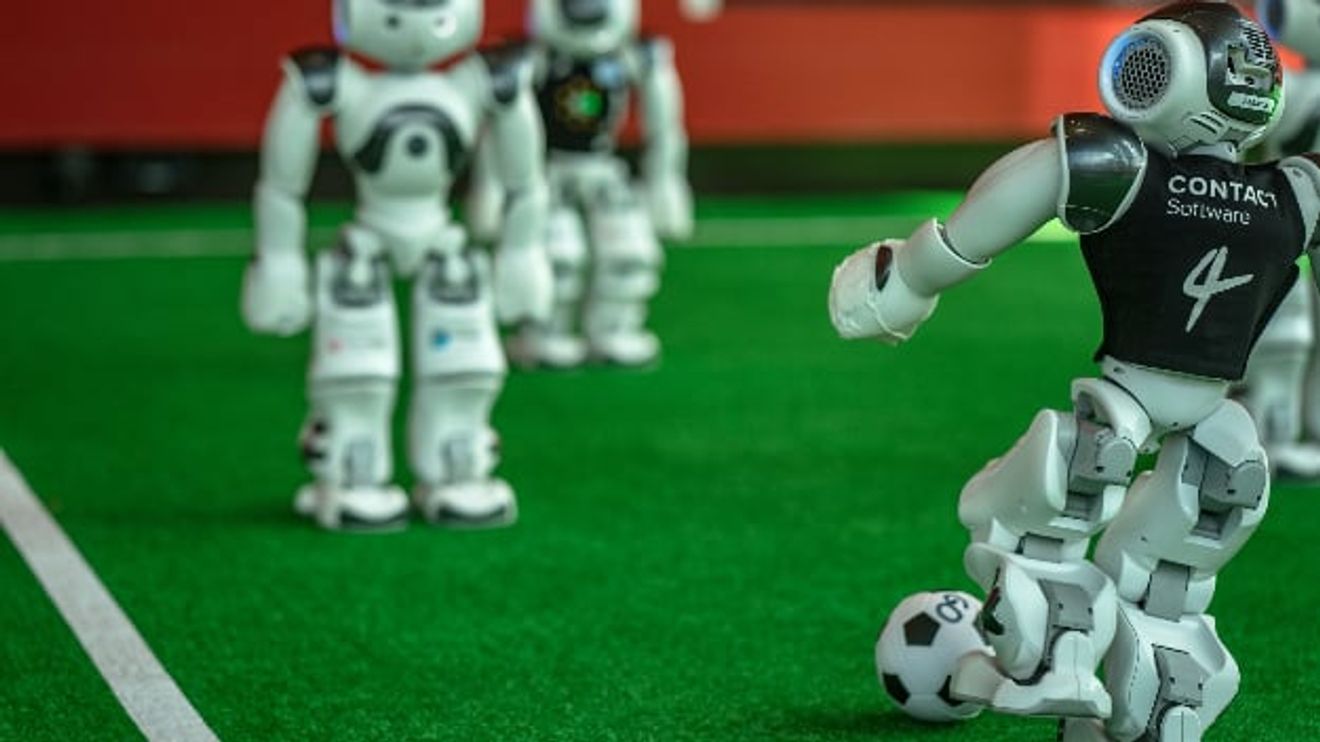
Under the title 'RoboCup 2021 Worldwide', the traditional competition was held in an unusual form due to the pandemic: from June 22 to 28, 2021, the teams came together exclusively virtually to compete against each other and face various challenges. B-Human - the team from the University of Bremen and the German Research Center for Artificial Intelligence (DFKI) - won three of the four new competitions in the Standard Platform League and successfully defended its 2019 title.
For the first time, the RoboCup World Cup was not about the number of goals scored. Instead of a traditional soccer tournament, the international teams were faced with competition formats that could not fully replicate the 'real' competitions, but in some cases presented new technical and scientific challenges. In the Standard Platform League (SPL) of RoboCup 2021, the regular competition, in which teams of five NAO robots normally compete against each other, was replaced by four individual competitions.
The first two competitions - the 'Passing Challenge' and the 'Obstacle Avoidance Challenge' - focused on the robots' soccer skills and were each played with their own NAOs on their own pitch. In the 'Passing Challenge', two robots had the task of passing a ball past obstacles as often as possible within five minutes. With a total of 27 passes between the Bremen NAOs, B-Human achieved by far the best result in this competition. The aim of the 'Obstacle Avoidance Challenge' was to dribble the ball past several obstacles into the goal as quickly as possible. Here too, B-Human won the competition as the fastest team.
The far more interesting and challenging competitions from a scientific point of view awaited the teams with the 'Autonomous Calibration Challenge' and the '1 vs. 1 Challenge'. Here, they transferred their software via the Internet to other teams' laboratories to run it on other NAOs and prove themselves on other teams' soccer pitches. The 'Autonomous Calibration Challenge' was about finding the positions of two balls on the field in the shortest possible time and approaching three given positions as precisely as possible. In a preceding 'calibration phase', the software automatically makes adjustments to the previously unknown robot. The Bremen software tackled this complex task in three different laboratories - in Dortmund, Amsterdam and Hamburg - and achieved the best score in each case. Other teams were sometimes slightly faster, but B-Human managed to determine the most precise positions in almost all cases.
The '1 vs. 1 Challenge' was the only competition that was actually played in matches against each other. As this was also played on foreign pitches and foreign robots, the knowledge and skills gained from the 'Autonomous Calibration Challenge' were of great value. B-human competed against the NAO team HTWK from the Leipzig University of Applied Sciences. Both teams were similarly fast and determined, but B-human missed the opponent's goal several times, meaning that they were unable to make up the resulting narrow deficit.


You might also be interested in
***** ENG *****China leads economic recovery
In China, the number of industrial robots sold increased by 19% in 2020, according to the International Federation of Robotics' (IFR) preliminary figures for World Robotics 2021.
 read more...
China leads economic recovery
In China, the number of industrial robots sold increased by 19% in 2020, as reported by the International Federation of Robotics (IFR) with the preliminary figures for World Robotics 2021.
read more...Combining technology and art
An industrial robot is one of the main actors in a play at the Staatstheater Augsburg, which audiences can watch from home as a 360-degree production using virtual reality goggles. Man and machine dance together on the virtual ballet stage.
read more...RoboCup World Championship 2019
These are the winners!
The 23rd RoboCup Championships were held in Sydney this year. Teams from all over the world competed against each other with their robots in various categories. The German participants were very successful.
read more...RoboCup World Championship 2018
Germany is the soccer world champion!
If not in Russia, then in Canada: robots from German universities recently beat the international competition in soccer at the RoboCup World Cup. But the robotics competition in Montréal was not just about soccer. A look back.
read more...RoboCup World Championship 2018
Germany is the soccer world champion!
If not in Russia, then in Canada: robots from German universities recently beat the international competition in soccer at the RoboCup World Cup. But the robotics competition in Montréal was not just about soccer. A look back.
read more...The smart screw 4.0 thinks for itself
With its smart machine components such as the 'Screw 4.0', Bremen-based start-up Sensosurf provides process information for the next level in order to make the blind spots in production visible.
read more...RoboCup World Championship 2017
German robots impress in Japan
Soccer skills were on display at the RoboCup robotics competition in Japan at the end of July. At the forefront: the robots from the German university teams. They also showed how advanced they are technologically in the industrial, household and...
read more...Masters manipulation tasks and difficult terrain
The 'Mantis' robot is able to negotiate steep craters and scree fields. It has gripping tools that enable it to change its surroundings. What's more, it even learns from its mistakes.
read more...