
Mobile robotics
Autonomous assistants are moving into factories
Human-robot collaboration (HRC) alone is not enough to make production more flexible. There is also a need for mobile platforms on which robots can move independently through factory halls and transport goods or workpieces.

Robotics is regarded as one of the cornerstones of flexible manufacturing à la Industry 4.0. The current trend is clearly moving towards lightweight construction concepts and solutions in which humans work in close proximity to robots or even together with them - without the need for safety guards. Ideally, the robot is not permanently installed at one station, but can be used for a wide variety of purposes at different points in production as required.
Kuka is one of the proponents of such concepts. In future, the Augsburg-based company not only wants to convince its customers of the resulting advantages, but also benefit from them itself - in its own production. Andreas Ostermann von Roth, Executive Vice President Operations at Kuka Roboter: "We want to position our production for the future and significantly increase efficiency in the process. Our goal is to achieve a capacity of more than 20,000 robots per year in Augsburg. We can only achieve this if we redesign the assembly processes using state-of-the-art methods."
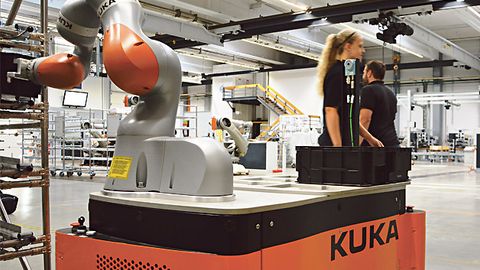
In 'Hall 7', Kuka assembles its 6-axis Quantec robots at its Augsburg headquarters - with the support of the KMR iiwa mobile platform.
© KukaWith this in mind, the company's own robot production was recently redesigned from a multi-line system to a line production of around 140 meters in length using lean production methods. The mobile robot KMR iiwa, an autonomously moving platform in conjunction with the lightweight robot LBR iiwa, automatically supplies the robot assembly workstation in the central manual assembly of the so-called KR-Quantec robots with production material. This is a family of 6-axis robots for payloads from 90 to 300 kg. The delivery of the assembly material 'just-in-sequence' (JIS) was a key component of this. Specifically, Kuka uses the KMR iiwa for the distribution of screws, sealing rings, nuts and other small parts according to the Kanban principle. This means that the screw manufacturer Würth delivers the ordered Kanban boxes to the central storage rack. At regular intervals, the mobile robot sensitively checks the individual shelves and removes the delivered boxes containing the small parts. The robot arm holds the box against a QR code scanner mounted on the platform and recognizes the individual target position of each box. The autonomously moving platform then transports the containers through the production hall and automatically delivers them to the workstation.
"This just-in-sequence delivery is part of our new logistics concept in the production of our robots," explains Sebastian Bodenmüller, Head of Assembly at Kuka Roboter. Two key points are taken into account to guarantee maximum efficiency: The KMR iiwa does not travel unnecessary distances and does not require a break. The mobile platform can be moved precisely in any direction from a standing position using the specially developed OmniMove Mecanum wheels (see box).
The robot and vehicle are operated together with a multi-kinematics-capable control system. Additional environment scanners on the vehicle enable obstacles to be detected. The lithium-ion batteries used supply the vehicle and robot directly with power. Using navigation software developed by Kuka itself, the KMR iiwa moves safely and freely in space without any cable connections. In other words, the mobile platform is able to recognize obstacles in its path at an early stage and thus navigate autonomously through production. A key feature of the KMR iiwa is its ability to share a common path with people and logistics trains. No special safeguarding or further processing of the routes is necessary.
"Our employees quickly accepted the KMR iiwa as a fully-fledged employee and colleague. They appreciate the benefits of this intelligent and mobile assistant," says Sebastian Bodenmüller, summing up the robotic colleague's first few weeks of use. It primarily performs monotonous tasks that are not ergonomic for humans. It works independently of break times and is always ready for action when it is needed. However, its possible areas of application are not yet exhausted with pure logistics tasks. Loading different industrial machines is just as conceivable as working directly with one or more employees in a shared or common workspace.
Driving with the Mecanum wheel

Vehicles on Mecanum wheels can move completely freely in two dimensions. Whether stationary or moving, they can head in any direction, take curves of any radius or turn on the spot.
© ImetronThe Mecanum wheel was invented in 1973 by Bengt Ilon, an engineer at the Swedish company Mecanum. The US Navy bought Mecanum's patent and initially used the technology exclusively for loading cargo on its ships. It was not until 1997 that the technology became available to commercial companies and for civilian use. How the Mecanum wheel works: Unlike conventional wheels, the Mecanum wheel does not have a closed tread. Instead, barrel-shaped rollers are mounted on its wheel rim, usually at an angle of 45° to the wheel's axis. These can rotate freely around their own inclined bearing axis. The shape, size and spacing of the rollers are chosen so that the wheel has a continuous rolling surface.
When a Mecanum wheel rotates, two force components are created: the first points in the direction of rotation of the entire wheel, the second is at right angles to it. However, as its rollers are movable, the Mecanum wheel does not track like its normal counterpart. If additional forces are added, its movement can be deflected in any direction. In vehicles with four Mecanum wheels, the 45° angles of the roller axles are offset by 90° to each other. On its own, each wheel would move diagonally into a different corner of an imaginary rectangle.
To move the vehicle straight ahead, for example, the force vectors of the front wheels must act forwards and inwards and those of the rear wheels with the same force - i.e. speed - forwards and outwards. In fact, all wheels turn forwards at the same speed, as in a conventional vehicle. If the Mecanum wheels at the front left and rear right turn forwards and the other two wheels turn backwards, all at the same speed, the vehicle moves sideways to the right. For a curve, all wheels turn in the same direction, as in a tracked vehicle, but the wheels on the outside of the curve turn faster than those on the inside. The greater the difference, the tighter the bend.


You might also be interested in
Review of the 'Expert Days on Service Robotics'
"Human meets Robotics" - this was the motto of Schunk's 9th 'Expert Days on Service Robotics'. It became clear that international standards are needed for robot-supported assistance systems to become a matter of course in everyday industrial life.
 read more...
Universal Robots - Sales almost doubled
Universal Robots, the Danish manufacturer of collaborative robots, achieved a turnover of 56 million euros last year - a growth of 91% compared to the previous year. Profits increased even more.
read more...Aquias' research project launched
The kick-off event for the 'Aquias' research project took place at the Fraunhofer IAO on February 2 and 3. Its aim is to enable broad groups of employees to participate in attractive work in human-robot collaboration.
read more...Joe Gemma ist neuer Präsident der IFR
Das Executive-Board der International Federation of Robotics (IFR) hat Joseph Gemma von Kuka Robotics Corporation US zum neuen Präsidenten gewählt. Gemma folgt auf Arturo Baroncelli von Comau Robotics, Italien.
read more...Auftakt für RoboCup-Saison 2016
Der internationale Robotik-Wettbewerb 'RoboCup' geht in eine neue Runde. Die Anmeldung für den deutschen Vorentscheid ist gestartet. Diejenigen, die sich beim RoboCup-Junior-Finale qualifizieren, kämpfen auf der RoboCup-WM in Leipzig gegen die...
read more...25 Roboter harmonieren in der Montage
Die Montage von Kurbelraumkernpaketen hat das Unternehmen Neue Halberg-Guss unlängst in die 'Hände' von 25 Robotern gelegt. Das Ergebnis: ein Produktivitäts- und Qualitätszuwachs von jeweils 50 %.
read more...Hydraulic cylinders become smart
Avoiding sudden machine breakdowns and optimizing maintenance routines - what operator of mobile machinery wouldn't want that? Vehicles can provide the necessary information automatically - for example with the help of position measurement in...
read more...Schaeffler manufactures electric motors
Schaeffler is entering electric motor production with a modular technology platform. Series production is planned from 2021.
read more...Mobile robotics in semiconductor production
Semiconductor production is complex and intricate. Hundreds of production steps are required before the finished product is ready. One challenge here is the transportation and handling of sensitive components from one step to the next.
read more...