

Thomas Hähn, United Robotics Group
"People must remain in control"
Service robots interact with people in a wide variety of areas. But how is the acceptance of service robots? Computer&Automation spoke to Thomas Hähn, CEO of the United Robotics Group, about this.
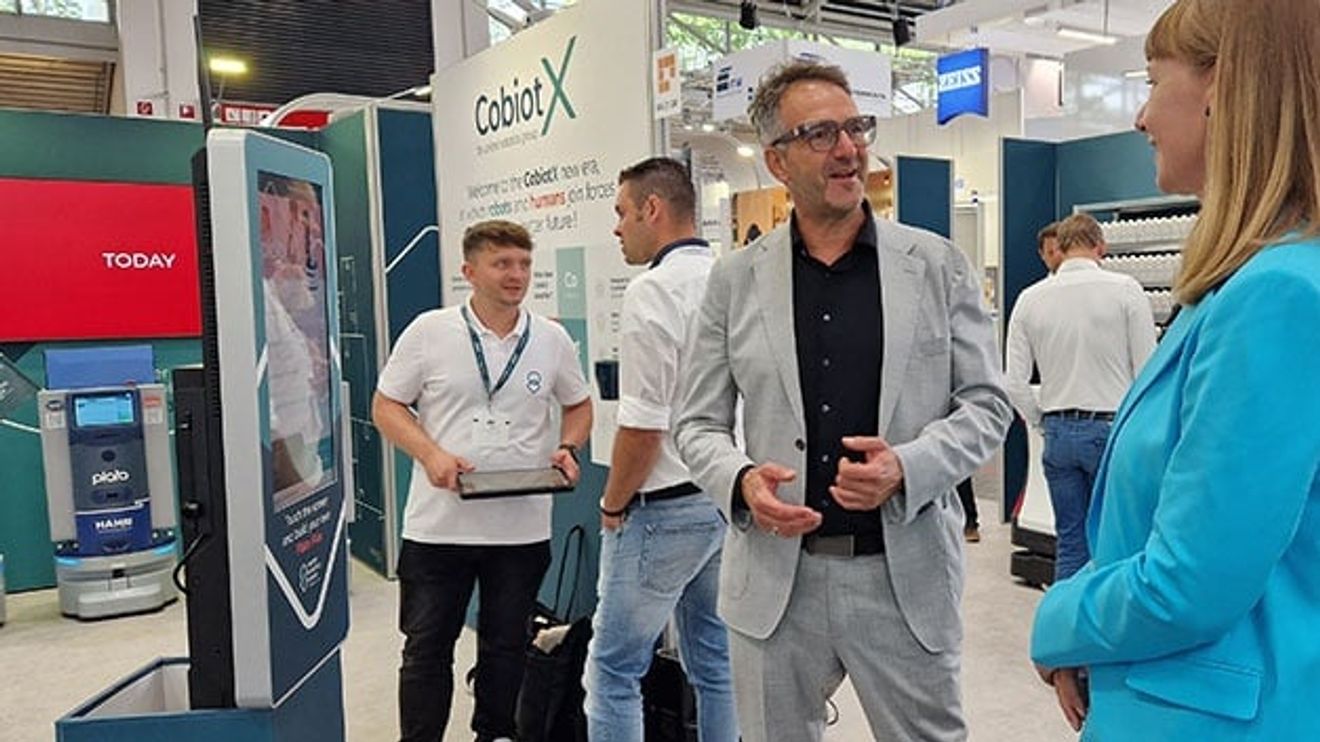
Thomas Hähn, CEO of the United Robotics Group, in conversation with Andrea Gillhuber.
© WFMThe International Federation of Robotics predicts high growth rates for service robotics. For what purpose are service robots used?
Thomas Hähn: Service robotics is an important key technology for overcoming some of the most urgent challenges, such as the shortage of skilled workers in the healthcare and hospitality sectors - here in Germany, but also in other countries. However, the following must be emphasized in advance: It is not about replacing human labor and thus making workforces superfluous. Rather, it is about targeted relief and support for staff. The robots should work with and for people. They should enable them to focus on human interactions that require creativity, care, service and social skills, for example.
For example, a robot like Plato can provide useful support to service staff in the hotel and hospitality industry by taking over routine tasks. Physical relief also plays a role. In the hospitality industry in particular, physical complaints cause a lot of downtime. There is also great potential for the use of robots in the care sector, for example in transportation or the allocation of medication. In addition, there is currently a considerable shortage of labor in laboratories. Here, robots can help to maintain 24-hour operations, be used well for process-critical and repetitive tasks and ensure process automation.
How do the areas of application in Germany differ from those in the rest of the world?
Hähn: Service robotics is a real growth market. Germany is way ahead of the rest of the world when it comes to penetration, even coming third behind the USA and China according to the IFR.
The research, development and production of Cobiot and CobiotX solutions offer an opportunity for Germany, and Europe as a whole, to position itself at the forefront of a future segment right from the start. In order to achieve pan-European sovereignty in this area, cooperation between robotics experts is required. The United Robotics Group also cooperates intensively with specialized companies, including clinics, nursing and retirement homes, laboratories, universities and other partners. During the development phase of the solutions, not only engineers but also philosophers, for example, are involved in order to cover all aspects of cooperation between humans and machines.
If you compare the circumstances in the different regions of the world, it is of course true that there is generally a higher acceptance of robots in Asia, as people there are very tech-savvy. However, increasing acceptance can also be observed in Europe - which is likely to grow with the increased use of service robots and the associated positive experiences.
Service robots are in direct contact with humans and are often 'humanized' for this reason. However, there are people who find robots with human features, for example with eyes, rather creepy. Why is that the case?
Hähn: There are various studies on this topic, the results of which we are of course monitoring closely. In general, we can say that human-like robots initially meet with a positive response. However, this can quickly change if they look too human - which typically triggers a certain level of unease. The so-called 'Uncanny Valley' phenomenon is responsible for this. This describes how the acceptance of humanoid robots increases up to a certain point, before it falls drastically as soon as robots look too human-like and even turns into discomfort or rejection.
Especially in the service sector, gradations and nuances in robot design are crucial: it must be friendly, not too robotic, but not too human-like either. The main focus is on the robot's face. Here we have two proven specialists within the United Robotics Group, Aldebaran Robotics and Rethink Robotics, with their developments 'Pepper' and 'Nao' or 'Plato. Nao and Pepper have a friendly, sympathetic hardware face, while Plato shows such a face on its display. We now want to develop a combination of the two. There are applications in which a display is completely sufficient, and those in which a humanoid head is required.
At the United Robotics Group, a team of philosophers, psychologists and ethnologists is working on human-robot collaboration. How does the team help to make service robots more acceptable to humans?
Hähn: Our team is interdisciplinary and therefore also includes areas such as philosophy and education. In the development of CobiotX solutions, they are increasingly used alongside our engineering knowledge so that aspects beyond technology can also be examined.
Philosophers are involved, for example, in describing the various customer use cases from the perspective of the respective group of people affected and drawing conclusions about the exact appearance of the service robots. It can be frightening for a resident of a retirement home when a mechanical gripper arm hands them a drink or a medicine. The design, movement and interactive communication of the robotic solution used should be friendly. In addition to the ability to move autonomously and safely in disorderly environments, ease of use is also important for acceptance. Service robots should be intuitive to operate. As they are mobile in use, they must also meet higher safety requirements.
We have a responsibility and must define what we want to allow as a society. One thing is certain: humans must remain in control. In principle, only a consistently human-centered approach can help service robotics gain real acceptance among users and employees.
How to promote the acceptance of robotics

What characteristics do the mechanical helpers need to have in order to be accepted?
Hähn: Service robots shouldn't act like machines, but should be likeable and helpful. It's not just the appearance that plays a role, it's also about how movements are designed and how interactive communication with humans works. How should robots respond? Should they have a computer voice or a human voice? We need to develop our own sympathetic form of communication for this.
We also need clearly recognizable sounds that unmistakably communicate that a robot is nearby - for example, a buzzing sound or something similar. And there must be a verbal form of communication. We have developed a neutral robot voice for our service robot Plato so that it sounds neither clearly male nor female. It's recognizably an artificial voice, but it doesn't sound cold and 'typically robotic'. Plato's display shows a friendly face, which we also use for communication while the robot is driving. When Plato turns, it looks in the direction in which it is driving, just as we are used to doing in our everyday interactions with people.
How do you influence the 'facial expressions' or 'nature' of a robot?
Hähn: As I said, a robot has to be friendly and should neither be too machine-like nor too human-like. We have given our robots a friendly hardware or display face and will next develop a combination of the two.
By involving our in-house philosophers and educators as well as experts from other specialist areas, we prevent the development phase from being all about technical feasibility. How the findings and recommendations are actually incorporated into the work on Cobiots is decided according to different criteria. But one thing is certain: in service robotics, the facial expressions and character of a robot are decisive for its acceptance at the place of use.
Do you carry out acceptance tests for robots in real environments? If so, how do they work?
Hähn: We carry out test runs in special test scenarios, but also in real environments. Several projects are underway, for example with a large clinic in Cologne or in hotels or restaurants. We are observing both the technical side and the reactions of people. At the United Robotics Group, we don't just see our role as developing Cobiot and CobiotX solutions. We also review and revise the processes and participate in the social discourse. The development of practical robots would not be possible if we did not know exactly how the processes work and what challenges await us. In any case, we have to take people with us - and that is only possible if we take a holistic view of the development of the new generation of robots.
I can imagine that the ethics team is already questioning the use of robots very critically. Can you give some examples of difficult questions that have given you food for thought?
Hähn: As a society, we have to keep asking ourselves what we want to allow and what not. It creates discomfort when people can no longer decide whether something is carried out by another person or a machine. This can lead to skepticism and a general rejection of robotics. This is precisely why we ensure that humans always remain in control. In principle, the complete responsibility lies with the people who manufacture, own and operate robotic solutions. The point is always that robots can never act or make decisions independently.
But it is also about communicating what we can gain. As people in Europe and around the world are getting older, chronic conditions are also on the rise and this increases the stress on healthcare systems. Without the use of automation and robotics in these areas, we will not be able to maintain or even improve our standards.
How were these findings incorporated into the development?
Hähn: I can only repeat it: Humans must remain in control, there needs to be safety barriers and also regulation. We make sure that service robots are likeable - this applies to their appearance, but also their movements and, above all, their interactive communication.
That's easy to say. But it is a technical challenge to teach the Cobiots the appropriate movements. They also have to be easy to operate. Compliance with ethical guidelines and our responsibility set the standards for our work. For example, our Cobiot Plato is the first robot of its kind to comply with the EU Safety Directive 2006/42/EC, which deals with robots in social environments.
On the whole: Is there generally too little focus on robotics from the perspective of ethics, psychology and philosophy?
Hähn: No, I believe that we are seeing a much more holistic picture in the discourse, especially in recent years, and the direction is right.


You might also be interested in
Interview with Hartmut Rauen, VDMA
A job with meaning
The shortage of skilled workers is real. Hartmut Rauen knows that this is not due to the attractiveness of the training program. Rather, the aim is to improve communication and highlight the importance of technology for the future. Another topic:...
 read more...
Robotics and automation - quo vadis?
The German robotics and automation industry expects sector growth of 9% to 15.7 billion euros in 2023. Patrick Schwarzkopf, Managing Director of the VDMA Robotics + Automation Association, comments on current trends and developments.
read more...Cobots - lightweight robots with great potential
In recent years, so-called lightweight robots have been developed. They are also known as collaborative robots or cobots. A group of scientists at RWTH Aachen University has researched how these mechanical helpers can be integrated into a system.
read more...Federal Statistical Office/VDMA
German industry receives fewer orders again
A cushion of orders from the coronavirus pandemic is still supporting the industry. However, orders are falling at the start of the second quarter. Economists see this as a bad omen for the economy. The VDMA is also reporting a decline in orders.
read more...Erich Schober is a new member of the Management Board
The VDMA Robotics Executive Board has appointed a new board member: Erich Schober, CSO of Kuka Germany, succeeds his former colleague Michael Otto, who left Kuka at the end of 2022.
read more...The top articles in February 2024
In February's top articles, you will discover the results of international robotics studies, new developments in the security industry and find out how innovations in artificial intelligence are helping to shape the future - but can also have...
read more...International study on robot acceptance
Robots and their use in society are associated with different associations and expectations. The United Robotics Group conducted an international study with the help of market research expert Harris Interactive to find out how they are accepted.
read more...Thomas Hähn is a new member of the Executive Board
Thomas Hähn, founder and CEO of the United Robotics Group, was elected to the board of the VDMA Robotics Division.
read more...25 years of Computer&Automation - The e-paper
For 25 years, Computer&Automation has accompanied the growing influence of IT in automation technology. Ultimately, IT and automation can no longer be clearly separated. In this anniversary issue, you can read about the importance that...
read more...