
United Robotics Group
International study on robot acceptance
Robots and their use in society are associated with different associations and expectations. The United Robotics Group conducted an international study with the help of market research expert Harris Interactive to find out how they are accepted.
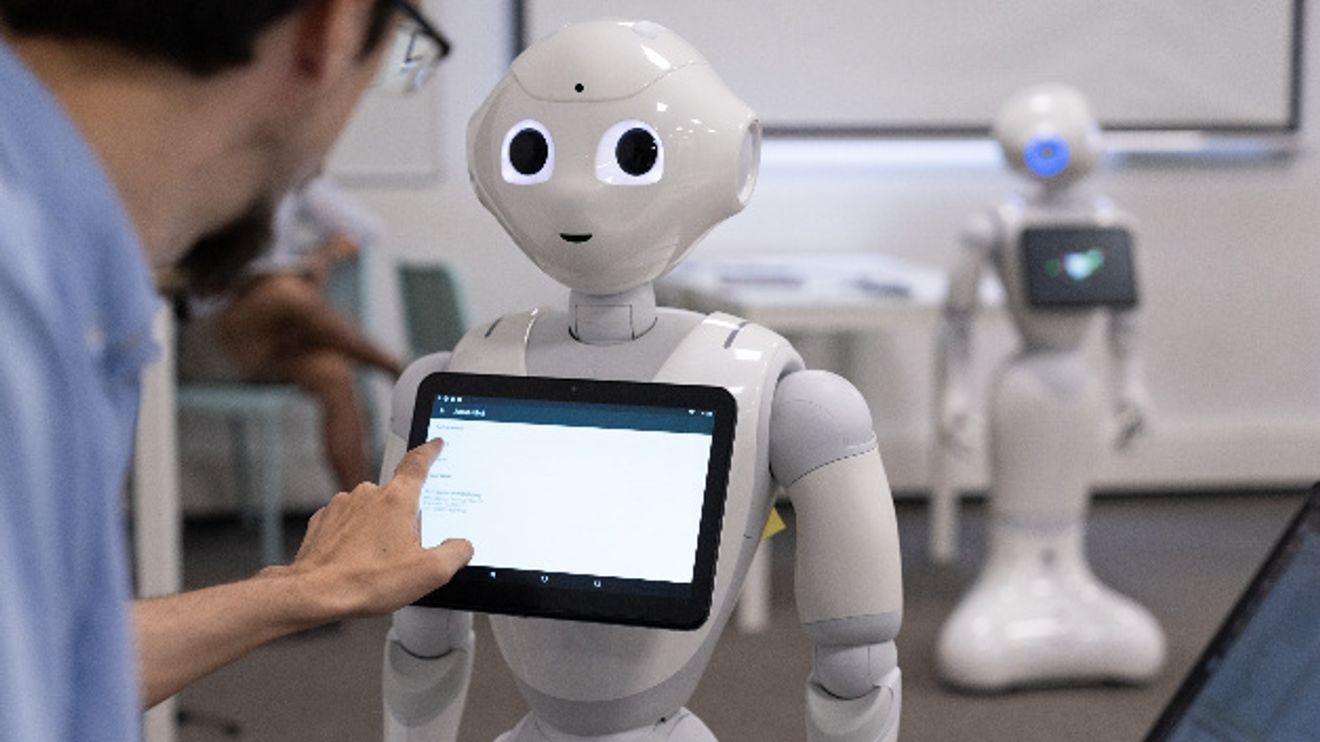
The study by United Robotics was conducted with a total of 7,779 participants in Germany, France, Italy, Canada and the United States. Its tenor: people in the countries surveyed are generally very interested in robotics. There is a consensus among the respondents that the sector will grow and gain in importance - in Germany, a full 90% of respondents believe this. In areas such as industry, digital technology, security and, above all, healthcare, the view is overwhelmingly positive.
In general, the Germans surveyed see robotics as a good opportunity to tackle some of the pressing social challenges - from demographic change and the resulting shortage of skilled workers to the growing importance of innovative services. Even more than in other countries, participants from Germany see considerable potential for the increased use of robots in social areas such as the hospitality industry (61%), care (67%) or the education sector (67%).
At the same time, the level of information on the topic of robotics in society is relatively low. The study results make it clear that many people feel inadequately informed or not informed at all - particularly in Germany and France. This lack of knowledge leads to numerous uncertainties and fears about the actual effects of the use of robots in everyday life. These range from discomfort in the presence of a largely autonomous robot to concerns about the impairment of social ties and worries about the rationalization of jobs.
Overall, opinions are divided in Germany with regard to the opportunities and risks of robotics. A majority believe that both are roughly balanced - with a slight preponderance of risks. In contrast, respondents in Italy and the United States in particular emphasize the benefits somewhat more strongly.
"Almost everyone is aware of the growing importance of robotics - but in view of the concerns that still exist, continued education is just as important as clarifying the benefits in order to reduce fears and uncertainties. Raising awareness of the topic should start as early as possible. This requires massive investment in training," explains Thomas Linkenheil, Co-CEO of the United Robotics Group. "If suitable financing strategies are developed for service robotics in Europe and funding for research and innovation is increased, robotics can unleash its full potential - and convincingly refute the arguments of skeptics."
Germany needs to catch up in education

However, the interviewees see not only risks, but above all the key levers for a robotics transformation in the two main areas of 'the world of work' and 'education'.
Robotics has an important function in the education system, as this is where the conditions for further progress are created and the skilled workers of tomorrow are trained. Nevertheless, this area in particular shows significant deficits. This is particularly true in Germany, where only 38% of elementary school pupils support learning with the help of robotics. In fact, only 11% have come into contact with the topic here so far; in secondary schools and universities, the figure is 19% each. The corresponding figures are higher in all other countries. The participants in the study predominantly agree with the topic: The teaching of robotics content is particularly popular at secondary school and university level.
Parents and pupils or students have a predominantly positive view of the use of robotics in lessons and the presence of robots in the classroom. Parents also tend to be more in favor of integrating robotics into the curriculum from the outset than teachers or students. Users expect it to promote rational thinking in areas such as mathematics or engineering (70 to 79% approval) and organizational skills (49% approval).
Opportunities in the world of work
In the world of work, robotics is rated positively by almost 80% of respondents overall, particularly with regard to corresponding activities in this sector. 70% of all respondents believe that robotics and the relevant companies in the sector are attractive potential employers. However, around 75% are still unclear about suitable entry opportunities in the sector. Furthermore, such activities are primarily seen as an offer for a group of employees with a higher level of education. Nevertheless, 49% of study participants from Germany between the ages of 15 and 24 can imagine working in this sector when choosing a career - in comparison, this is less than in other countries.
About the study
The online surveys were conducted by Toluna Harris Interactive from October 24 to November 2, 2023. A total of 7,779 people were surveyed simultaneously in the five countries: Germany (1,561 people), France (1,568 people), Italy (1,566 people), the United States (1,536 people) and Canada (1,548 people). A representative sample of the national population aged 15 and over was surveyed in each country. The representativeness of the sample was ensured by the quota method according to the criteria of gender, age, place of residence and income level (with the exception of France, where the socio-professional category [SPK] was used).
The United Robotics Group
Founded in 2020 by Thomas Hähn, the United Robotics Group unites eight service robotics companies to form an ecosystem by combining hardware and software expertise under one roof. More than 500 employees from 30 nations work for the company. Headquartered in Bochum, Germany, United Robotics Group brings together cutting-edge technology and robotics experts from the social and industrial world with the common goal of supporting humanity with technology and facilitating processes for people so that they can focus on human interactions in a safe environment. United Robotics Group is a subsidiary of RAG-Stiftung Beteiligungsgesellschaft (RSBG SE), which mainly focuses on technology and engineering-driven companies. SoftBank Robotics Group is a minority shareholder of United Robotics Group.


You might also be interested in
The top articles in February 2024
In February's top articles, you will discover the results of international robotics studies, new developments in the security industry and find out how innovations in artificial intelligence are helping to shape the future - but can also have...
 read more...
Thomas Hähn is a new member of the Executive Board
Thomas Hähn, founder and CEO of the United Robotics Group, was elected to the board of the VDMA Robotics Division.
read more...25 years of Computer&Automation - The e-paper
For 25 years, Computer&Automation has accompanied the growing influence of IT in automation technology. Ultimately, IT and automation can no longer be clearly separated. In this anniversary issue, you can read about the importance that...
read more...Thomas Hähn, United Robotics Group
"People must remain in control"
Service robots interact with people in a wide variety of areas. But how is the acceptance of service robots? Computer&Automation spoke to Thomas Hähn, CEO of the United Robotics Group, about this.
read more...Expansion of service robotics
Germany-based United Robotics Group announces its majority stake in Robotnik Automation, headquartered in Valencia, Spain, a provider of mobile service robotics technologies.
read more...Digital Material Selection reduces CO₂ Emissions
Using an industrial gripper as an example, Schunk and CADFEM demonstrate that simulation-based material selection can reduce CO₂ emissions from secondary materials and additive manufacturing by up to 40%.
read more..."AKIMI" Research Project develops AI for Flexible Robotics
The AKIMI research project is launching at the WZL at RWTH Aachen University. The goal is to develop agent-based AI that simplifies the programming and reconfiguration of robotic systems for small and medium-sized enterprises.
read more...Barcelona Declaration on Robotics and...
Robotics Associations Adopt Global Automation Strategy
The global robotics industry is stepping up its collaboration. The associations AER Automation, A3, IFR, and VDMA Robotics + Automation have formed a long-term alliance by signing the “Barcelona Declaration on Robotics and Automation 2026.” The...
read more...Humanoid Robotics at BMW in Spartanburg
"Physical AI" combines digital AI with real machines and robots. This allows intelligent systems, such as humanoid robots, to be integrated into real-world production processes. Following the successful deployment of the Figure 02 humanoid robot at...
read more...