
Guidance systems
Turn five into one
A new central control room instead of the previous five decentralized control stations: Jungmann Systemtechnik was entrusted with this project by Infraleuna-Betriebsanlagen. Multiconsoling and special software were used to operate the control systems.
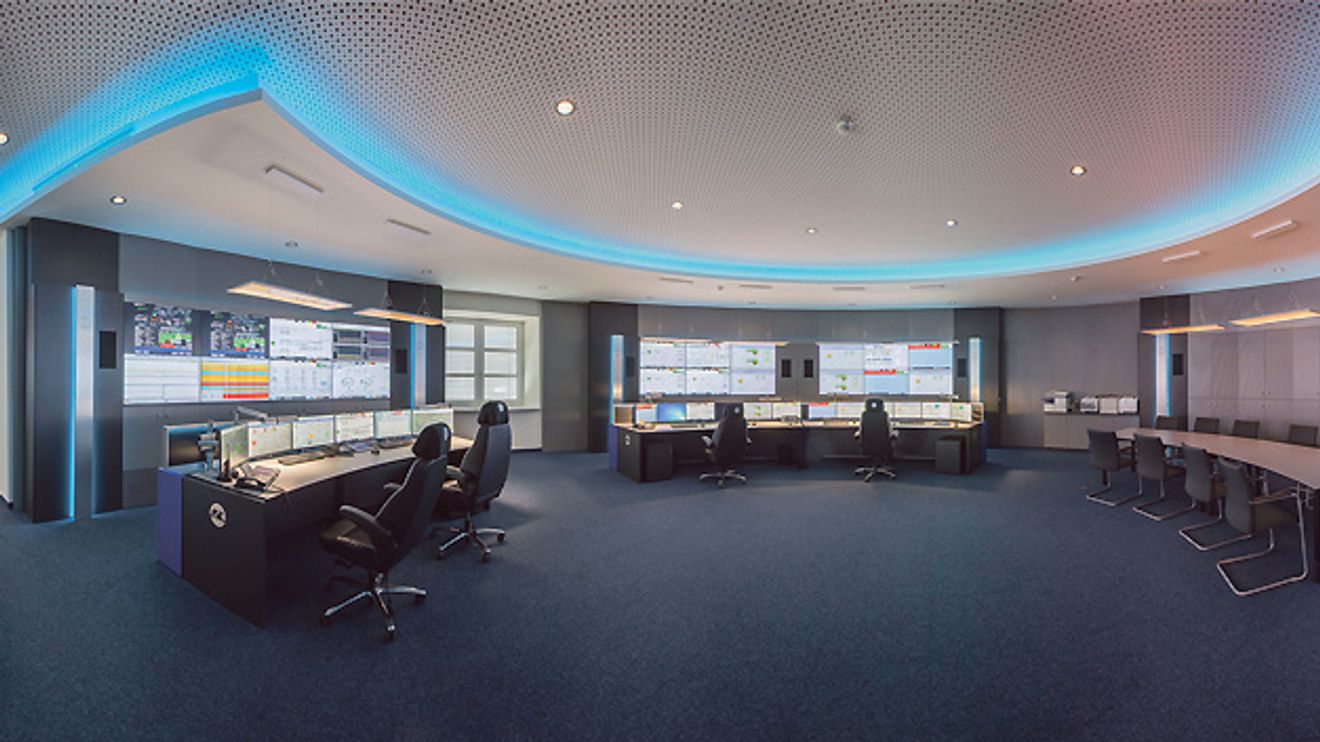
Until now, Infraleuna has monitored and controlled the operating systems for energy and water supply as well as water disposal in five decentralized control rooms. In 2014, however, the site operator decided to convert one of the existing control rooms into a central control room as part of a modernization plan. To this end, the owner and operator of the infrastructure facilities at the Leuna chemical site entrusted Jungmann Systemtechnik (JST) with a concept study and the subsequent implementation planning and realization.
"We made the decision to combine the previous control stations into a central control room for several reasons," explains Dipl.-Ing. Thomas Räcke, Head of Energy and Water at Infraleuna. "Among other things, we wanted to create the technical and organizational conditions to ensure that the automation technology in the area of energy and water systems can be used in an even more coordinated manner in the future." The aim was to optimize internal interfaces, improve cross-plant communication and increase the efficiency of work organization. In addition, multiple plant operation with permanent staffing of the central control room in combination with a plant-specific runner system directly on site was planned for technologically similar energy and water systems. The demographic development of the plant personnel, with a high proportion of older employees who are about to retire, was also taken into account in the project. "Overall, we had set ourselves the goal of creating a full-time control room with reduced alternating shift staffing and optimized day shift staffing," Räcke summarizes.
Control room concept
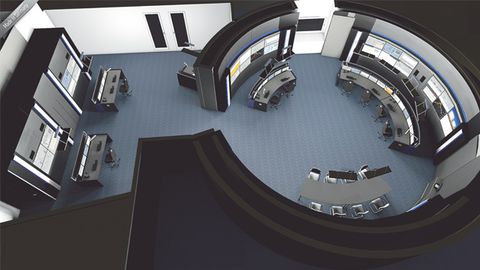
Within four weeks, JST's specialist staff installed the actual control room, including a separate anteroom for the energy workstations, and also set up a multifunctional room with a proactive monitor wall and a technical room.
© Jungmann System TechnologyFirst of all, the parties involved agreed on the location of the new central control room - and decided to expand the control room for the operation of energy networks and systems, as it was not only centrally located and equipped with the necessary basic technical equipment, but the conversion was also possible during ongoing operations. "There was also an unused water tower adjacent to the previous control room, which was easy to integrate structurally," explains Räcke. After some structural changes had been made inside the tower - for example, a new floor area and a new ceiling level were installed and a breakthrough was made to the previous control room level - JST's specialist staff installed the new control room, including a separate anteroom for the energy workstations, within four weeks and also set up a multifunctional room with a large screen wall and a technical room.
Optimal working conditions
In order to create pleasant working conditions for the system operators, a sophisticated climate, lighting and acoustics concept was implemented in the control room: "For example, we moved all the computers into the server room," explains Carsten Jungmann, Managing Director of JST. This has various advantages: You save space in the control room desk, which means more legroom for employees, and there is significantly less heat development as well as noise in the control room. In addition, special care was taken with the air conditioning to ensure that the plant operators are not exposed to draughts: The cool air flows in through ventilation grilles below the monitor wall, rises upwards and cools the screens before being silently extracted in the central ring of the acoustic ceiling. Employees are protected by the ergonomic, height-adjustable control room desks, which are flush with the floor. Humidity and temperature could be tailored to the needs of the plant operators and no longer to those of the outsourced technology.
As the control room is a room with only one window due to its location in the former water tower, it was also necessary to create pleasant daylight conditions. The workplace lighting, for example, is both functional - i.e. reflection-free - and flexibly adjustable for the personal comfort of the plant operator. "Brightness and color temperature can be changed so that each operator can individually adjust the lighting conditions in the control room to their needs," explains Räcke.
The acoustic ceiling was also specially adapted to the conditions: "Sound refracts much more often in a round room. The planning was therefore a particular challenge in terms of sound absorption, especially because lighting and air conditioning also had to be integrated into the ceiling," explains Jungmann. For example, JST also used sound-absorbing large screen wall cladding.
A total of five workstations were created in the new central control room: operational control, grid control, energy system and water systems 1 and 2. "This consolidation of all decentralized control rooms and the close proximity of the workstations has significantly improved direct communication between the responsible operators since commissioning," explains Räcke.
Fewer monitors thanks to multiconsoling
In addition, each plant operator is only responsible for four or six screens at the control room desk and four or eight screens on the large display wall - despite the large number of systems to be monitored. "Our employees manage a total of 120 sources," says the division manager. This task, which would normally require 120 monitors in the central control room, can only be managed efficiently because hardware and software specially developed by JST is used: multiconsoling correlates monitors - in other words, the system operator always gets the display he needs on one of his own screens. In the past, employees often had to walk from one workstation to another to check things and make settings. This is now also a thing of the past, as all system screens can be connected to the so-called multi-console, meaning that the operator can freely assign the screens according to his needs. The image display and keyboard/mouse operation takes place in real time, multiconsoling also transmits independently of the IP network and requires no additional software on the source computers.
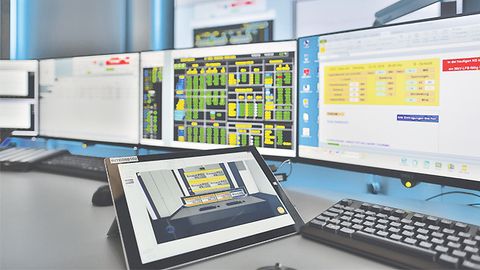
The MyGUI user interface - shown here on a touchpad - is helpful for flexible visualization and operation. It can be used to display all workstation consoles and the large screen wall as a control room image.
© Jungmann System TechnologyAnother key difference to other systems is that the four or eight panels on the monitor wall assigned to a plant operator are not only used to mirror the screens on the control room console, but can also be used to control the plants via mouse and keyboard. They are used in particular as an alerting tool, thus shortening response times. "The MyGUI user interface is also very helpful for the flexible visualization and operation of the various control systems," says Räcke. In this multiconsoling component, all workstation consoles and the large display wall are displayed as a 'control room image', i.e. as a 3D model of the control room. All the required sources are displayed on the left-hand side - the user can simply drag them onto the multi-console and operate them using customizable icons. This ensures reliable control, especially in stressful situations such as faults: "If a fault occurs, the plant operators need to find the relevant camera or plant images quickly in order to be able to rectify the problem," explains Jungmann. Other systems use hotkey commands, for example, but this is not practical with such a large number of sources. In MyGUI, on the other hand, certain alarm scenarios can be set up so that, for example, all relevant data in the power plant fault area can be displayed with a click of the mouse. A source list with moving preview images is displayed, which experienced control room staff can use to directly select the plants affected by the fault.
In total, around one and a half years were planned for the study, project planning and implementation of the new central control room. "A tight schedule, but one that was implemented on time thanks to the excellent cooperation between all project partners," says Räcke. In summary, ergonomic workstations have been set up for five plant operators, which are equipped with eight to 14 multi-consoles. Thanks to special multiconsole hardware, 120 video sources can be accessed on these consoles, which can be visualized and operated. The proactive large screen wall with a total of 28 screens in the control room and four in the break room does not reflect the workstations as usual, but can also be used to control the systems, saving a total of around 17 screens. The new central control room was officially commissioned in March 2016.
Currently, the work tasks at four of the five new alternating shift workstations are carried out by one operator in the central control room and several runners in the plant on site. While the operator monitors and controls the energy and water systems, the runner carries out scheduled on-site plant inspections and event-related checks under the direction of the operator.
Example of water systems
The water systems, for example, which Infraleuna previously operated and monitored from three decentralized control rooms, can now be completely controlled from two workstations in the central control room. The site operator is also continuing to work with JST - for example on the maintenance of the new central control room: "We have therefore committed to isolating any problems within 60 minutes and rectifying them completely within twelve hours," says Jungmann.
Author:
Anja Meier is responsible for Public Relations at Jungmann Systemtechnik.


You might also be interested in
Double security through redundancy
The 'Safety Key' from Hy-Line allows the simple integration of safety-relevant switches in glass displays.
 read more...
Operation via touch, glove, pen or digitizer
Getac launches the next generation of 'F110' and 'K120' tablets: The new F110 is suitable for use in a variety of harsh outdoor and indoor scenarios.
read more...Flexible visualization
'Prime Panel Touch' and 'Prime Panel Extend' from Schubert System Elektronik (SSE) are suitable for sophisticated visualization concepts in industry.
read more...Support arm panel expands portfolio
The 'TT 1564' multi-touch operating panel for mounting arm installation extends the Sigmatek range.
read more...Managing Board expanded
Kontron expands its Management Board with Philipp Schulz and Dr. Johannes Fues. As COO, Schulz will be responsible for the Aerospace and North America business units, while Dr. Fues will assume the position of COO for the GreenTec business unit.
read more...Tablet for the Ex area
With the 'Pad-Ex 01 P12', Pepperl+Fuchs is launching a new tablet for professional use in potentially explosive atmospheres in Zone 2/22, Division 2.
read more...Modular embedded touch HMI
Irlbacher, provider of free-form touch solutions, has a new solution kit for modular embedded HMIs.
read more...Control elements that can be used for security
The control element PIToe ETH with activatable Ethernet port from Pilz protects freely accessible Ethernet interfaces in industry against unauthorized access.
read more...Control panel series updated
Kontron has developed a new generation of its Control Panels which, thanks to the more powerful Arm NXP i.MX8M Plus processors, provide a significant performance boost compared to previous models.
read more...