
SCADA systems
The water protection wall
Gigantic barrages are to protect Venice from high tides in the future. SCADA software is helping with the construction work: the structures, which weigh several tons, can be positioned on the seabed with millimetre precision.
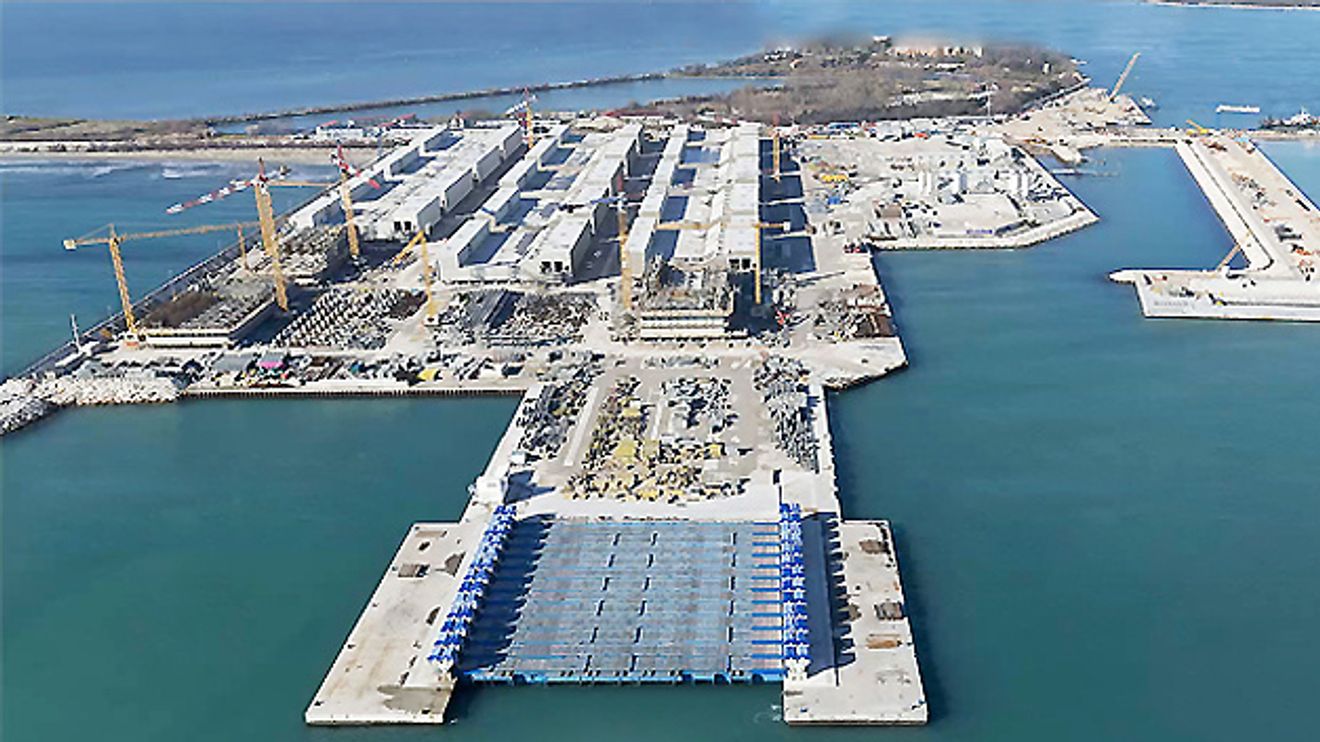
One of the construction sites for the project: In the background are the caissons, which are placed on the seabed with the help of pontoons (foreground).
© Progea SRLThe construction of a series of movable barrages at the three lagoon mouths of Lido, Malamocco and Chioggia is intended to protect Venice from tidal flooding and storm surges: In an emergency, the Venice lagoon can be sealed off from the Adriatic Sea. The MO.S.E. project is a public ecological hydraulic engineering project that has not yet been completed. Together with other measures such as coastal weirs, the raising and fortification of the shore area and the redesign of the lagoon itself, MO.S.E. (modulo sperimentale elettomeccanico) aims to protect Venice and its lagoon against flooding up to a height of three meters above normal level. The system is currently in operation during tidal floods of over 110 cm.
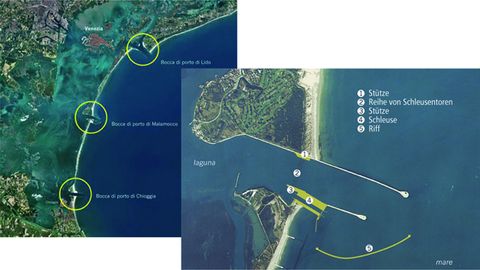
The barriers (bottom right in the picture) are being built at the mouths of the ports of Lido, Malamocco and Chioggia (top left in the picture).
© Progea SRLThe MO.S.E. project includes four flood barriers consisting of a total of 78 movable, independently functioning flood gates: two barriers with 21 and 20 flood gates respectively off the northern and southern Lido inlet and two further barriers connected by an artificial island at the Malamocco inlet (with 19 gates) and the Chioggia inlet (with 18 gates).
The movable tide gates are steel boxes that are invisible during normal tides because they are filled with water and rest in the caissons on the seabed. Each gate is attached to the caissons with two hinges. The water can be displaced with compressed air so that the gates rise up and form an inclined dam towards the Adriatic Sea, where they align themselves independently of each other with the movement of the waves. In this way, the tide gates can maintain the respective tidal difference between the lagoon and the open sea.
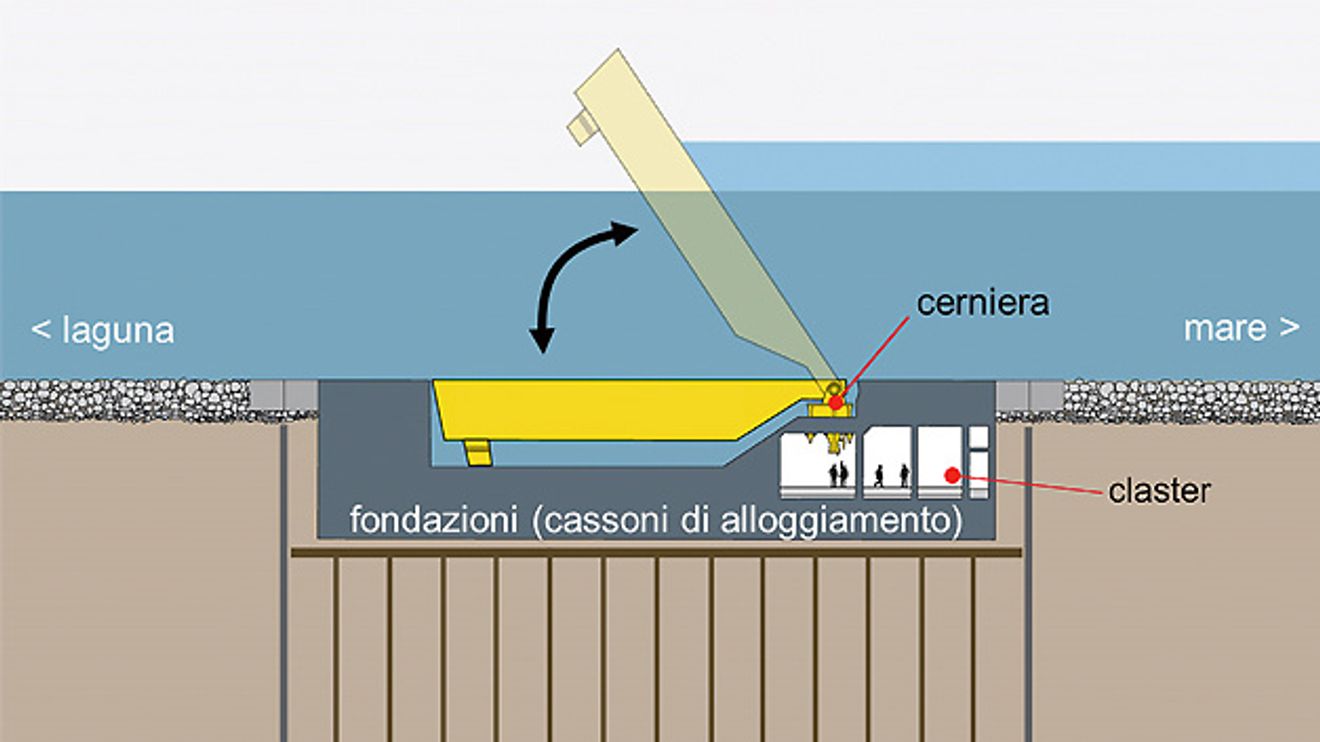
Threshold and shoulder boxes
The flood gates and the caissons are the two main components of the MO.S.E. system. The sill and shoulder caissons are concrete blocks that are positioned and partially anchored in trenches dredged under the sea. These concrete blocks vary in size depending on the length of the flood gates they are intended to accommodate and the depth of the respective lagoon inlet: the smallest at the Lido inlet measures 60 m × 36 m × 8 m, the largest at Malamocco 60 m x 48 m × 11.55 m.
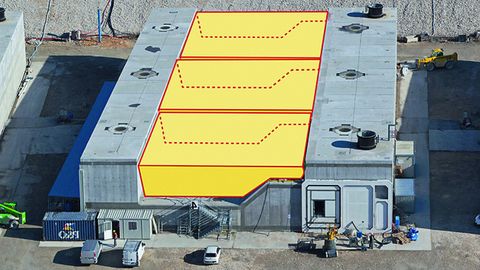
Lined up next to each other, the sill caissons form the flood barrier of the respective inlet. The shoulder caissons form an interface between the sill caissons and the mainland to which they are anchored. The prefabricated caissons contain cavities that are either filled with water and/or cement or left empty - for example as access shafts for maintenance work. The shoulder caissons are the most impressive constructions: At Malamocco, for example, they are 28 meters high with a base area of 60 × 24 m².
The requirements
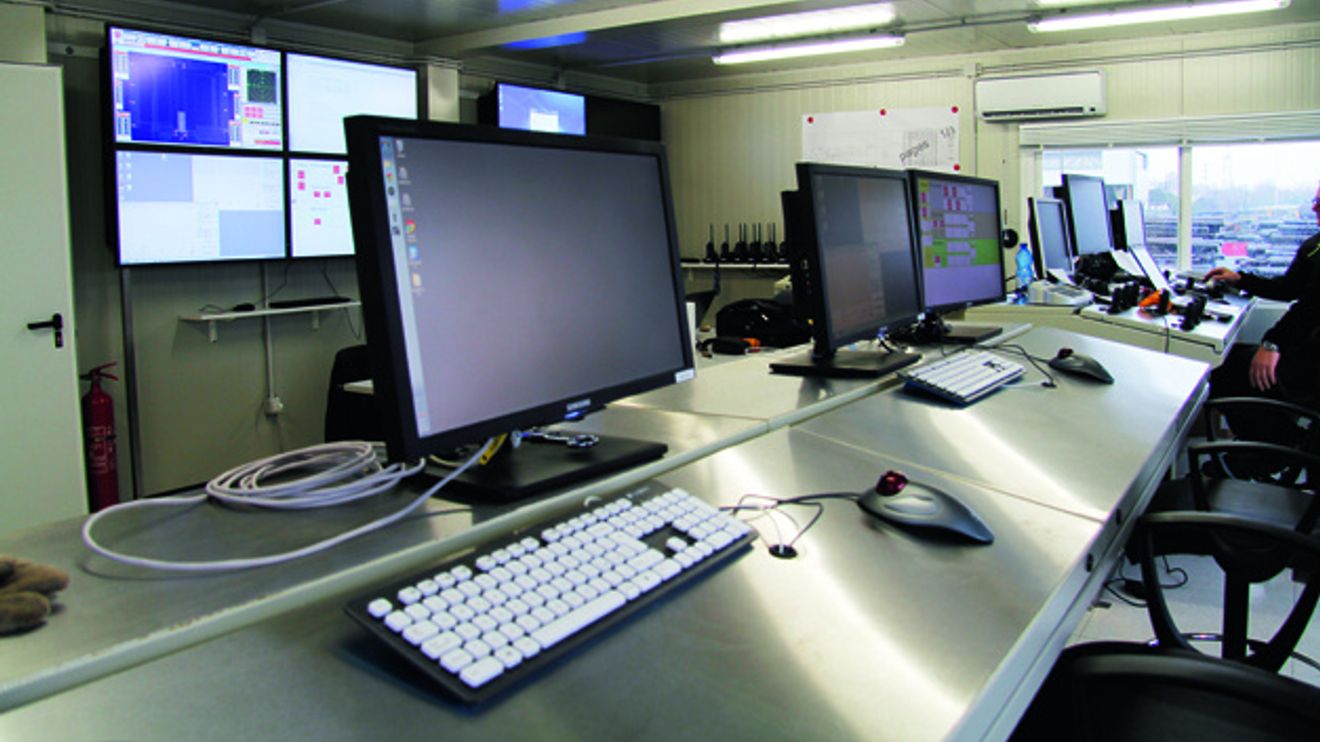
To anchor the caissons to the inlets, the Italian company Eureka System Srl - a Movicon system integrator and solution provider - planned, developed and designed an automation system. The solution was to cover the following tasks:
- Dynamic assembly of the sill lowering boxes with the aid of winches (cable winches).
- Lowering the sleeper caissons to the seabed using lifting platforms with stability control.
- Watertight placement of the sleeper caissons next to each other with control of the sealing density.
- Leveling of the two shoulder caissons sunk at the beginning and end of the flood barrier with the adjacent sill caissons.
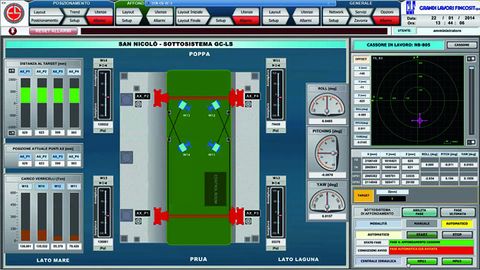
Various graphics and parameters for the exact positioning of a caisson - implemented with Movicon
© Progea SRLThe following principle was used for the application: The caissons are prefabricated concrete boxes that are empty or partially filled with ballast so that they remain buoyant and can therefore be transported using tugs. The caissons can be lowered to their predetermined positions and filled with ballast according to type and requirements.
This is where 'Movicon 11' comes into play: the HMI/SCADA system ensures that the caissons remain stable in a horizontal position when filling the various cavities. A pontoon - a floating body that is usually firmly anchored and acts as a water-level-dependent carrier - has the task of filling the caissons with ballast. It is equipped with battery-operated silos that feed cement into the cavities.
The monitoring solution also uses the ballast filling system to control the buoyancy and buoyancy of the pontoon. This is because the pontoon is also equipped with ballast tanks that are emptied and refilled depending on the buoyancy fluctuation registered on board. Emptying and refilling the silos with cement causes considerable weight differences, which could cause the pontoon to capsize in extreme weather.
Positioning the caissons
With the help of another pontoon (pontoon 1), the process of placing the swell caissons is also carried out. These caissons also have cavities that are gradually filled with ballast - so that they can no longer float without the help of winches. These winches can then be used to lower the caissons. This system is called 'Dynamic Winch Positioning'; it is the only one of its kind in Italy. This method is used because the caissons have to be lowered and positioned with a precision tolerance of +/-25 mm. It is a tricky game of weight and balance that is performed here with caissons of enormous size and mass. The SCADA system in conjunction with a computerized sensor system shows the exact depth and position of the caisson at any given time.
The most difficult challenge is the positioning of the next caisson, for which the positioning system is monitored telemetrically both on site and in the offices in Treviso, a good 30 km away.
The system architecture
Eureka System designed, developed and supplied a control system for the two pontoons based on the SCADA software solution 'Movicon 11.4 SCADA' from Progea. This solution uses a server and three clients, installed on the VMware solutions 'Vsphere Hypervisor 5' and Horizon-View as well as domain controllers with Win-Server-2008-R2-64bit system and corresponding virtual computers with a 64-bit Win7Pro operating system.
Pontoon 1 for placing the caissons has the most complex system. It was equipped with five local HMI workstations with zero-client monitors, which are connected to the hypervisor. It uses the PCoIP protocol and two 2x2 matrix video wall systems with 46-inch displays and monitoring screens that mirror the HMI workstation displays connected through the lagoon's Wi-Fi network. In addition, remote access to this system is possible through VPN and the
Internet - using 4G phone cards.
The virtualization of the entire ICT infrastructure of the control center makes it possible to create a monitoring system with completely hardware-free front-end stations that can be centrally managed for backups, system upgrades, remote maintenance and UPS concerns.
The implementation with 'Movicon' partly extended the usual standard techniques to implement graphics such as bar charts, gauges and trends. The careful structuring of the MS-SQ database in combination with event management balanced the load between the PLC and HMI, allowing all information to be logged historically. "At the same time, this procedure - similar to a 'playback' - met the need for post-operative analysis," says Eros Contò of Eureka System: "Thanks to the design miracle of the floating pontoons, the contractor's technicians were able to position 22,000-ton caissons 25 meters underwater with millimeter precision by controlling each work step from the control room."
Authors:
Markus Stadelhofer is Managing Director at Progea Germany;
Eros Contò is employed by Eureka System SRL.


You might also be interested in
New Managing Director at Bachmann electronic
Bachmann electronic has appointed Daniel Pfeifer as its new Managing Director with effect from January 1, 2026. He succeeds Bernhard Zangerl, who will be leaving the company.
 read more...
Dual leadership in Shanghai
Stefan Becker has been appointed Managing Director of Eckelmann Automation Technology in Shanghai and will manage the subsidiary together with Zhongwei Huang.
read more...Secure data management in the cloud
Bachmann presents new functions of the platform-independent visualization solution 'atvise': Thanks to container operation and a consistent client concept, the solution can now also be used securely as a higher-level IoT (Internet of Things) service.
read more...Automated detection of damage to trains
No more overlooked damage: A project team at TH Wildau has optimized the inspection of passenger trains using AI-supported computer-visual techniques. The results of the "ESPEK" project are summarized by the research partners.
read more...Support arm panel expands portfolio
The 'TT 1564' multi-touch operating panel for mounting arm installation extends the Sigmatek range.
read more...Tablet for the Ex area
With the 'Pad-Ex 01 P12', Pepperl+Fuchs is launching a new tablet for professional use in potentially explosive atmospheres in Zone 2/22, Division 2.
read more...Keyboards with glass surface
Ateg offers capacitive PC keyboards with a glass surface from the French manufacturer Tactys. The glass of the user interface is made of 3 mm thick, hardened white glass, which is robust against mechanical influences.
read more...The golden mean
What to do with vision applications that are too complex for rule-based image processing on the one hand, but too simple to justify investing in a full deep learning solution on the other? One option is machine learning 'at the edge'.
read more...HMI in the assembly line modernized
Swedish packaging manufacturer Kinnareds Well has modernized its human-machine interfaces in the assembly line with Rockwell Automation partner Hax Technologies. The aim was to improve productivity and user-friendliness.
read more...