
Apps
The app store for the industry
Apps are also becoming increasingly interesting for companies. However, one important element is still missing to achieve the final breakthrough: A suitable app store to make applications available to both customers and employees.

Apps for entertainment, apps to increase productivity in the office, health and fitness apps or educational apps for children - for most smartphone users, there is only one place to browse and buy: The Apple App Store (iOS) or the Google Play Store (Android).
Before the applications are made available in the app stores, Apple and Google carry out intensive and automated analyses of the app codes in order to minimize the distribution of malicious code. In addition, manual tests are carried out on each app to verify the app's value proposition, identify crashes and ensure compliance with design guidelines. This ensures high-quality apps and encourages users to pay for them. A certain status of excellence is evoked among app developers. A sales commission of 30% of the sales price is payable for paid apps.
There are no plans to issue volume licenses or maintenance contracts, nor is it possible to restrict access rights. On the contrary: according to the guidelines of the Apple App Store, for example, individual users may not be excluded from using the app. This is intensively checked by Apple during the review process. In addition, once installed, apps can only be deleted by the user themselves and not remotely.
Public app stores are therefore not at all suitable for the distribution of individual apps. It would only be possible for a manufacturer of series machines to offer all customers the same additional services in the form of apps and distribute these via public app stores.
Special features of the industry
In contrast to living room and leisure use, different rules apply to the use of apps in industry. In principle, the following requirements can be established for app stores for corporate needs:
- Licensing/monetization:
Unlike in the consumer market, topics such as maintenance contracts and volume licenses are of interest in industry. A maintenance contract guarantees the customer the elimination of errors in the application and grants him a certain level of support. Volume licenses grant a customer a discount if he has purchased a certain number of licenses. - Confidentiality/authorization
Not every employee and certainly not the entire public may be offered certain apps for installation. It must be possible to regulate the allocation of access rights at this level. - Employee lifecycle
Employees come and go. If a new employee joins, they must be able to install the necessary apps according to their role. If an employee leaves, it must be possible to automatically remove the installed apps remotely. If employees are assigned new tasks and responsibilities as part of their employment, this may also affect the number of apps that can be installed.
Apple also offers products that meet some of these requirements: Non-public versions of its app store for distributing business applications and mapping customer relationships. Unfortunately, Google does not offer anything comparable.
The Apple B2B program is available to every iOS app developer. Companies can use it to define customer relationships and issue volume licenses. However, the prerequisite is that the business partners are also registered with Apple.
The Apple Enterprise In-house model enables the distribution of apps within a company. This model requires separate registration and a more expensive membership of the Apple Developer Program. In return, however, Apple allows apps to be hosted on a company server - bypassing the Apple App Store - and made available to the company's own employees and partners. A review of the apps by Apple and the associated delay in the publication of apps is thus completely eliminated. The process for distributing apps can be significantly streamlined and accelerated. However, Apple's terms and conditions prohibit the distribution of apps beyond the boundaries of the company or its corporate partners. Mapping supplier-customer relationships with the Apple Enterprise In-house model is possible, but time-consuming.
Mobile Device Management
Mobile device management (MDM) solutions, which are usually based on the enterprise in-house model, have established themselves particularly for the realization of the employee lifecycle. A complex client-server infrastructure is provided for this purpose. Employees and apps as well as the relationships between them can be managed via a management dashboard. Apps can be installed and uninstalled remotely and apps from public app stores can also be whitelisted and blacklisted to prevent the use of Facebook, for example.
The problem: MDM solutions are comprehensive tools that are designed to meet the requirements of multinational corporations. As a result, they are enormously complex, and mastering them is a full-time job that requires a great deal of expertise.
The company store
Back to the actual requirement: a machine or plant manufacturer wants to provide an app directly on its customers' mobile devices. Monkeyworks offers a service that has already been made available to the first users of the 'HMI Suite Workbench' (see box) for initial projects: the 'Monkeyworks Cloud' consisting of a 'Build Cloud' and a connected store. The first users are project partners and customers of Monkeyworks.

Screenshot of the customer view of the store. The customer only sees the apps for which they have been activated.
© Monkey WorksProjects created with the 'HMI Suite Workbench' can be uploaded to the 'Build Cloud'. There, ready-to-install apps are automatically and transparently produced from the source code projects and immediately uploaded to a private store provided by Monkeyworks. Just a few minutes later, the customer receives a message that their app is ready for installation. Each Workbench customer receives their own store, in which they are the administrator and which they manage themselves. Users and apps can be managed in the administration area of their own store using web forms. For example, users can be assigned to groups - such as 'Maintenance' and 'Operation' - and apps can be activated or blocked for individual or multiple groups. Users in the 'Operation' group can therefore only see the apps in the respective group.
Comprehensive statistics allow industry-compatible billing models and mobile device management functions - such as forced updates or the exclusion of an employee. Important logs can be viewed in the administration area of your own store - for example, which user has installed which app on which device from which location in the world and at what time. This allows companies to generate usage statistics that can form the basis for billing. Control mechanisms can also be displayed, for example to identify improper use and initiate measures. If a user has to be excluded due to such misuse or when they leave the company, an administrator can revoke their access rights. Although the excluded employee still has the app installed, they will no longer see any data when using the app. Updates to this app and the installation of other applications are no longer possible. Android and iOS apps can be built and distributed equally via the 'Monkeyworks Cloud'.
The 'Monkeyworks Cloud' is still in its infancy, but it already shows that industrial solutions can be just as simple as those that we have come to appreciate in our private lives, for example through Apple, and that we can no longer imagine life without.
Author:
Dr. Stefan Hennig is Managing Director and Technical Director at Monkey Works
The requirements in practice
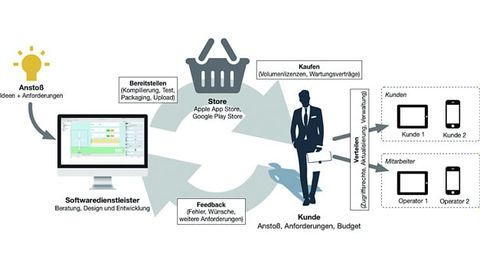
A series machine manufacturer plans to provide its customers with a universal app for commissioning and diagnosing its machines. He commissions a software service provider to develop and maintain the app. In addition to developing the app for Android and iOS, the service provider is responsible for making the apps available in the respective app stores. This requires corresponding developer accounts, the creation of certificates and an extensive process for publication in the app store - for both iOS and Android. Customers of the series machine manufacturer download the app from the app store and can get started immediately.
It is difficult when customers of the series machine manufacturer want individual apps or special machines require individual adaptations of the apps. In this case, the process described above must be run through for each customer or project. It is then neither possible nor desirable to distribute the apps in a public app store.
The HMI Suite Workbench

The 'Build Cloud' from Monkeyworks with connected store enables the distribution of apps.
© Monkey WorksWith the 'HMI Suite Workbench' from Monkeyworks, mobile HMIs can be created quickly and easily and used as native apps for iOS and Android. At first glance, the workbench looks like a normal HMI designer. Engineers design their mobile industrial app in a graphical editor and then parameterize process data and alarms. The workbench also takes into account the various device types on which the industrial app is to be used - for example smartwatches, smartphones and tablets. The workbench contains export modules that convert the created HMI designs into platform-specific source code for iOS and Android at the touch of a button, which can then be executed as a native app immediately after compilation on the respective end device. Manual programming work is not necessary.


You might also be interested in
Double security through redundancy
The 'Safety Key' from Hy-Line allows the simple integration of safety-relevant switches in glass displays.
 read more...
Operation via touch, glove, pen or digitizer
Getac launches the next generation of 'F110' and 'K120' tablets: The new F110 is suitable for use in a variety of harsh outdoor and indoor scenarios.
read more...Flexible visualization
'Prime Panel Touch' and 'Prime Panel Extend' from Schubert System Elektronik (SSE) are suitable for sophisticated visualization concepts in industry.
read more...Support arm panel expands portfolio
The 'TT 1564' multi-touch operating panel for mounting arm installation extends the Sigmatek range.
read more...Managing Board expanded
Kontron expands its Management Board with Philipp Schulz and Dr. Johannes Fues. As COO, Schulz will be responsible for the Aerospace and North America business units, while Dr. Fues will assume the position of COO for the GreenTec business unit.
read more...Tablet for the Ex area
With the 'Pad-Ex 01 P12', Pepperl+Fuchs is launching a new tablet for professional use in potentially explosive atmospheres in Zone 2/22, Division 2.
read more...Modular embedded touch HMI
Irlbacher, provider of free-form touch solutions, has a new solution kit for modular embedded HMIs.
read more...Control elements that can be used for security
The control element PIToe ETH with activatable Ethernet port from Pilz protects freely accessible Ethernet interfaces in industry against unauthorized access.
read more...Control panel series updated
Kontron has developed a new generation of its Control Panels which, thanks to the more powerful Arm NXP i.MX8M Plus processors, provide a significant performance boost compared to previous models.
read more...