
Process control technology
Six locks - one control station
A height difference of 55 meters over a length of 91.3 kilometers - six barrages ensure smooth shipping traffic on the Saar. When modernizing the process control technology, the engineers opted for an open HMI/SCADA solution.
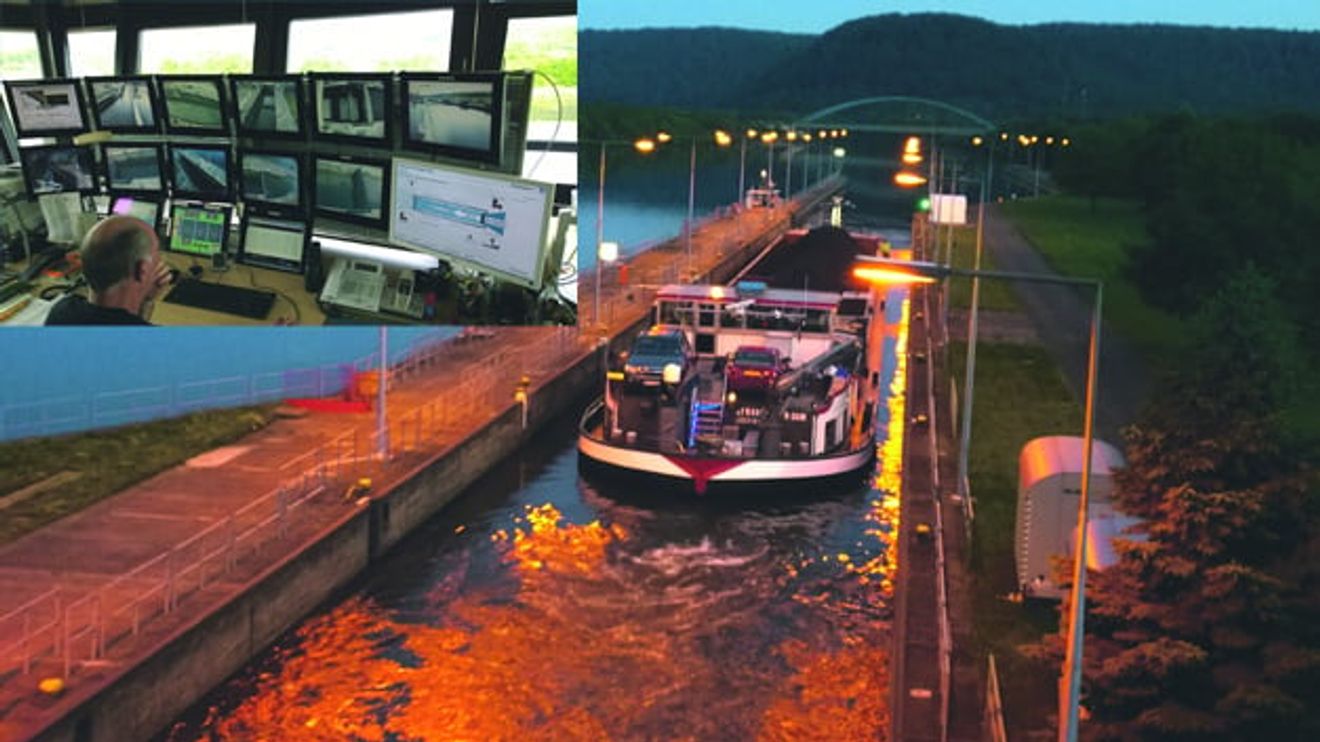
As both passengers and valuable goods are transported on inland waterways, the Federal Waterways and Shipping Administration (WSV) placed the highest demands on the safety and reliability of the process control technology. Control technology failures and operating errors were to be avoided at all costs. In a comprehensive set of specifications, the specialist mechanical engineering department in Koblenz therefore defined exactly which criteria the process control technology had to meet and how its visualization should be structured.
A lifting height of 14.50 m, a filling volume of the chamber of around 36,000 m3 and a filling time of 10.2 minutes - these are the technical parameters of the Serrig large navigation lock on the Saar. Alongside Kanzem, Mettlach, Rehlingen, Lisdorf and Saarbrücken, this is one of a total of six barrages that compensate for a height difference of 55 m on the 91.3 km long stretch between Saarbrücken and where the Saar flows into the Moselle near Konz.
The barrages with their weirs, locks and power stations built along the river as part of the Saar expansion are currently being modernized and the switchgear, some of which is 30 years old, is being replaced. As part of these modernization measures, the automation technology is also being brought up to date. One of the aims of the measure is to enable remote operation from a central control station.
The Federal Waterways and Shipping Administration (WSV) awarded the contract for the development and installation of the central and decentralized process control technology with a volume of around 1.6 million euros to the Meschede-based process control technology specialist HST Systemtechnik as part of a tendering process.
High requirements
In addition to the high demands on the safety and reliability of the process control technology, another challenge of the project was the tight schedule. The Saarbrücken Waterways and Shipping Authority (WSA) planned one week of navigation closures per lock for the conversion of the technology. These closures were scheduled five years in advance to make planning easier, especially for commercial shipping. This meant that HST had to install and commission the control technology in each lock precisely within this predefined, narrow time window.
Complex processes
The project itself was also complex. Each of the six locks has between 2,500 and 4,500 process variables to be processed, depending on their size, and the central control station set up in Mettlach even has around 15,000. Data consistency was the crux of the networking, as the data from the individual local servers had to be displayed as an image in the control station on call and correctly linked to the control commands entered there. Despite the large number of shunting operations, no misrouting must occur during the transmission of commands.
"The system control of interlocks is much more complex than is generally assumed. The commands 'gate open' / 'gate closed' or 'water in' / 'water out' are not enough. For example, the heating of the lock gates, the inflow of air to remove deposits on the riverbed, the hydraulic pumps, the traffic lights for the ships and the video transmission of the surveillance cameras all have to be controlled," explains Uwe Frigger, Head of Products IT & Automation at HST.
Visualization of the process data
For the implementation, HST implemented the central and decentralized control technology for the WSA using the 'ScadaV10' (HydroDat) process control system developed on the basis of 'Visiwin 7'. This system visualizes all process data, enables graphical process analysis and includes complete alarm management.
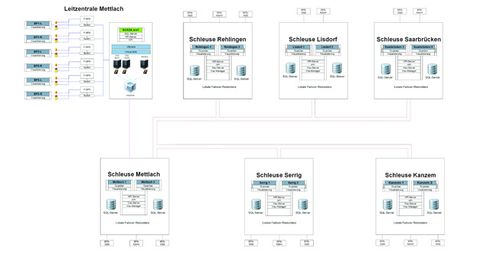
The entire process control technology is redundant, and the six airlocks can be controlled both centrally from the control center in Mettlach and locally.
© InosoftFor security reasons, both the server structures in the control center in Mettlach and the local structures in the six locks are set up redundantly. For the same reason, the locks can be controlled not only centrally via the control center, but also locally from the respective lock control room. Data is transmitted between the individual locks and the control center via a fiber optic cable.
The visualization of the process control technology plays a central role in this project. On the one hand, the operators can monitor and control each of the six locks from any of the six workstations in the control center in Mettlach. This means that they can call up the airlock to be operated on the screen as required. It is extremely important that the data link works reliably so that video and audio signals or lock stop commands arrive at the correct lock. On the other hand, HST designed the user interface of the interlock operators to be so simple and reliable that no operating errors are possible. This means, for example, that functions that are currently not allowed to be operated are not offered or displayed to the operator.
Flexible developer tool
In order to be able to implement the high demands on the visualization of the process control technology, HST built it on the 'Visiwin 7' software from Inosoft, which gives the programmer great freedom in individual design. It is based on the .NET technologies WPF and Windows Forms from Microsoft as well as HTML 5. Due to its openness and the use of standard tools, the software is suitable as the basis for the 'Scada V10' system. Visiwin 7 provides a modular system with typical HMI/Scada software functions (process communication, data recording, alarm management, plant logbook, user management). Scada V10 expands this modular system with specific functions that HST requires for its own projects and for its customers in the water and wastewater industry, such as wastewater pumps or aeration tanks. In this project, for example, these are signaling systems as well as sluice chambers and gates.
A major advantage of the Visiwin platform is that users already working in a Microsoft environment can seamlessly integrate the software into tools such as Visual Studio. In the current version, it is possible for developers to remain completely in their familiar Visual Studio programming environment after creating a new project in Visiwin. This is because all editors for the project configuration, the relevant process data and Visiwin definitions are integrated in Visual Studio.
Thanks to Visiwin 7's freedom of development, HST was able to implement application-specific requirements from WSV's specifications, such as the plastic representation of the airlock gate when opening and closing - also because the software enables the design of high-quality graphic elements such as transparency effects, color gradients, 2D and 3D animations and the display of multimedia content using standard tools such as 'Blend' and 'Visual Studio' from Microsoft. In addition, the display could be implemented as a pure visualization without any Windows functions displayed, so that the lock operators cannot, for example, accidentally click on the 'Shut down' button or non-application programs.
Seven lock chambers at the sites in Mettlach, Rehlingen, Serrig and Saarbrücken have now been converted to the new technology. The remaining four will follow by the end of 2017.
Free ride
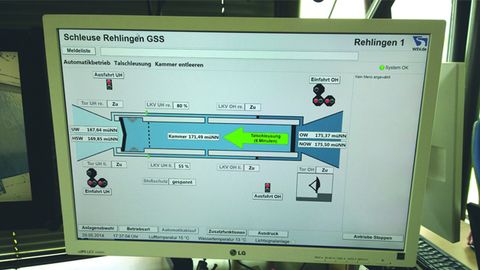
Thanks to the visualization solution based on Visiwin 7, the operators in the local control rooms in Serrig, Mettlach and Rehlingen can already control and monitor the modernized locks around the clock every day. The user interface contributes to smooth operation and maximum safety.
"Implementing the complex process control technology with the required high availability and in compliance with the tight schedule was a real challenge. Visualization was the central issue during the modernization. Without Visiwin 7 as the platform for our visualization concept, we would not have been able to implement the WSV's strict design specifications so easily," says Uwe Frigger, Head of IT & Automation Products at HST.
Author: Stefan Niermann is Key Account Manager at Inosoft.


You might also be interested in
Double security through redundancy
The 'Safety Key' from Hy-Line allows the simple integration of safety-relevant switches in glass displays.
 read more...
Operation via touch, glove, pen or digitizer
Getac launches the next generation of 'F110' and 'K120' tablets: The new F110 is suitable for use in a variety of harsh outdoor and indoor scenarios.
read more...Flexible visualization
'Prime Panel Touch' and 'Prime Panel Extend' from Schubert System Elektronik (SSE) are suitable for sophisticated visualization concepts in industry.
read more...Support arm panel expands portfolio
The 'TT 1564' multi-touch operating panel for mounting arm installation extends the Sigmatek range.
read more...Managing Board expanded
Kontron expands its Management Board with Philipp Schulz and Dr. Johannes Fues. As COO, Schulz will be responsible for the Aerospace and North America business units, while Dr. Fues will assume the position of COO for the GreenTec business unit.
read more...Tablet for the Ex area
With the 'Pad-Ex 01 P12', Pepperl+Fuchs is launching a new tablet for professional use in potentially explosive atmospheres in Zone 2/22, Division 2.
read more...Modular embedded touch HMI
Irlbacher, provider of free-form touch solutions, has a new solution kit for modular embedded HMIs.
read more...Control elements that can be used for security
The control element PIToe ETH with activatable Ethernet port from Pilz protects freely accessible Ethernet interfaces in industry against unauthorized access.
read more...Control panel series updated
Kontron has developed a new generation of its Control Panels which, thanks to the more powerful Arm NXP i.MX8M Plus processors, provide a significant performance boost compared to previous models.
read more...