
HMI devices
Operate with 3D gestures
The first 3D touchscreens are now entering the market. How does this new generation of HMIs work? What advantages does it offer? And finally, where can it be used? A technological overview.
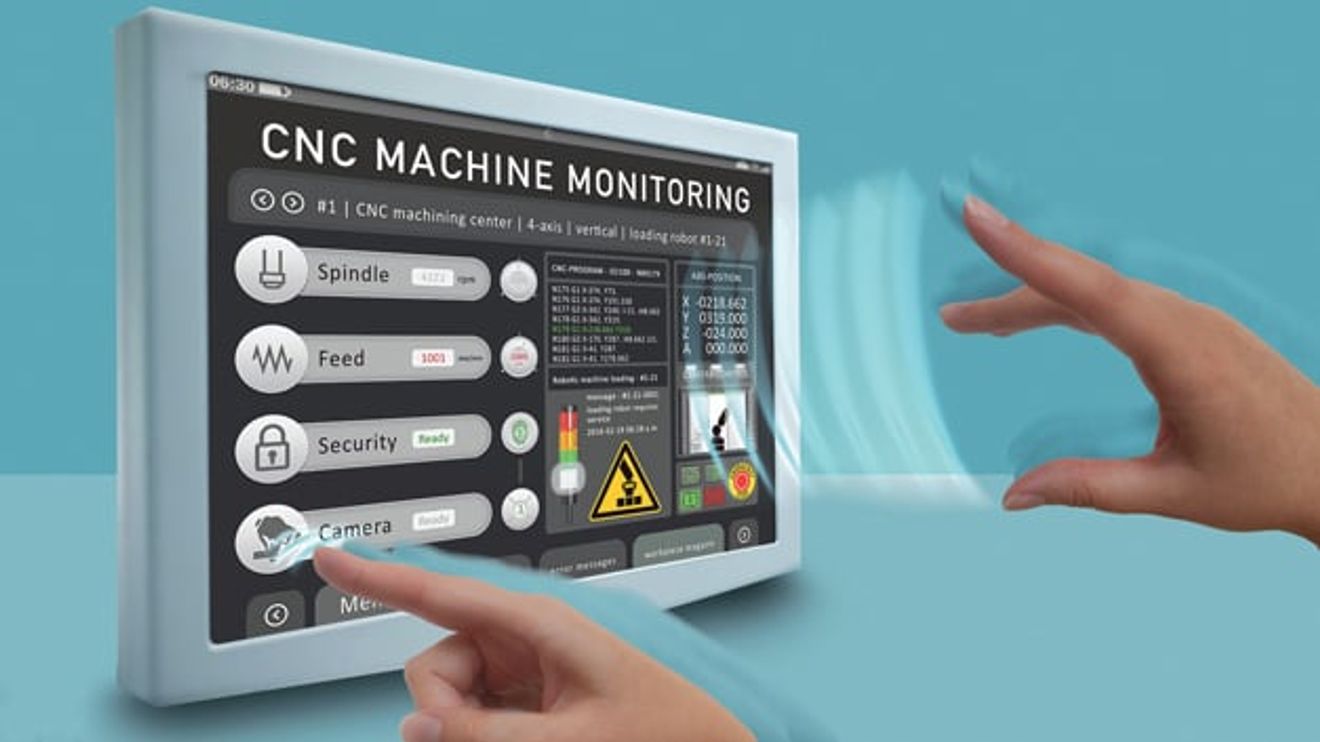
Now that conventional touch systems have established themselves on the market, a new generation of HMI systems is already being tested: various global players are currently working on different implementations of a 3D touchscreen. Here too - as with conventional touch systems - the market was driven by the mobile sector. One approach was hovering, which allows the 'cursor' to be moved without actually touching the touch surface. The Z information is evaluated, i.e. the distance from the finger to the screen. The maximum distance is a few centimeters in the single-digit range. However, the advantages over conventional touch input have not been made convincingly clear to the consumer by the manufacturers. In addition, there is often a lack of meaningful software support to generate added value.
Another manufacturer from the mobile sector even declares its product as 3D touch, although no input at a distance from the cover is possible here. On the contrary, a mechanical deformation of the lens relative to a second plane on the back is measured. This makes it possible, for example, to generate a right-click with a finger without any time delay. The inevitably thin and therefore fragile, deformable cover lens is not tolerated in most industrial applications. Pure distance sensors (proximity), which operate via an IR LED, for example, cannot achieve the required distance and complexity of gesture detection, or are very complex to construct. They are also relatively easy to disrupt in their function if, for example, an additional IR source comes into play. Camera-based solutions usually require an opening in the printing of the cover lens. In addition, the financial outlay for integration and image analysis (processing power) is considerable.
3D touch in the industry
A touch used in industry that evaluates 3D must avoid all the disadvantages of the above-mentioned approaches. Ideally, it should be able to cope with thicker front screens and also be operable with gloves. The aim is for hand recognition to work at a greater distance from the display. The system must also work robustly, even if it is coupled in via the supply lines or a field noise. DIN 61000-4-x should be mentioned here in particular. One potential candidate is a touch controller from Silicon Integrated Systems (SIS) in combination with GestIC technology from Microchip. The pairing offers an intuitive solution that is scalable in terms of operating complexity. The aim here is not so much to completely replace the classic 2D touch, but to expand it to include the third dimension. Many inputs are still made with the finger on the display, but other functions can be called up directly via gesture control, floating freely above the display.
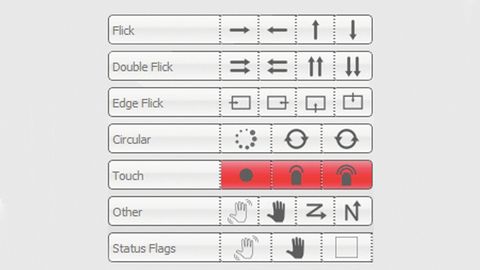
Currently possible 3D gestures are shown in the image. The 'flick' is the three-dimensional counterpart to the movement that is usually used to switch between images on the smartphone. The 'edge flick' gesture is also very similar, with the only difference being that the gesture starts outside the image area and must end inside. Circular movements are also recognized effortlessly. It is important to note that the center of mass is always decisive for recognition. For example, a circling finger with a stationary hand above it may not be detected, or only sluggishly, although fast detection is possible if another finger is added. N- or Z-shaped movements can also be detected with a very good recognition rate among many other gestures. However, it is advisable to deactivate all gestures that are not required for input so that misinterpretation is minimized.
One example of an application with great potential in the near future is the car radio. Here, flick gestures from right to left (steering wheel on the left) will not be a good idea. This is because in most cases the hand is first moved past the sensor from left to right, triggering an unintentional flick gesture. However, practice shows that the desired gestures are triggered in most cases after a short familiarization phase. All gestures are stored as a profile in the firmware. If a movement pattern resembles a profile with sufficient accuracy, the gesture is communicated by the controller. In all other cases, the gesture is discarded.
Distance up to 35 cm
In addition to the actual function of gesture recognition, the 3D touch can also be used for proximity recognition. It is also possible to determine the relative coordinates in three-dimensional space. For example, several icons on the desktop can be positioned one behind the other to save space or grouped together. Up to 200 positions per second are currently recognized and the spatial resolution is 150 dpi.
The maximum possible distance of the hand to the touch is roughly determined by the geometry of the electrodes, the boost voltage (3 to 18 V) of the transmitting electrode (Tx), the earthing concept and the permitted gestures. With a grounded 30.74 cm (12.1 inch) touch and a 'hold' gesture (hand static in front of sensor), up to 35 cm is possible.
The functional principle is a mixture of Mutal Capacitive and Self Capacitive. One transmitter (Tx) and four or five receiver (Rx) electrodes are required. In combination with a 2D touch, the 2D touch can also be used as a Tx if the 2D controller allows it or if boost chips are used. The Rx electrodes are usually grouped around the 2D touch as a printed circuit board. However, other materials are also conceivable, as the design rules offer scope for flexibility. A simple test setup would even be possible with copper tape on a glass pane. For the industrial approach, a GND shield should definitely be placed behind the Rx electrodes at a distance of around 1 mm to keep disturbing noise largely out of the system. This requires two to three layers. The 3D chip continuously detects the noise level. If necessary, it can then adjust its operating frequency independently. Five candidates are available for this, which are permanently programmed into the firmware. Individual frequencies can also be deactivated by the software. This and other internal algorithms stabilize the system so that the typical automotive and industrial EMC requirements can be met with a reasonable setup.
Automatic calibration
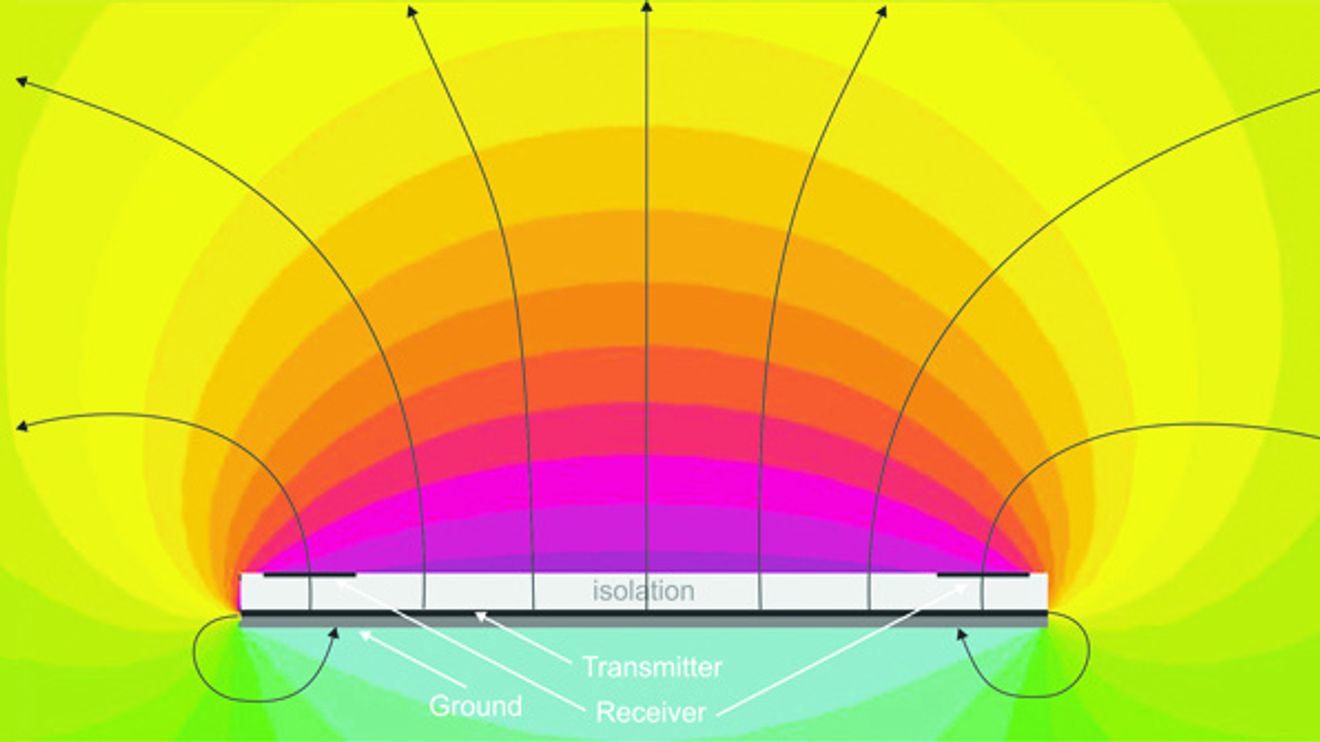
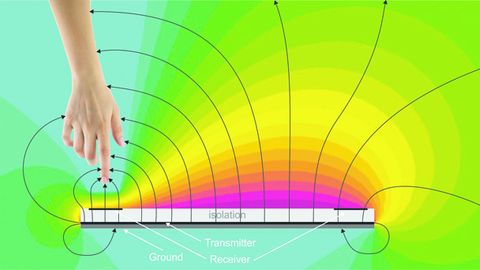
Conductive objects - such as the hand - influence the E-field of the 3D sensor. Here, the E-field in the undisturbed and ...
© Microchip TechnologyAnother advantage is certainly that the signals do not contain any electromagnetic components, i.e. a pure E-field is created. Conductive and possibly earthed objects influence the E-field of the 3D sensor - an effect that makes detection possible in the first place. However, it is often unavoidable that there are other conductive objects in the immediate vicinity that also dissipate energy. To eliminate this unwanted interference, the controller performs an automatic calibration. The calibration algorithm works very efficiently. After an adjustable period of time, stationary objects are eliminated so that perfect operation is possible again, even directly in front of the interfering object. The moment the object is removed, the controller recognizes this and immediately returns to normal uncalibrated operating mode.
The system currently requires the 3D chip, a 2D touch controller from Silicon Integrated Systems (SIS), one or two boost chips (depending on the diagonal) and a small PIC microcontroller for communication with each other. The first consolidation of the SIS 2D chip with the PIC microcontroller is already on the roadmap.
If no display with its own touch is used and the application is subject to consumer requirements, the hardware effort can be significantly reduced. For example, a gesture-controlled light switch would be conceivable. Here, only the host processor, the 3D controller and external circuitry would be required. Even operation with a button cell could be realized. The 3D chip supports three operating modes for optimum power efficiency:
- Full Operation Mode: approximately 20 mA;
- Deep sleep mode: less than 10 µA;
- Wake-up-on-approach: 110 to around 900 µA.
In 'Deep Sleep Mode', the controller must be woken up via its data interface. In wake-up on approach, the controller checks at regular intervals whether it is approaching. If so, it changes the operating mode automatically.
The previous teething troubles, such as short range, cost-intensive hardware/integration, poor EMC behavior and no clear gesture recognition, are a thing of the past.
Teething troubles are a thing of the past
Now it is up to the designer's imagination to discover the new dimension and fill it with life. 3D is not just a 'nice gimmick', but can bring security and speed to operation. The benefit can probably best be compared with the advantage of no longer having to look at the keyboard when typing or using the hands-free facility when driving.
Numerous applications will continue to exist without 3D input, but for others it is very likely to become a quasi-standard. In the near future, for example, no one will be surprised to see drivers making one-handed movements while driving, similar to those of a conductor. And in industry, for example in the food sector, touch surfaces scratched by chain gloves will be history. Other areas of application are also opening up in the smart home, for example for controlling blinds, light dimmers and entertainment systems.
Author:
Marco Schreiber is a Field Application Engineer at MSC Technologies.


You might also be interested in
Double security through redundancy
The 'Safety Key' from Hy-Line allows the simple integration of safety-relevant switches in glass displays.
 read more...
Operation via touch, glove, pen or digitizer
Getac launches the next generation of 'F110' and 'K120' tablets: The new F110 is suitable for use in a variety of harsh outdoor and indoor scenarios.
read more...Flexible visualization
'Prime Panel Touch' and 'Prime Panel Extend' from Schubert System Elektronik (SSE) are suitable for sophisticated visualization concepts in industry.
read more...Support arm panel expands portfolio
The 'TT 1564' multi-touch operating panel for mounting arm installation extends the Sigmatek range.
read more...Managing Board expanded
Kontron expands its Management Board with Philipp Schulz and Dr. Johannes Fues. As COO, Schulz will be responsible for the Aerospace and North America business units, while Dr. Fues will assume the position of COO for the GreenTec business unit.
read more...Tablet for the Ex area
With the 'Pad-Ex 01 P12', Pepperl+Fuchs is launching a new tablet for professional use in potentially explosive atmospheres in Zone 2/22, Division 2.
read more...Modular embedded touch HMI
Irlbacher, provider of free-form touch solutions, has a new solution kit for modular embedded HMIs.
read more...Control elements that can be used for security
The control element PIToe ETH with activatable Ethernet port from Pilz protects freely accessible Ethernet interfaces in industry against unauthorized access.
read more...Control panel series updated
Kontron has developed a new generation of its Control Panels which, thanks to the more powerful Arm NXP i.MX8M Plus processors, provide a significant performance boost compared to previous models.
read more...