
Touch systems
Industrial PCs for every taste
At Silesia, industrial PCs provide the necessary overview in the production of flavors - under difficult conditions. The devices have to withstand dust and water.
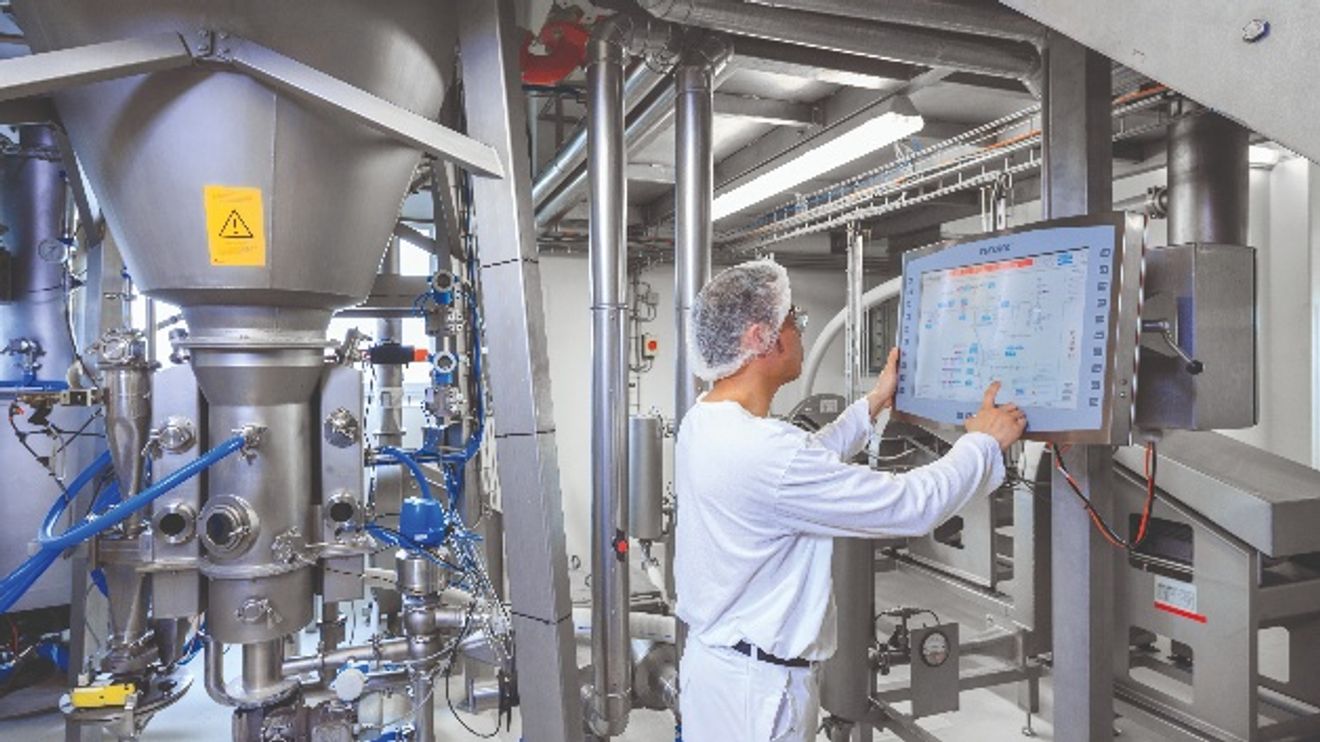
The Silesia company produces flavorings, and these can be found in almost all industrially produced foods: in the baking mix for lemon cake, in fruit yoghurt, in gummy bears and ice cream, in stock cubes or in the spice mix for gyros. The pharmacist Otto Strauhs soon realized that the future would belong to confectionery: At the company headquarters in Düsseldorf and later in Neuss, where Silesia was relocated, he initially produced toffees, caramels, dragées, chocolates or fruit fillings for pralines. This always required flavorings, which he also had to produce. This laid the foundation for the company's current direction. In 1999, the entrepreneurial family built the second plant in Germany in Kalkar on the Lower Rhine. There, a production facility was brought up to the latest state of the art - including with industrial PCs from Noax.
Process control via touchscreen
Dirk van Holt is an electrical engineer responsible for process automation. He points to the corridor that separates two production areas: "Look, the left side is sweet, where only sweet flavors are produced. You can find them in cakes, desserts, puddings and the like, for example. The right-hand side is savory." The production processes are the same on both sides: various ingredients are precisely weighed, dosed, mixed, cooked, distilled and filled into packaging. Initially, the distillates obtained in this way are liquid. With the help of a special process, liquid flavors can be applied to a powdery carrier substance, which offers more processing options.
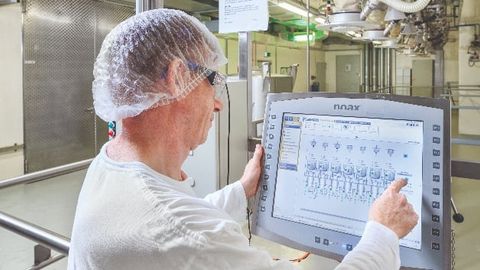
Employees use the industrial PCs to operate the production systems and obtain information about their current status.
© NoaxMost of the processes at Silesia are automated, with industrial PCs from Noax playing a crucial role. With their help, van Holt's colleagues operate the production systems and obtain information about their current status. The touchscreen of the IPCs serves both as a user interface and a display medium. "Process visualization is the second central task of the industrial PCs alongside operation," explains van Holt, "and our employees can intervene as soon as something doesn't go according to plan." All systems are displayed and can be operated on all Noax computers in the company. The advantage: the devices can be used independently of each other.
Silesia uses SAP R/3 software with an add-on that was specially developed for the flavor manufacturer, as well as process control software. This controls more than 20 system components, including a multi-component dosing system, mixer, flavor stove and several weighing areas.
The process screens, order lists, selective component lists, active dosing processes and the current status of production and container filling are displayed in real time on the IPCs. Noax industrial PCs of the type Steel S15 and Steel S19 with a screen diagonal of 15 and 19 inches respectively are used. They have a completely smooth stainless steel surface - without cracks or crevices. This is particularly important as it prevents bacteria, fungi and other micro-organisms that could spoil the valuable essences and distillates from settling on and in the devices.
However, Silesia not only attaches great importance to a crack-free design, but also to overall dust and waterproof hardware - which the industrial PCs offer with their protection class of up to IP69K. This degree of protection is important due to the dust that is in the air in some production rooms, because, as already mentioned, some of the flavors are applied to a powdery carrier substance, while the other part remains in a liquid state. Van Holt explains: "After each production run, we thoroughly clean the rooms and systems - and therefore also the industrial PCs. To do this, they are lathered with a cleaning agent and then sprayed down again, sometimes under high pressure. We also disinfect our systems every time we clean them."
Ten years of continuous operation
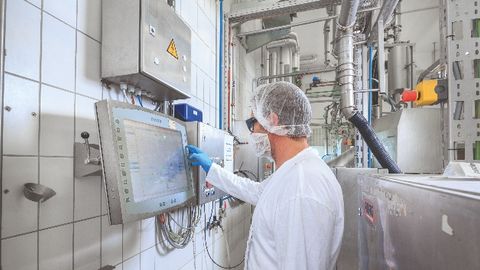
Furthermore, these industrial PCs equipped with a resistive analog touch display can also be operated with gloves. This is also important, as most employees at Silesia wear gloves during their work.
The longevity of the industrial PCs also plays a major role: "We ordered the first Noax IPCs in 2007 and today - after more than ten years of operation - they are still running perfectly," explains the electrical engineer. Before Silesia implemented the industrial PCs, other hardware was used to control the systems and for process visualization. However, this revealed considerable deficits: Ventilation slots open to the outside meant that they became clogged with dust and ultimately no longer fulfilled their function. The ventilation failed and the device had to be taken in for servicing. These conditions were no longer acceptable for cost reasons alone. For this reason, those responsible at Silesia decided to replace the devices with robust industrial PCs.
More security
The industrial PCs from Noax can cope with extreme heat and bitter cold. In addition, the systems have a microcontroller unit that monitors important functions and gives the operator immediate feedback as soon as the values for safe operation are exceeded. These are, for example, the write cycles on the storage medium or the condition of the CMOS battery. This tool also ensures the reliability of the industrial PCs and therefore also the process reliability in production. Due to their stability, the IPCs will not only be used in Kalkar, but also at other locations.
Author: Michael Naumann is a freelance technical journalist from Munich.


You might also be interested in
Double security through redundancy
The 'Safety Key' from Hy-Line allows the simple integration of safety-relevant switches in glass displays.
 read more...
Operation via touch, glove, pen or digitizer
Getac launches the next generation of 'F110' and 'K120' tablets: The new F110 is suitable for use in a variety of harsh outdoor and indoor scenarios.
read more...Flexible visualization
'Prime Panel Touch' and 'Prime Panel Extend' from Schubert System Elektronik (SSE) are suitable for sophisticated visualization concepts in industry.
read more...Support arm panel expands portfolio
The 'TT 1564' multi-touch operating panel for mounting arm installation extends the Sigmatek range.
read more...Managing Board expanded
Kontron expands its Management Board with Philipp Schulz and Dr. Johannes Fues. As COO, Schulz will be responsible for the Aerospace and North America business units, while Dr. Fues will assume the position of COO for the GreenTec business unit.
read more...Tablet for the Ex area
With the 'Pad-Ex 01 P12', Pepperl+Fuchs is launching a new tablet for professional use in potentially explosive atmospheres in Zone 2/22, Division 2.
read more...Modular embedded touch HMI
Irlbacher, provider of free-form touch solutions, has a new solution kit for modular embedded HMIs.
read more...Control elements that can be used for security
The control element PIToe ETH with activatable Ethernet port from Pilz protects freely accessible Ethernet interfaces in industry against unauthorized access.
read more...Control panel series updated
Kontron has developed a new generation of its Control Panels which, thanks to the more powerful Arm NXP i.MX8M Plus processors, provide a significant performance boost compared to previous models.
read more...