
Hardware offensive planned
Google wants to make its devices even smarter with AI
Google is the number 1 in web searches and develops the most widely used smartphone OS, Android. In competition with rivals such as Apple, the company's products are set to become smarter. It recently announced a pair of glasses that display live translations as subtitles during conversations.

Google CEO Sundar Pichai opened the Google I/O 2022 developer conference at Shoreline Amphitheatre (Mountain View) on Wednesday, May 11. The internet company traditionally uses the keynote speeches to announce new products.
© -/Google/dpa
The latest phone in the A series, "Google Pixel 6a", is packed with the powerful "Google Tensor" brain and many functions that the premium Pixel 6 and Pixel 6 Pro smartphones also have. The price: 449 US dollars.
© GoogleGoogle relies on artificial intelligence to make its services and devices more attractive in everyday life. At the Google I/O developer conference, the company showed, among other things, how software can automatically display useful information in the camera image on the smartphone screen - and how its voice assistant can do without the usual wake-up word. As a glimpse of the future, there was a prototype of a pair of glasses that can display translations from other languages in the user's field of vision during a conversation.
A visual search engine for the world around you
The search mask into which you type letters laid the foundation for Google's current greatness - but the company is also increasingly relying on smartphone cameras. At I/O on Wednesday, for example, it was shown how a photo of a meal is enough to find it at well-rated restaurants nearby. Or how you can point your phone's camera at a snack shelf to see which ones are healthier on the display.
Voice assistant feels addressed thanks to camera
Today, the Google Assistant voice assistant is usually activated by a wake word, just like Amazon's competitor Alexa or Apple's Siri. However, on the in-house Nest Hub device - a networked loudspeaker with display and camera - you can do without the "Hey, Google". The assistant feels addressed when the user looks at the device. The software only takes a fleeting glance into account when analyzing the camera images.
Watch from Google to compete with Apple Watch
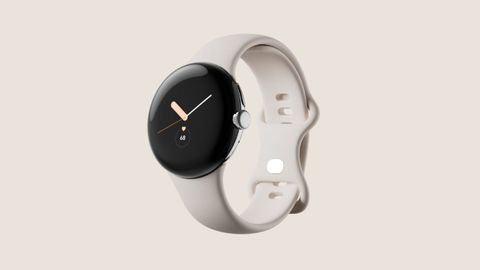
A handout image of the new Pixel Watch from Google on the wrist. The internet company Google unveiled its first smartwatch with the Wear OS wearable operating system in Mountain View on Wednesday. It is set to go on sale next fall.
© -/Google/dpaGoogle is also making a new attempt to break Apple's dominance in the computer watch business. The company announced its own Pixel Watch, which is intended for users of Android smartphones. However, it will not be launched on the market until the fall. Google did not give an exact date or a price.
Apple took the lead in the computer watch business with the launch of its Watch in 2015 and has held it ever since - despite various Android phone manufacturers launching their smartwatches on the market. However, the devices had weaknesses in terms of software and design. The Pixel Watch is the first computer watch to be developed by Google inside and out, emphasized device boss Rick Osterloh. As with the Apple Watch, fitness is to be a central application.
In 2019, Google bought the fitness band specialist Fitbit, whose technology is used in the Pixel Watch. Technology under the Fitbit brand will also continue to be available. Osterloh emphasized that the Pixel Watch can also navigate without a paired smartphone, for example on a bike ride. It can also be used to make contactless payments, just like the Apple Watch.
Hardware offensive makes Google more of a rival to Android partners
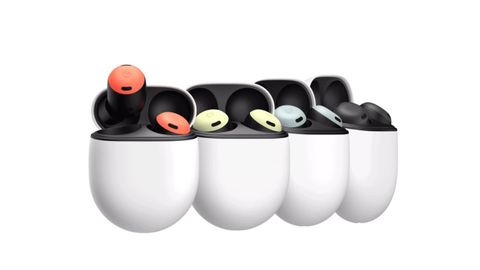
The company is also expanding its Pixel product range in line with Apple's range of devices: An improved Pro model of the Pixel Buds earphones is also coming and there is to be a new Pixel tablet next year. So far, Android tablets have not been able to shape the market like Apple's iPad.
Google's hardware offensive is bringing it more into competition with manufacturers of Android devices such as Samsung. As the developer of the Android operating system, the Internet company has so far held back somewhat in the hardware business. Now device boss Osterloh has emphasized the advantages of seamless interaction between devices from a single source.
Glasses fade in translation during conversation
In the future, Google is working on computer glasses that can automatically display translations in the wearer's field of vision. A prototype of the device could at least be seen in action in a video: "Like subtitles for the real world." There was no information on technical details such as battery life. From the outside, however, the device looked like conventional horn-rimmed glasses, apart from the slightly wider temples.
Technology that superimposes digital content into real environments - on displays or directly into the user's field of vision - is referred to as augmented reality (AR). It is already known that Apple and Facebook, among others, are also working on AR glasses. A few years ago, the German Bosch Group presented a prototype of a pair of glasses that can, for example, show the user arrows for navigation instructions.
Google was already a pioneer in computer glasses in 2012 with Google Glass, which had a small display and a camera. However, in addition to technical weaknesses, data protection concerns were the device's undoing.


You might also be interested in
New Managing Director at Bachmann electronic
Bachmann electronic has appointed Daniel Pfeifer as its new Managing Director with effect from January 1, 2026. He succeeds Bernhard Zangerl, who will be leaving the company.
 read more...
Dual leadership in Shanghai
Stefan Becker has been appointed Managing Director of Eckelmann Automation Technology in Shanghai and will manage the subsidiary together with Zhongwei Huang.
read more...Secure data management in the cloud
Bachmann presents new functions of the platform-independent visualization solution 'atvise': Thanks to container operation and a consistent client concept, the solution can now also be used securely as a higher-level IoT (Internet of Things) service.
read more...Automated detection of damage to trains
No more overlooked damage: A project team at TH Wildau has optimized the inspection of passenger trains using AI-supported computer-visual techniques. The results of the "ESPEK" project are summarized by the research partners.
read more...Support arm panel expands portfolio
The 'TT 1564' multi-touch operating panel for mounting arm installation extends the Sigmatek range.
read more...Tablet for the Ex area
With the 'Pad-Ex 01 P12', Pepperl+Fuchs is launching a new tablet for professional use in potentially explosive atmospheres in Zone 2/22, Division 2.
read more...Keyboards with glass surface
Ateg offers capacitive PC keyboards with a glass surface from the French manufacturer Tactys. The glass of the user interface is made of 3 mm thick, hardened white glass, which is robust against mechanical influences.
read more...The golden mean
What to do with vision applications that are too complex for rule-based image processing on the one hand, but too simple to justify investing in a full deep learning solution on the other? One option is machine learning 'at the edge'.
read more...HMI in the assembly line modernized
Swedish packaging manufacturer Kinnareds Well has modernized its human-machine interfaces in the assembly line with Rockwell Automation partner Hax Technologies. The aim was to improve productivity and user-friendliness.
read more...