
Augmented reality
Error-free thanks to smart glasses
The assembly service provider WS Kunststoff-Service uses augmented reality in production: data glasses in combination with a wearable wristband support the workers during assembly. The goal: fast yet error-free production.
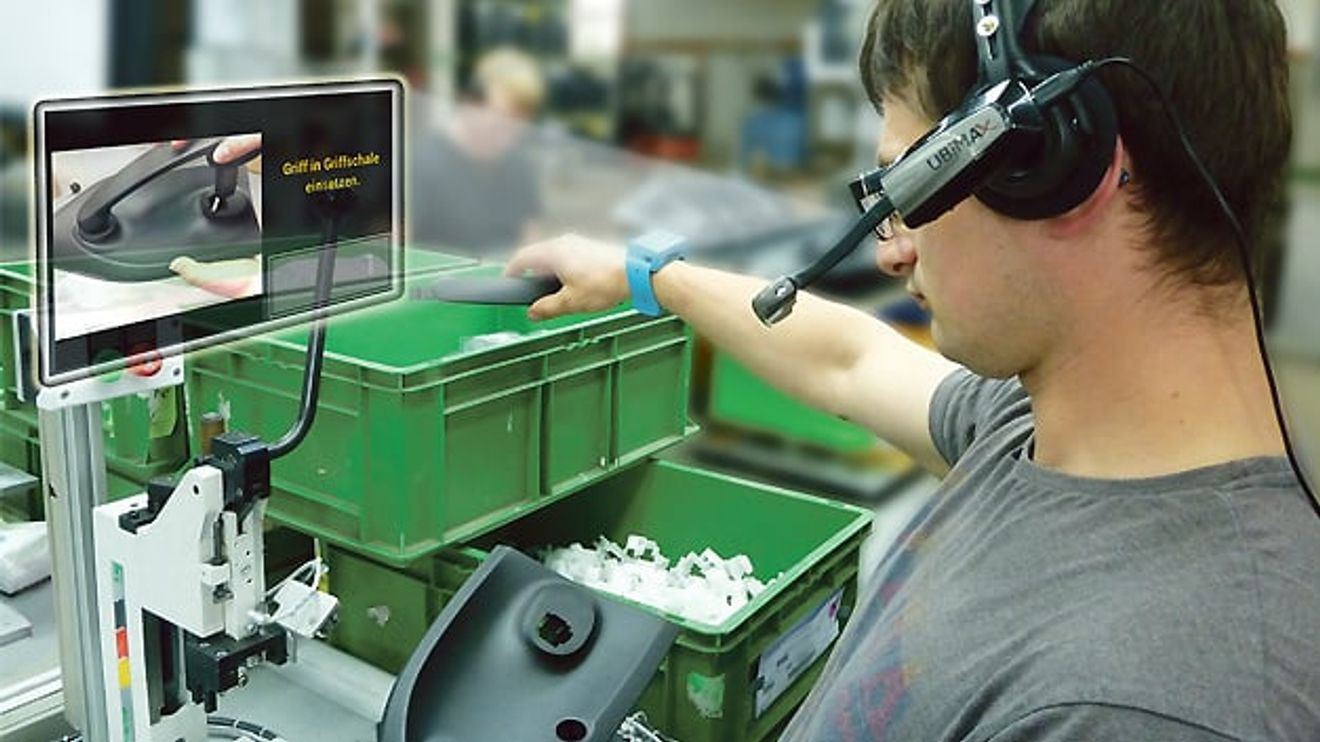
The industry is increasingly forced to find adequate answers to challenges such as employee turnover, competitive pressure from low-wage countries and rising quality standards. New types of portable electronic devices, so-called wearables, offer starting points for solving problems and can give companies a significant advantage over the competition. There are numerous possibilities for integrating wearables into existing business processes and supporting workers. Intelligent gloves with sensors and screens on the back of the hand, wristbands that receive signals via radio waves or smart glasses that can project context-relevant information into the worker's field of vision. The latter in particular are in vogue across all industries and are constantly being adapted and optimized to meet changing market requirements.

Decisive factors for success: by working with smart glasses, the worker is not restricted in his work and is also provided with relevant data. Another point is the simple, intuitive operation of smart glasses. Numerous technology start-ups (Vuzix, Telepathy, ODG, etc.) are currently shaking up the market, but many established companies (Google, Microsoft, Fujitsu, etc.) are also trying to position themselves in the lucrative smart glasses market. Gartner is forecasting growth in sales of wearable computing devices of 18.4% in 2016 alone.
The screen of the data glasses most commonly used in industry today, such as 'Vuzix M100' or 'Google Glass'(see table), is located in the worker's peripheral field of vision, so that perception of the real world is not restricted when using the glasses. Work instructions can be displayed visually with photos, videos and 3D models directly on the data glasses - acoustic signals provide additional support for the worker. The integrated cameras can be used to scan any 1D and 2D barcodes and to record screenshots and videos for documentation purposes or for live transmission.
Guiding the worker
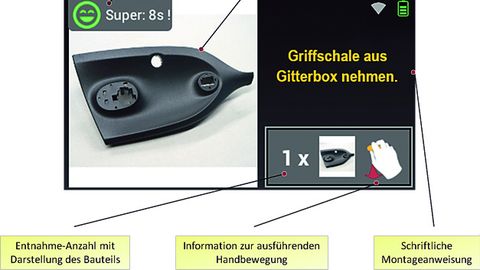
Everything in view: The standardized screen is superimposed on the worker's field of vision via the goggles.
© UbimaxThe German packaging and assembly service provider WS Kunststoff-Service is already using the portable technology and benefiting from its advantages: Increasing efficiency and minimizing error rates while increasing quality in an intuitive work environment that allows for high flexibility and personalization.
The company produces assemblies for the consumer electronics and automotive industries and has been using wearable computing technology from Bremen-based Ubimax since 2014. The Hanseatic company is one of ten certified Google Glass partners worldwide and has developed an 'Enterprise Wearable Computing Suite' for the entire industrial value chain: from logistics, assembly and quality assurance to maintenance work and remote support, all business processes can be supported with smart glasses. The 'Vuzix M100' augmented reality glasses can be used flexibly and in a variety of ways in the work process - also in combination with other sensors and interfaces. WS Kunststoff-Service uses the Ubimax 'xMake' application on two production lines. It supports the workers by displaying instructions and processes with visual information in individual steps in an intuitive and understandable way.
In the assembly hall of WS Kunststoff-Service, workers assemble vehicle handles, among other things. Vuzix M100 data goggles are used in combination with various external sensors. The process involves workers removing components from boxes, assembling them manually and then fixing them in place with the help of machines. During this process, the worker sees a standardized screen, the user interface, on the data goggles. This can be seen: Graphical instructions for the current assembly process or brief written instructions, progress bars and technical details - such as battery charge level and signal strength. There is also the option of incorporating feedback for the worker's performance, a so-called gamification element, with the display of time information, smileys and short statements, for example.
Decisive competitive advantages

Architecture structure: The 'xMake' server connects the wearables on the worker with the external sensors.
© UbimaxIn addition to the glasses, an innovative multi-sensor system supports the process. The 'xBand' from Ubimax is used to remove components from a compartment. The wristband uses RFID technology to detect when parts are picked. If the worker reaches into the correct box, which is also marked with an RFID tag, at the right time, the work step is acknowledged. This makes work easier: Time-consuming scanning, manual acknowledgements or long walking distances are eliminated. There are also motion sensors and light barriers that use infrared to detect whether the component has been correctly fixed in the fixture. Precise load cells detect whether the correct quantity has been removed from the removal containers. The interaction of the different sensors, which are all seamlessly embedded in the production process, demonstrates the strengths of the integrated solution. All the sensors used are linked to the glasses via a Siemens PLC interface to the 'xMake' server, which communicates with the smart glasses via WLAN. Implementation into the existing IT landscape is quick and easy. Errors detected by sensors are immediately reported to the smart glasses and the user can react in real time.
The advantages of smart glasses in an industrial environment are clear to see, or rather both hands. The decisive advantage is that both hands are free so that the worker can concentrate fully on their primary task. The technology can be integrated into human processes without distracting them from their work. This is of crucial importance during a long working shift, including the question of acceptance by the workers. Intuitive operation and an easy-to-understand interface mean that new employees can be trained more quickly. This also makes it possible to flexibly deploy a worker on several production lines without having to undergo time-consuming and personnel-intensive training. There are also two different display modes: one for beginners with all available information and another for long-term users or experts with only essential messages. The devices only sound an alarm in the event of errors.
Digitization of manual work processes
In addition to speed and efficiency, quality is increased at the same time. This actual contradiction is made possible by the permanent monitoring by sensors, which make time-consuming confirmations by the worker superfluous. The 'xMake' application is always personalized and adapted to the specific needs of the company. The entire 'Enterprise Wearable Computing Suite' with a total of four applications is a proprietary product from Ubimax and is compatible with all current and future data glasses.
The other solutions in the 'Enterprise Wearable Computing Suite' complete the industrial value chain: 'xPick' for intralogistics processes such as order picking, 'xInspect' for inspection and maintenance processes and 'xAssist' - which establishes bidirectional communication between the worker with the smart glasses and a remote expert in the event of a malfunction - for remote support.
All applications can be installed and operated on just one pair of smart glasses, eliminating the need for time-consuming device changes and keeping acquisition and maintenance costs low. The Ubimax developers are currently working with the University of Bremen on optical infrared and camera-based activity recognition that can record human activities.
The digitalization of manual work processes is making increasing progress and today marks the beginning of a new industrial era. Among other things, innovative human-machine interfaces that make tomorrow's work economically efficient and ergonomically sensible will be crucial to its success - and smart glasses can be an important building block here.
Author:
Nicole Arndt is responsible for marketing and PR at Ubimax.


You might also be interested in
Double security through redundancy
The 'Safety Key' from Hy-Line allows the simple integration of safety-relevant switches in glass displays.
 read more...
Operation via touch, glove, pen or digitizer
Getac launches the next generation of 'F110' and 'K120' tablets: The new F110 is suitable for use in a variety of harsh outdoor and indoor scenarios.
read more...Flexible visualization
'Prime Panel Touch' and 'Prime Panel Extend' from Schubert System Elektronik (SSE) are suitable for sophisticated visualization concepts in industry.
read more...Support arm panel expands portfolio
The 'TT 1564' multi-touch operating panel for mounting arm installation extends the Sigmatek range.
read more...Managing Board expanded
Kontron expands its Management Board with Philipp Schulz and Dr. Johannes Fues. As COO, Schulz will be responsible for the Aerospace and North America business units, while Dr. Fues will assume the position of COO for the GreenTec business unit.
read more...Tablet for the Ex area
With the 'Pad-Ex 01 P12', Pepperl+Fuchs is launching a new tablet for professional use in potentially explosive atmospheres in Zone 2/22, Division 2.
read more...Modular embedded touch HMI
Irlbacher, provider of free-form touch solutions, has a new solution kit for modular embedded HMIs.
read more...Control elements that can be used for security
The control element PIToe ETH with activatable Ethernet port from Pilz protects freely accessible Ethernet interfaces in industry against unauthorized access.
read more...Control panel series updated
Kontron has developed a new generation of its Control Panels which, thanks to the more powerful Arm NXP i.MX8M Plus processors, provide a significant performance boost compared to previous models.
read more...