
Althen
Determined by DMS
In a material test, the properties and structures of a material are determined in the form of parameters using various physical or chemical tests and measurements. Reliable helpers in this process: strain gauges.
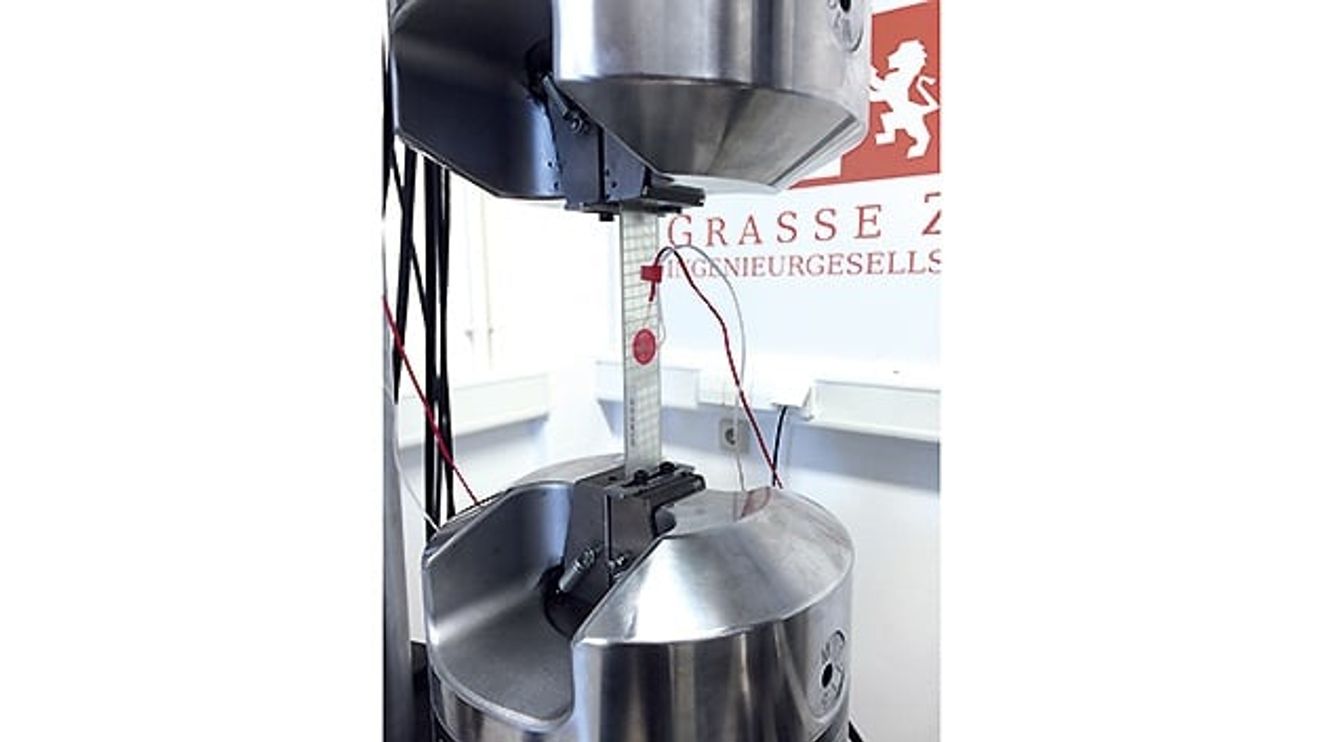
Material tests are important for companies to be able to assess whether the newly developed component will withstand future stresses. For certain applications and industries, they also provide the required proof of quality.
Grasse Zur Composite Testing operates an accredited materials testing laboratory and specializes in testing fibre-reinforced plastics, particularly for the automotive, aerospace, chemical and rotor blade industries. Materials testing is the core business of the Berlin-based company. In addition, it develops testing equipment - on the one hand for its own processes, but on the other hand companies that operate their own laboratories can also purchase these testing devices.
Fiber-reinforced plastics are particularly suitable for lightweight construction, as they are characterized by high specific stiffness and strength. They are generally used for flat structures. The majority of tests at Grasse Zur are carried out destructively, i.e. the customer company supplies the material to be tested in the form of a cured laminate to Grasse Zur, where a test specimen is produced from it. This is destructively tested in a universal testing machine using tensile, shear, compression or bending tests to determine material characteristics.
Strain gages record changes in the specimen
Strain gauges from Althen are a key tool for recording changes in the specimen under load. They determine the strain directly on the surface of the test specimen and are prescribed by various DIN standards for determining the material characteristics of fiber-reinforced plastics.
Shear test to ASTM D7078 using a rail shear test fixture with a V-shaped notched specimen in which a strain gauge rosette with a measuring grid length of 10 mm is used. The aim of the test is to determine the shear properties (shear modulus, shear strength and maximum shear strain).
© Grasse Zur Engineering CompanyA strain gauge is a meandering metal conductor - usually made of constantan or karma - that is etched onto a thin carrier such as polyimide. It is primarily attached to the test specimen using specific adhesives. A strain gauge acts as an electrical conductor which, when compressed or stretched, shows a change in electrical resistance, which in turn indicates a change in voltage and is thus converted into an electrical signal. The corresponding measuring device can output the voltage change in mV/V as well as directly display the actual strain of the strain gauge in µm/m.
As fiber composites are poor heat conductors, a strain gauge should always be selected from the higher impedance range, especially for long-term measurements - with at least 350 Ω, as the heat development could lead to errors in the measurement result. Grasse Zur, on the other hand, involves very short tests until the specimen tears and the strain gauge is destroyed. These small measurement errors caused by the heat development are negligible, so that strain gages with 120 Ω are also sufficient.
Larger strain gages for a good measurement result
For the best possible measurement result, Grasse Zur selects strain gages that are as large as possible, whereby large here means a measuring grid length of 10 mm; small strain gages have a measuring grid length of approx. 2 mm. The strain gages should be as large as possible in order to achieve good averaging over the tensile specimen. In the case of a fiber composite, it is unfavorable if the strain gauge only covers one fiber bundle instead of measuring across several fiber bundles. This falsifies the measurement result. The dimensions of the respective test specimen, which is usually 100 to 250 mm long and 10 to 25 mm wide, have a limiting effect on the size of the strain gage.
The strain gages are then bonded to the specimen in a longitudinal or transverse direction, depending on the test requirements: linear strain gages are mainly used to measure a uniaxial stress state. A 0/90° strain gauge (T-rosette) is used for a biaxial stress state - when forces act both in the tensile direction of the tensile specimen and offset by 90° to the right and left. If the main direction of strain is unknown, i.e. it is unclear where the forces are applied, a triaxial 0/45/90° rosette with three grids is used. Theoretically, all measurements can be carried out with individual linear strips, which the user arranges in the correct position. To make measuring easier for users, Althen offers the 0/90° and 0/45/90° variants ready-made. This means that only a single strain gauge with the corresponding number of strain gauge grids needs to be glued on.
Accurate bonding process

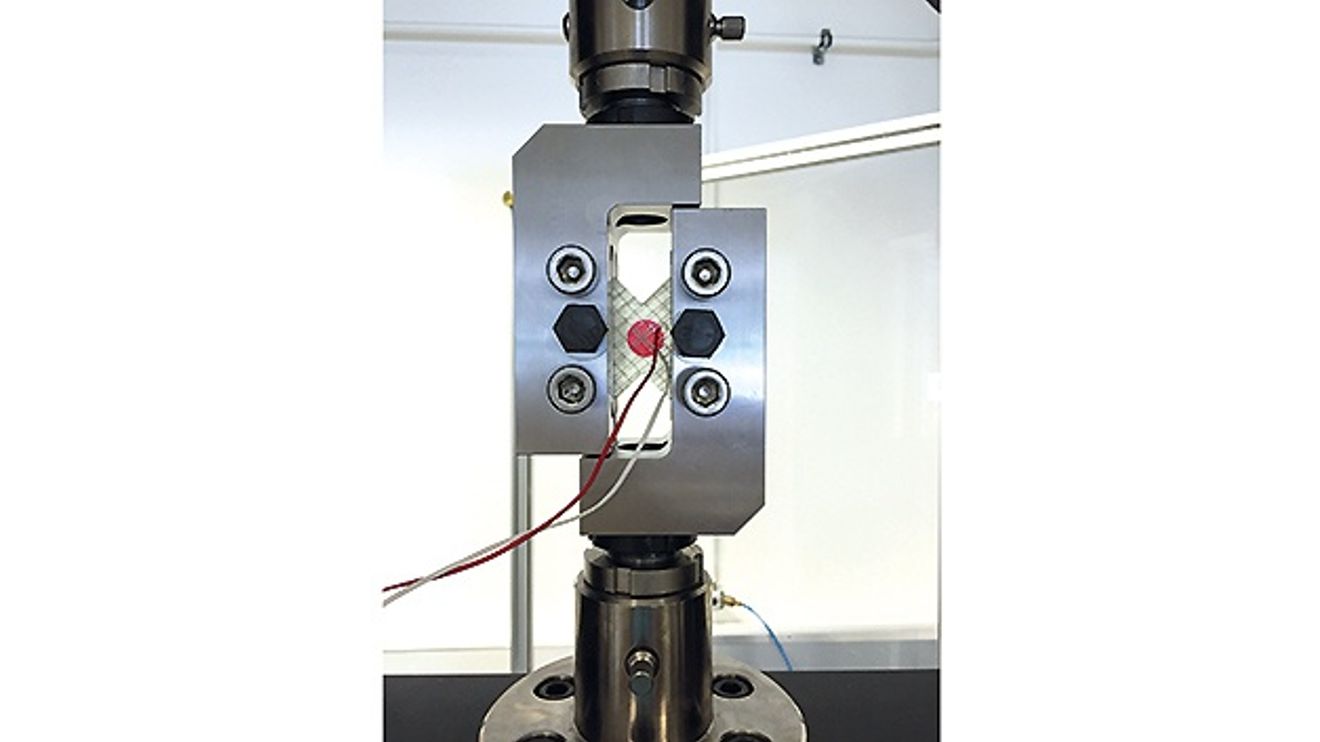
Shear test to DIN EN ISO 14129 with flat specimens in a servo-hydraulic testing machine from MTS, in which a strain gauge rosette with a measuring grid length of 10 mm is used. The shear properties (shear modulus, shear strength and maximum shear strain) are determined. No testing device is required for the test; a standard clamping system is sufficient.
© Grasse Zur Engineering CompanyStrain gages at Grasse Zur are usually applied with a quick-drying cyanoacrylate or instant adhesive of the CN type. For short-term measurements without environmental influences or higher temperatures (measurements are possible up to +120 °C), an instant adhesive is sufficient. The adhesive layer must be applied very thinly, as otherwise the measurement would not take place on the component, but slightly above it. Inclusions caused by air bubbles or dust particles must also be avoided, as they can also distort the measurement result.
At higher test temperatures, Grasse Zur uses an epoxy resin adhesive from Althen, which is somewhat more complex to use, as it has to be mixed and the strain gauge later hardens for longer under a prescribed contact pressure.
Before the bonding process, it is important to prepare the component so that the adhesive and the strain gage hold well. This requires a certain degree of roughness on the surface of the fiber composite material. However, the fibers of the composite material must not be damaged by grinding or roughening in order not to falsify the test. A great deal of experience and dexterity is therefore required on the part of the employee to ensure that the fibers are not damaged during roughening. The more resin-rich the materials are, the less sensitive they are to grinding damage.
Strength and rigidity
The strain gage must hold well and securely during the test for two characteristic values in particular: determining the strength and determining the stiffness of a test specimen. The strength describes the maximum force at which the material is destroyed. For this purpose, the force is set in relation to the surface area. This parameter is determined at the end of the test procedure, at the moment of tearing. The stiffness shows how much force must be applied to deform a test specimen. It is determined right at the beginning of the test, while the material behavior is still in the linear-elastic range. At this point, the specimen could return to its original shape when the tensile process is adjusted.
Another parameter is the elongation at break. It indicates how far the specimen was stretched at the moment it failed, i.e. at the moment the strength was determined. If the strain gauge was not well bonded, it may be possible to measure the stiffness at the beginning and also the strength at the end, but not the elongation at break, as the strain gauge was no longer properly bonded at this moment.
Integrated cable connections on the strain gage

The author: Udo Könsgen works in technical consulting for DMS & sales at Althen Mess- & Sensortechnik in Kelkheim.
© AlthenOne added value of the strain gauges sold by Althen is the optional integrated cabling, which means significant time savings for customers during application: the strain gauge can be glued on and connected directly, without soldering or similar processes, and is therefore ready for use immediately after gluing.


You might also be interested in
Danger of tipping over averted
Heavy transports with oversized loads require complex planning and logistics in order to be carried out properly and safely. Mobile measuring systems for monitoring the angle of inclination of the load ensure that the risk of tipping is minimized.
 read more...
Dynamic weight measurement in freight transport
By measuring the weight of freight trains, loads on the infrastructure can be determined and predictive maintenance measures can be taken on wagons and rails. A special dynamic weighing system is now also on the rails in Germany.
read more...3D surface inspection and defect detection
The '3D ReflectControl' sensors from Micro-Epsilon are used for surface inspection and defect detection on highly reflective and transparent surfaces.
read more...Submit applications now
The AMA Association for Sensors and Measurement (AMA) is calling on scientists and developers from industry and research to apply for the AMA Innovation Award 2025. We are looking for research and development results in sensor and measurement...
read more...Management expanded
Axel Hessenkämper joined Janitza as the new Chief Executive Officer (CEO) on September 1, 2024 and is part of the management team alongside Mr. Janitza, Mr. Müller and Mr. Veidt.
read more...Update for multifunctional energy analyzer
The multifunctional energy analyzer 'UMG 806' from Janitza is now available in a low-power version and with UL certification.
read more...Flow meter for conductive liquids
The 'Flowtrans MAG H20' from Jumo measures conductive media with high precision - even drop by drop - and can be used flexibly in a wide variety of processes.
read more...Endress+Hauser at the SPS 2024
Product line for level and pressure measurement
Endress+Hauser presents the 'Compact Line', a product line specially developed to meet the requirements of the life sciences and food and beverage industries.
read more...Three-phase adapter for test devices and CEE sockets
Gossen Metrawatt has introduced new three-phase adapters for connecting test devices to 5-pin CEE sockets.
read more...