
Production control
Towards Industry 4.0 with OPC routers
Auria Solutions produces floor panels that are supplied just-in-time to car manufacturers. In order to make this possible despite numerous variants, the supplier had its ERP software expanded into a system for automatic production control using an OPC router.

Since 2017, the Straubing plant of the International Automotive Components (IAC) Group has belonged to Auria, a joint venture founded with the Chinese Shanghai Shenda Company. However, the automotive supplier has been producing floor panels for the automotive industry here since 1987. Sound insulation mats and wheel arch linings are now also manufactured here. Around 200 employees produce around 1700 floor linings per day, usually in two shifts.
Premium manufacturers such as the one in nearby Dingolfing place the highest demands on the material, the quality of workmanship and complete traceability. Around 80 product variants are supplied for just one series of the well-known customer. In total, the company has tools, materials and production programs for around 300 active floor coverings. Three and a half days after a binding delivery call-off, the two-part floor claddings must be ready on time and in exactly the right sequence in transport racks on the conveyor belts of the customer's respective plants. "Even the smallest errors in the sequence or product labeling would jeopardize our results," reports plant manager Christian Graßmann: "We can only meet the growing requirements thanks to a constantly updated automation concept for Industry 4.0."
Three levels of automation
In a twelve-year partnership with Inray Industriesoftware, the company developed a lean, but redundantly secured automation solution according to the respective requirements. Today, this controls and documents all production processes in direct communication between the PLC, label printers and SAP.
At the lowest level, all PLC controls of the individual stations, such as hydraulic thermoforming presses, transport systems or water jet cutting systems, were connected to a KepServerEx from Kepware. The ERP system from SAP, which specifies raw materials and recipes, thermoforming tools and production programs as well as the products to be produced, the storage and retrieval processes and the correct sequence for deliveries, takes over the top control level. In between, the OPC router from Inray controls communication as a graphical, programmable data hub. It determines which PLC signals are passed on to SAP and the peripheral devices, and which data is sent from SAP to the PLC and the label printers installed everywhere. IT administrator Michael Kalbe explains: "The graphical user interface of the OPC router can be mastered even without extensive programming knowledge. You can therefore easily make everyday changes to individual process steps yourself." If required, small program routines can be integrated and templates for various processes can be easily copied and adapted.
Data is transferred via Remote Function Call (RFC) with handshake. The receipt of a data packet is therefore always confirmed before the information it contains is processed. This increases the security and reliability of the system enormously. The status is updated every ten seconds. In order to reduce the volume of data in the network, it is compressed before being sent, so that it can be enriched again at its destination. "The OPC router displays the ongoing transmission processes graphically," says Michael Kalbe. "This allows me to localize errors quickly and take remedial action if a PLC stops transmitting or a label printer stops working."
Guarantee error-free processes
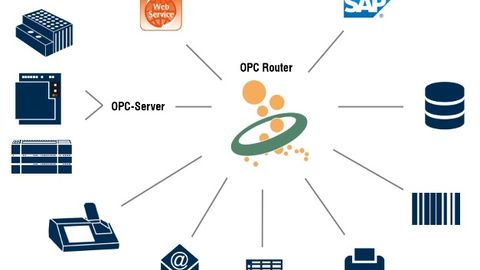
The Inray OPC router controls communication between controllers, peripherals and SAP.
© Inray industrial softwareThis point is of particular importance: with each process step, a label is automatically printed that replaces the previous one on the semi-finished product. For example, a printer generates the first label for the floor coverings with each stroke of the thermoforming press, thus ensuring traceability to the rolls of carpet and insulation material used. For the next work step, the label is read in by a hand scanner or (during the final inspection) by a device and confirmed by the system. This means that components can no longer be mixed up, incorrectly labeled or processed. "Evil tongues claim that our production would come to a standstill if we could no longer print labels," says Christian Graßmann. "But we have protected ourselves against this in many ways." The side-mounted labels are cheaper than RFID technology and easier to apply. The employees read them quickly - and if the data is correct, the next process step is already released. "This has enabled us to significantly increase our cycle times and eliminate 99.9% of errors," explains Christian Graßmann. In future, the manual checks using barcode scanners are to be increasingly replaced by permanently installed devices.
Employee motivation
Nevertheless, employees are at the heart of this Industry 4.0 concept: due to the nature of the material, the sensitivity and precision required for certain process steps and the need to think for oneself, human labor still plays a major role - even if robots are already taking over the backfoaming of floor coverings to specifically improve noise insulation. This makes it all the more important to pay and motivate the teams in line with their performance.

Want to take the path towards Industry 4.0 together: IT administrator Michael Kalbe and plant manager Christian Graßmann.
© Inray industrial softwareFor this reason, key performance indicators such as output in percent, reject rate, customer complaints in parts per million (PPM) and quality costs have been defined for many workstations. Depending on how well they are met, these result in performance bonuses of up to several hundred euros for the team members. To enable employees to achieve these, they should be informed about the degree of fulfillment during their work.
Inray realized this with another software developed in-house. The web-based production portal 'Factoy Application Server' (FAS) processes the necessary data from the OPC router in order to visualize it online. Large monitors now hang above the workstations, displaying bar charts of the current data and a forecast up to the end of the shift: At a glance, team members can now assess whether their performance is within the desired value ranges. "In projects like this, we have created an end-to-end system for Industry 4.0 that we can flexibly adapt and add to as required," explains Michael Kalbe.
Integrated test reports
This is also demonstrated by the latest project in the collaboration. In the USA, a series of serious car accidents occurred because floor mats had bulged up under the brake pedal, causing an obstruction. As a result, the main customer made a new requirement: for every floor covering supplied, proof had to be provided that the twist locks for fastening the mats were securely engaged.

The result at the end of the shift is forecast from the current key performance indicators.
© Inray industrial softwareTogether with Inray, a solution was developed for mapping and documenting this process in the software. Safe installation is now checked using a complex system and the status is documented. Once the signal has been given that the installation meets the requirements, the floor cladding is stored.
The IT system will also be improved and expanded in the future. Security and reliability play a major role here. All systems are kept redundant so that disruptions do not lead to production downtime. The company's central IT department has a parallel SAP installation that is immediately ready for use in the event of local problems. The IT managers can access Inray's OPC server remotely at any time via a browser. And the service is available in the background: "When I report a problem to some system houses, I only get one ticket," says Michael Kalbe. "At Inray, I immediately reach an employee who is looking for a solution." - However, there have been no major problems with the solutions so far.
Author:
Dr. Thomas Tosse is a specialist journalist in Munich


You might also be interested in
CAD software: Models available remotely via browser
With the release of IndustrialPhysics 3.0, the machine engineering team has integrated new features into the software. For example, synchronized mechatronic engineering is now possible via the so-called CAD offline buffer with workflow control.
 read more...
Will Industry 4.0 fail due to diversity?
Industry 4.0 has been 'the' topic of industrial automation for eight years. However, real results have been very poor to date. Why is it so difficult to establish a good idea? An attempt to explain.
read more...Set up for Industry 4.0
Without a powerful infrastructure, neither digitalization nor networking are possible in any meaningful way. Georg Stawowy, Chief Technology and Innovation Officer at Lapp in Stuttgart, explains how his company is preparing for the requirements of...
read more...The potential of quantum computers
Industry can benefit from the extreme computing power of quantum computers in the future. Companies can already use simulators to familiarize themselves with the technology, as Philippe Duluc, CTO for Big Data and Security at Atos, explains.
read more...The OpenFog reference architecture
The OpenFog reference architecture of the OpenFog consortium has now been adopted by the IEEE Standards Association (IEEE-SA) as the official standard for fog computing.
read more...Edge computing meets data glasses
A mobile edge computing PC combined with data glasses: Toshiba wants to enter the Industry 4.0 market with this assisted reality solution, as Jörg Schmidt, Head of B2B PC DACH at Toshiba Europe, explains.
read more...Use in the industry
Everyone is talking about blockchain technology, especially because of the Bitcoin hype. Originating from the financial sector, blockchain also has numerous potential applications in the industrial sector, as Wolfgang Prinz, Deputy Director of...
read more...Relayr receives 30 million dollars
Deutsche Telekom invests in Berlin IoT start-up
Deutsche Telekom has announced that it is investing in the start-up Relayr. The main focus here is on the great potential of industrial applications and, in particular, the intelligent interlinking of different machines and systems.
read more...German-Russian cooperation for Industry 4.0
German technology companies such as Siemens and SAP want to cooperate with Russian partners. On the Russian side, the telecoms service provider Rostelekom and the company Zyfra, which specializes in AI, are participating in the German-Russian...
read more...