
Industrial PCs
Will Industry 4.0 fail due to diversity?
Industry 4.0 has been 'the' topic of industrial automation for eight years. However, real results have been very poor to date. Why is it so difficult to establish a good idea? An attempt to explain.
The implementation of the Industry 4.0 idea is progressing very slowly. For eight years now, Industry 4.0 has been driven through the streets. Every self-respecting player has presented ideas, concepts and products for or around the hype: Cloud solutions, servers, node and edge devices through to Industry 4.0 sensors.
Fueled by the large number of 'connected' devices that the market is expected to produce and the huge amounts of data that need to be processed, many providers have seen the dollar signs literally pop up in their eyes. - No one wanted to be late to the market with corresponding products.
And so each provider virtually disappeared into its development department with an initial idea and came up with what it considered to be the best solution. Or, on the basis of their own customer base and supposed market power, they cooked up their own little soup to secure their traditional part of the business. According to the motto: from the hardware to the communication protocol to the cloud - my solution is the best!
The result is that with the wide range of offerings at all levels that the Industry 4.0 wave has now created, the customer has one main problem: deciding what to choose!
The large numbers problem
In general, a large-numbers situation is positive for the customer. A wide range of products with many competitors enables them to negotiate down the price. However, this approach does not take place in the market for Industry 4.0 products, or only to a very limited extent. Why is this the case? The customer is indeed faced with many offers, but these are not 1:1 interchangeable. In this case, there is an atypical large-numbers problem. The customer has the problem of deciding on an offer within this range of offers due to the wide but not directly interchangeable offer.
Where does the problem come from? The offers at the various implementation levels are not directly complementary due to a lack of standards, i.e. they are not in direct competition due to the lack of interchangeability. This is because the providers are currently still trying to secure the theoretically maximum market share by differentiating themselves as much as possible. The problem here essentially lies in the communication technology between the individual implementation levels: While the path from the sensor to the edge device is still well defined and standardized with the established serial interfaces or USB, the situation is different at the levels above.
How does the data get from the edge to the node? And further: How does the data get to the server and then to the cloud? Or does the data go directly to the cloud? And if so, which one? The combination of these questions paired with the respective broad range of options results in a complex decision matrix.
What's more, the customer is entering uncharted territory at almost all levels of an Industry 4.0 implementation. Mechanical engineering, which is considered conservative, often lacks the courage to take a 'first position'. The risks associated with the complex implementation of Industry 4.0 often seem too great compared to the potential positive effects. And an orderly partial entry is ruled out due to a lack of future security - due to a lack of standardization. Even various funded lighthouse projects such as the 'Cluster of Excellence Integrative Production Technology for High-Wage Countries' or 'Autonomics' have not yet eased this fear barrier due to their low profile and focus on large-scale projects.
Standard = openness
Openness - yes, it has been and continues to be signaled in the automation industry. In the past, however, it was non-existent on closer, critical inspection. To date, there has simply been a lack of real openness in the form of standards!
Yet the industrial PC sector - with standards such as VME, CompactPCI, ETX or Smarc - proves that the direct route via a standard is simpler and faster. Even if this path is often not easy. In the case of ETX, for example, it started with the search for partners, as ETX was driven by the manufacturer Jumptech at the time and for a long time had a 'proprietary' feel to it, but was ultimately adopted by more and more market players and finally accepted on the market as a 'quasi-standard'.
And perhaps the automation industry still has to learn that a real standard cannot be created by sheer size. Even companies such as Siemens or Deutsche Telekom are finding this difficult. However, it would also be sad if standards were always created by vendor power, as the best solutions would hardly or not at all be heard on the market due to the lack of size of the innovator and would disappear from the scene without a sound.
On the customer side, openness in the form of standards is therefore required. The demand for at least one 'second source' can hardly be realized in the current constellation across all levels of Industry 4.0. And very few people are prepared to go down the rocky road of putting together their own second source in a modular system due to the complexity involved. Replacing a standardized Smarc module on the carrier developed for the application is not enough. With Industry 4.0, there are simply a lot of interlocking gears, which makes such a project so complex.
Another important point is the quick and easy integration of the data into a cloud. But which cloud to use? And to what extent are the cloud offerings comparable in terms of connection and handling? At first glance, it seems obvious to fall back on the offerings of the top dogs Microsoft (Azure) and Amazon (AWS - Amazon Web Services). However, questions such as "Does my data belong to me?" and general security concerns are the brakes here. In addition, it is not only the production disciplines that decide on these IoT implementations, but also the company's IT department needs to be brought on board.
Light at the end of the standard tunnel
Now that eight years of dreaming of big business have passed, suppliers are slowly coming to the realization that they need to talk or join forces. This is leading to a growing acceptance of existing standards on both the supply and demand sides. At the same time, this is also driving the generation of new standards that supplement existing ones or close gaps in the Industry 4.0 structure.
OPC UA, for example - on the market since 2006 - has struggled for a long time. In the last three years, however, the OPC UA train has really picked up speed and, in combination with Time Sensitive Networks (TSN), one of the defining standards of the Industry 4.0 world is emerging. As a result, the automation industry experienced something of a standardization sensation at last year's SPS IPC Drives: all well-known automation companies - including the big names Mitsubishi, Siemens and Rockwell Automation - unanimously advocated a standard based on TSN and OPC UA.
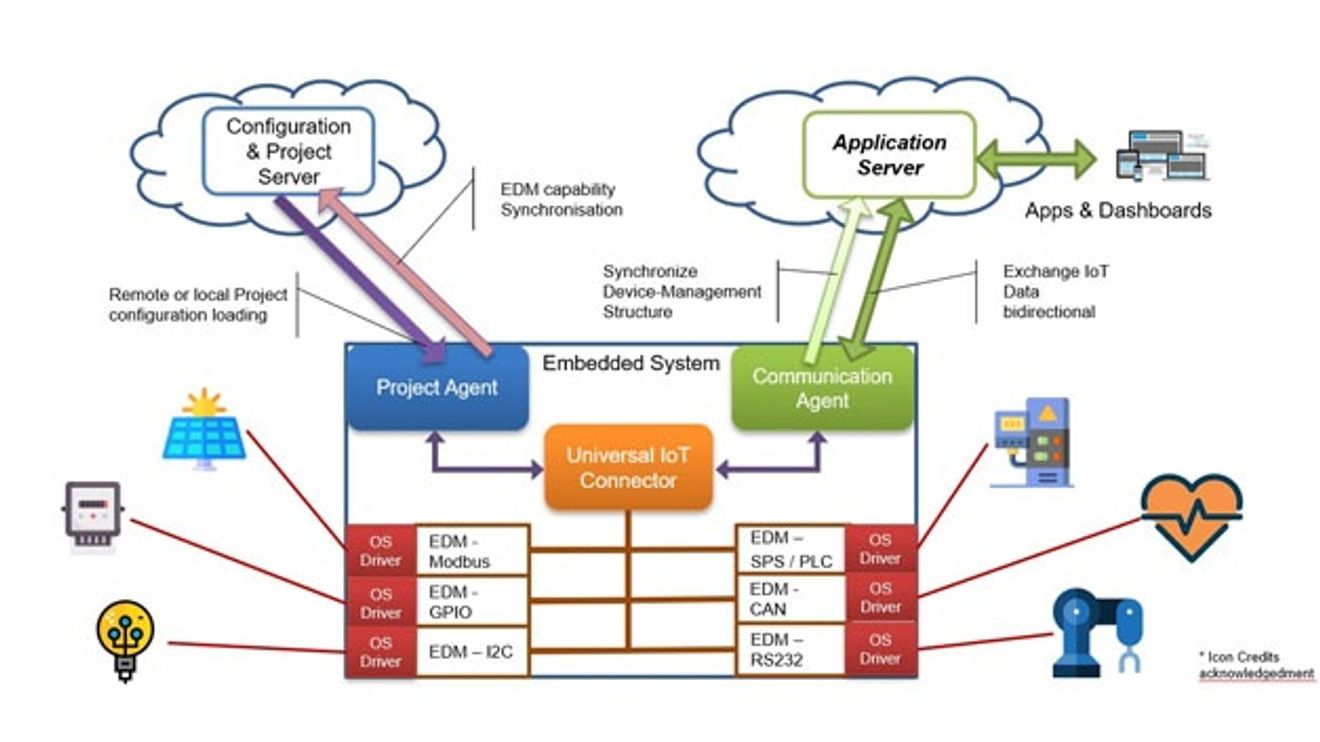
Embedded hardware manufacturers, who have joined forces in the SGeT, have also recognized the problem of communication and have defined a hardware-independent software standard with the 'Universal IoT Connector' (UIC). The UIC is a pure software standard that enables any embedded hardware - using MQTT or XRCE - to exchange data between embedded devices and an infrastructure hosted in the cloud. The standard hardware API is based on the eAPI specification, which is often used for computer-on-modules and other embedded hardware.

This solution is based on two pillars: a 'UIC Embedded Device Module' for hardware identification, security and device assignment and a UIC connector for communication processing with various cloud systems. Specifically, there are currently two cloud connections, one to the German provider M2MGO and one to the aforementioned Amazon Web Services.
UIC is therefore the link between embedded devices and sensors/actuators and over 500 cloud services worldwide. UIC defines the key components on the embedded hardware that are required to provide a common set of API calls and security standards for an end-to-end solution.
The Linux community has also made some progress that the industrial computing world has not really noticed: EdgeX Foundry, for example, is a vendor-neutral open source project hosted by "The Linux Foundation" that creates a common open framework for 'IoT Edge Computing'. The core of the project is an interoperability framework. This is hosted on a complete hardware- and operating system-independent reference software platform. The aim is to enable an ecosystem of plug-and-play components that standardizes the market and accelerates the deployment of IoT solutions. EdgeX is a key enabler for stakeholders to freely collaborate on open and interoperable IoT solutions built using existing connectivity standards combined with their own proprietary innovations. In order to be able to participate in the EdgeX Foundry, there are significantly higher hurdles in the form of membership fees than with a SGeT. On the other hand, a low-cost and quick start is offered in the form of a DevKit based on the Raspberry PI 3 Model B+. Another consortium, the Edge Computing Consortium Europe (ECCE), was founded at the end of 2018. The list of current members reads like a 'who's who' of solution providers from a wide range of industries. Current members include: Analog Devices, ARM, Bombardier, B&R, the Fraunhofer Institute for Open Communication Systems (FOKUS), German Edge Cloud (GEC), the German Research Center for Artificial Intelligence (DFKI), Harting, Huawei, Innovo Cloud, Intel, IBM, Kuka, National Instruments, Renesas, Schneider Electric, Software AG, Spirent, TTTech and others. It remains to be seen how quickly this illustrious group will come up with tangible practical solutions, as the interests are likely to vary considerably. The consortium has not yet announced anything substantial.
Perhaps one thing remains to be said: If you compare the UIC architecture and the EdgeX Foundry architecture, both are very close to each other at first glance. However, there are differences, which are probably due to the fact that the UIC was created by hardware specialists and the EdgeX Foundry is backed by Linux developers. Perhaps the ECCE, as the third committee, can take up something from both sides and land a 'golden shot' on this basis. As already mentioned in the introduction: talking to each other helps!
Author: Peter Ahne is Product Marketing Manager EMEA at Portwell Germany.
Towards the standards!

With their industrial PC designs, the manufacturers in the embedded scene believe they are well equipped for the Industry 4.0 market. Portwell subsidiary Mitwell, for example, recently presented the compact Kuber box PC series. Thanks to its design, which is geared towards extended EMC and EMS requirements, it is suitable for applications in demanding edge device environments. On the software side, Windows 10 IoT Enterprise and Yocto Linux as operating systems, eAPI in combination with SGeT's UIC (Universal IoT Connector) and Microsoft Azure support guarantee a high level of compatibility in industrial use. Industrial interfaces such as Gb Industrial Ethernet and USB 3.0. and WIFI are used for local data acquisition. Thanks to Azure certification, a fast connection to the Microsoft cloud and its services is also guaranteed.


You might also be interested in
CAD software: Models available remotely via browser
With the release of IndustrialPhysics 3.0, the machine engineering team has integrated new features into the software. For example, synchronized mechatronic engineering is now possible via the so-called CAD offline buffer with workflow control.
 read more...
Set up for Industry 4.0
Without a powerful infrastructure, neither digitalization nor networking are possible in any meaningful way. Georg Stawowy, Chief Technology and Innovation Officer at Lapp in Stuttgart, explains how his company is preparing for the requirements of...
read more...Towards Industry 4.0 with OPC routers
Auria Solutions produces floor panels that are supplied just-in-time to car manufacturers. In order to make this possible despite numerous variants, the supplier had its ERP software expanded into a system for automatic production control using an...
read more...The potential of quantum computers
Industry can benefit from the extreme computing power of quantum computers in the future. Companies can already use simulators to familiarize themselves with the technology, as Philippe Duluc, CTO for Big Data and Security at Atos, explains.
read more...The OpenFog reference architecture
The OpenFog reference architecture of the OpenFog consortium has now been adopted by the IEEE Standards Association (IEEE-SA) as the official standard for fog computing.
read more...Edge computing meets data glasses
A mobile edge computing PC combined with data glasses: Toshiba wants to enter the Industry 4.0 market with this assisted reality solution, as Jörg Schmidt, Head of B2B PC DACH at Toshiba Europe, explains.
read more...Use in the industry
Everyone is talking about blockchain technology, especially because of the Bitcoin hype. Originating from the financial sector, blockchain also has numerous potential applications in the industrial sector, as Wolfgang Prinz, Deputy Director of...
read more...Relayr receives 30 million dollars
Deutsche Telekom invests in Berlin IoT start-up
Deutsche Telekom has announced that it is investing in the start-up Relayr. The main focus here is on the great potential of industrial applications and, in particular, the intelligent interlinking of different machines and systems.
read more...German-Russian cooperation for Industry 4.0
German technology companies such as Siemens and SAP want to cooperate with Russian partners. On the Russian side, the telecoms service provider Rostelekom and the company Zyfra, which specializes in AI, are participating in the German-Russian...
read more...