
Hewlett Packard Enterprise
Data anarchy still prevails!
What about data value creation in companies? Hewlett Packard Enterprise got to the bottom of this question. The results.
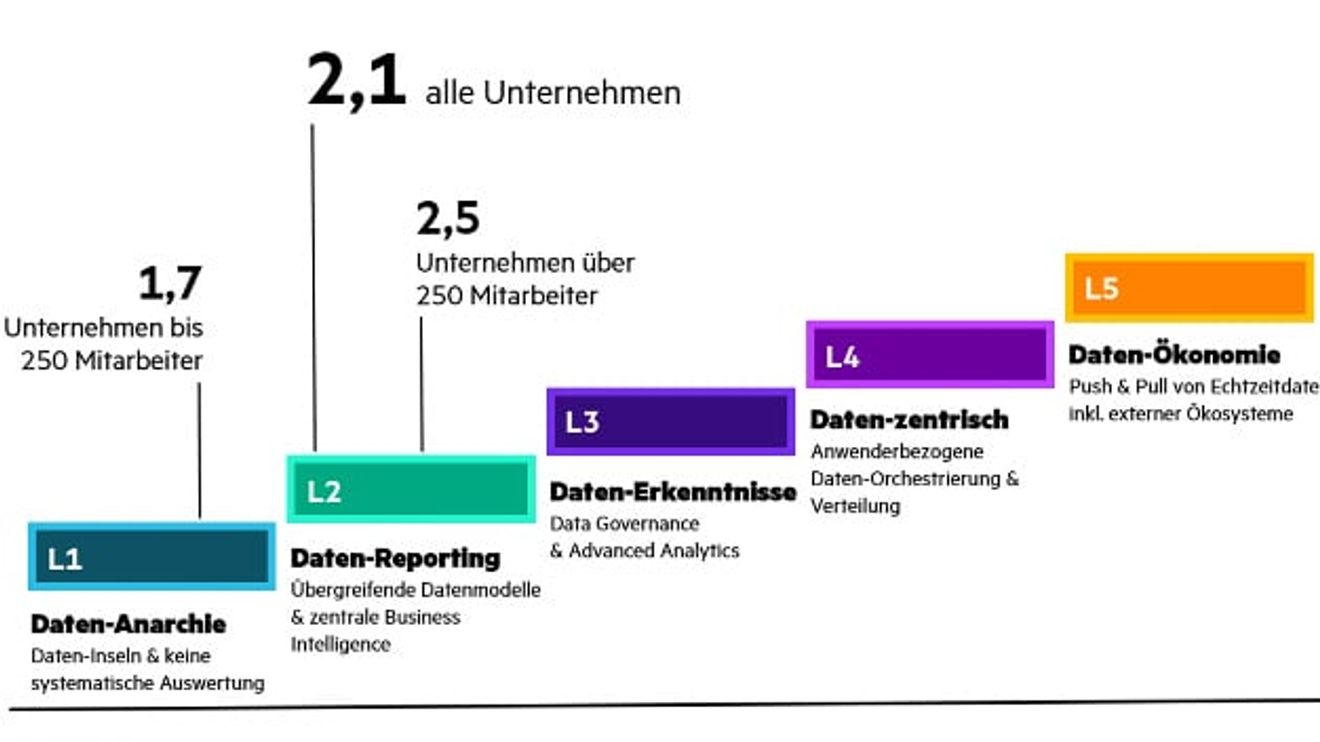
The HPE maturity model with the 5 maturity levels shows: At 2.1, the average data value creation maturity level in German companies still has a lot of room for improvement.
© HPEData is the "lifeline of economic development" - this is the generally prevailing postulate in the manufacturing industry. But how well equipped are companies in Germany, Austria and Switzerland in this respect? A survey conducted by the market research company YouGov on behalf of Hewlett Packard Enterprise (HPE) among 803 managers - from CEOs to team leaders - got to the bottom of this question.
For example, 37% of all executives surveyed and 65% of board members and managing directors said that their company had no data strategy at all, not even as part of the IT strategy. Half of all respondents and 75% of board members state that their company does not systematically take care of bringing data-based products or services to market. And 66% of all respondents (85% of board members) state that no analytics or AI (artificial intelligence) methods are used in their company, but that analyses are carried out using spreadsheets.
The HPE maturity model
The survey is based on a model developed by HPE that evaluates the data value creation maturity level of an organization along six dimensions - taking into account strategic, organizational and technological characteristics. The lowest maturity level (1) is called "data anarchy" - here, business units manage their data inventories in isolation from one another and hardly analyze the data systematically. The highest level (5) is called "Data Economy" - at this level, there is uniform data management across internal business units and external ecosystems, and the company uses data effectively to create value.
According to the HPE maturity model, the companies and public institutions surveyed by YouGov have an average maturity level of 2.1 - although smaller companies with up to 250 employees have a significantly lower maturity level of 1.7. For companies with over 250 employees, the average is 2.5.
Source of economic growth
In particular, the exponential growth of professional and industrial data is seen as a key source of economic development in the coming decades. This affects all sectors. McKinsey, for example, has calculated that the utilization of data from connected vehicles could generate annual added value of 250 to 400 billion US dollars for players in the entire mobility system by 2030. Initiatives such as Gaia-X aim to ensure that the necessary data exchange between companies is efficient, compliant with data protection regulations and digitally sovereign for all participants.
However, companies can only realize this potential if they meet a number of strategic, organizational and technical requirements. Data value creation requires, for example, the linking and aggregation of data or data insights from different applications, areas or companies. For example, information from the service department can help the sales department to sell more effectively to existing customers. Usage data from sold products helps the development department to better align the next product generation with customer needs.
It is therefore a sign of a low level of data value creation maturity if the data, its analysis and utilization are restricted to individual areas. In the survey, for example, 42% of managers stated that their data is only available in the respective applications - i.e. it is not available in other applications or has to be transferred there via individual interfaces. Just under a tenth of respondents (9%) stated that their company has established a central data hub for all data (or a data-centric architecture) that also includes real-time data. And for 6% of respondents, this data hub also includes external data sources.
An aid

Rainer Peters, Head of the Business Solutions Group at Hewlett Packard Enterprise in Germany, Austria and Switzerland: "There is no shortcut on the path to the data economy, it requires a holistic approach that affects all facets of a company."
© HPEHPE is now providing an online self-assessment with which companies can determine their own data value creation maturity level and compare themselves with the results of the survey. The detailed results for each maturity level dimension provide a differentiated picture of the company's own strengths and weaknesses. This can be used as a starting point to plan the next development steps for optimizing their data value creation.


You might also be interested in
A first Gaia-X solution
Hewlett Packard Enterprise is now announcing solutions to help companies use Gaia-X. The focus is on a framework, a marketplace and services.
 read more...
The edge-to-cloud architecture
HPE, Intel and Microsoft are now jointly launching an integrated edge-to-cloud architecture for industry. The aim is to enable the end-to-end exchange of data and services in heterogeneous and distributed manufacturing environments.
read more...From sensor to intelligent system
Sensors, measurement technology and artificial intelligence are merging to form intelligent systems. From June 9 to 11, 2026, Sensor+Test in Nuremberg will showcase the most important trends in a changing industry.
read more...Solid sales development in 2025
The Kistler Group generated sales of 424 million Swiss francs in 2025. With a currency-adjusted decline of 1 percent, or 5 percent in Swiss francs, the company was able to keep sales stable compared to the previous year.
read more...Chauvin Arnoux at the SPS 2024
Multimeter for hazardous areas
With the 'MTX 3297Ex', Chauvin Arnoux is launching an intrinsically safe multimeter for continuous use in potentially explosive ATEX environments.
read more...Submit applications now
The AMA Association for Sensors and Measurement (AMA) is calling on scientists and developers from industry and research to apply for the AMA Innovation Award 2025. We are looking for research and development results in sensor and measurement...
read more...Management expanded
Axel Hessenkämper joined Janitza as the new Chief Executive Officer (CEO) on September 1, 2024 and is part of the management team alongside Mr. Janitza, Mr. Müller and Mr. Veidt.
read more...Update for multifunctional energy analyzer
The multifunctional energy analyzer 'UMG 806' from Janitza is now available in a low-power version and with UL certification.
read more...Three-phase adapter for test devices and CEE sockets
Gossen Metrawatt has introduced new three-phase adapters for connecting test devices to 5-pin CEE sockets.
read more...