
Digitization
Cebit 2018 - the change
Cebit - that's 30 years of IT history. Deutsche Messe has undergone a fundamental change to ensure that tradition does not become a burden and that digitalization is actually lived at the exhibition grounds in Hanover.
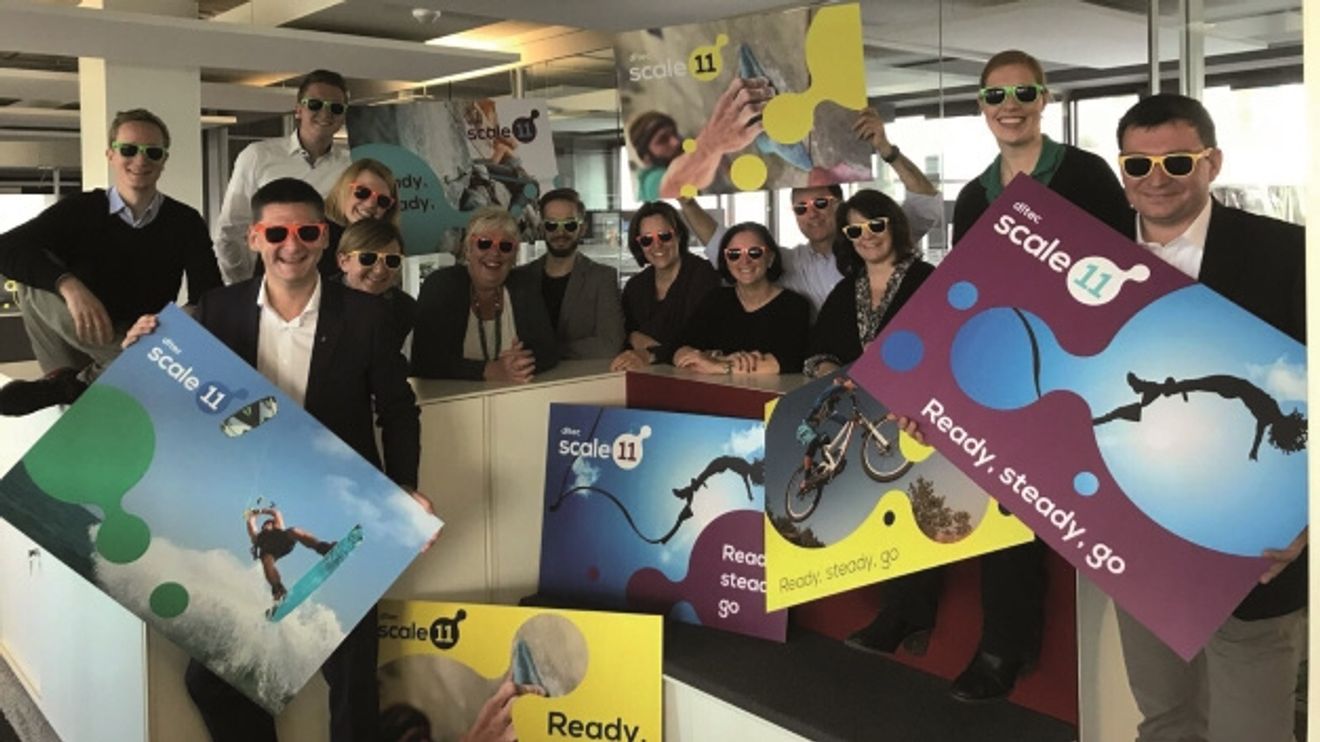
Young and digital: The new Cebit represents a "momentum", also for Deutsche Messe itself
© German Trade FairIt all started with a world record. From 1970, Hall 1 at the exhibition grounds in Hanover offered over 81,000 square meters of exhibition space and made it into the Guinness Book of Records as the "world's largest exhibition hall" - including 750 small prefabricated apartments for the exhibitors on the roof of the monumental building. The birth of "Cebit" - Hannover Messe's "Center for Office and Information Technology".
In 1970, however, it was mainly manufacturers of data processing machines and office tools such as typewriters who presented their innovations in Hall 1, and subsequently in other halls for reasons of space. Only gradually were IT providers added: the age of the PC dawned and gradually went beyond the scope of Cebit as part of Hannover Messe: in 1986, the first "Hannover Messe Cebit" followed as an independent event and as an important part of the coming IT decades - which reached far beyond Germany's borders.
Farewell, computer fair
Over the past 30 years, a lot has happened at the exhibition center in the capital of Lower Saxony. Whether it was Windows 95, presented to cheering crowds by 39-year-old Bill Gates himself, or the first MP3 player - many technologies celebrated their public premiere in Hanover and made "Cebit" the world's largest computer trade fair.
Since those days, however, the industry has also changed fundamentally and Cebit no longer wants to be seen as a computer trade fair, in line with the development of IT - less hardware, more solutions business, as Deutsche Messe board member Oliver Frese announced in 2016. The organizers had already set fresh impulses in 2014, giving the trade fair a clear B2B focus and writing "digitalization" in large letters on the banners. Away from product-heavy events such as Computex in Taipei or CES in Las Vegas, towards a "global event for digital business".
A bang for the buck
Despite many innovations, young formats such as the start-up hall Scale 11 or trend topics such as virtual reality and drones, Cebit had to be measured again and again by the industry, visitors and the press against previous years and its own history, and its current exhibitor and participant numbers had to be taken into account. "The trade fair was getting on in years," explains Cebit spokesperson Hartwig von Saß in an interview with funkschau.
Then came the bombshell at Cebit 2017: with the megatrend of digitalization and ever faster disruption, the industry's demands on its central event platform would also change, explained Oliver Frese on the Wednesday of the trade fair. "That's why Cebit will also change noticeably now." Together with the digital economy, the trade fair is being restructured from the ground up. After 30 years of history, the event is to become a completely new experience, a new Cebit. It will be "more fun, surprising, courageous, open up new horizons and sometimes provocative", says Frese. It relies heavily on emotions and thus makes itself fit for Generation Y. Many details of the exact concept were still being worked out at the time, but two important changes had already been decided: the new spelling "Cebit" and the future date. For the first time, Cebit will no longer take place in March and mark the start of the IT year, but in June and thus far away from the often icy gusts of wind that turned the walk from hall to hall into a gauntlet.
A white sheet
However, the changes are far more than just weather-related and cosmetic in nature. The organizers have called everything into question and initiated a restructuring that is said to be unique in this form in the history of the trade fair. Only the Cebit brand and the Hanover venue were set, all other aspects were up for discussion and disposition. Deutsche Messe wanted to start on a blank sheet of paper and, according to its own statements, break completely new ground.
The fact that Cebit 2018 is a rejection of business as usual can also be seen in the process of finding a "new language". In 2016, consultants, journalists, exhibitors, marketing experts and even people who had never been to Cebit before came together in an artist's studio in the start-up metropolis of Berlin. The aim was to shape and inspire the new trade fair with unbiased, multifaceted and non-IT opinions. The result of the brainstorming session: Cebit should emphasize its conference and networking character and be more of an event than simply a trade fair. "Cebit as an experience," explains von Saß. More than just rational benefits. The aim is to appeal more strongly to a young, technology-savvy target group in addition to the existing visitors, to ensure more diversity among the participants and to anchor digitalization deeply in the structure of the event.
"Highly efficient business platform"
Despite jeans and a shirt instead of a suit and tie, the new Cebit is intended to be a new beginning, but not a break with the tradition of the past three decades - rather a bridging of the gap. Deutsche Messe is therefore planning a digital festival that will be a "highly efficient business platform" consisting of four core elements, not despite but precisely because of the fresh impetus. Firstly, the "d!campus", a central area in the heart of the exhibition grounds under the wooden pavilion in front of Hall 12, where concerts by artists such as Jan Delay will take place, visitors can sample street food and network between exhibitor showcases until late in the evening. The 9 a.m. to 6 p.m. mentality is also a thing of the past with the new schedule. In 2018, Cebit will open its doors from 10 a.m. to 11 p.m. for the first time, so as not to counteract the festival character with a time clock.
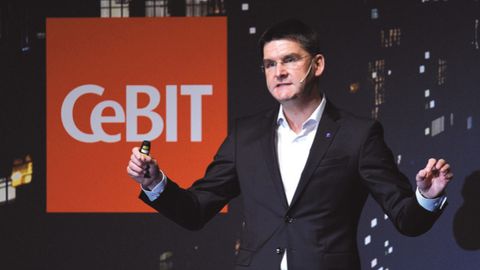
Oliver Frese, Member of the Board of Management of Deutsche Messe: "The new Cebit is more fun, it surprises, is courageous, opens up new horizons and sometimes provokes."
© German Trade FairOn the other hand, a total of seven exhibition halls are part of the new concept under the title "d!conomy", which not only accommodate the majority of exhibitors, but also underpin the trade fair's enduring business claim. In addition, there is the conference and workshop format "d!talk" and "d!tek", which, according to the organizers, is a meeting place for start-ups, founders, developers and "disruptive business models".
Many exhibitors welcomed this in part radically new concept and immediately spoke out in favor of the joint approach when it was announced at the beginning of the year. "This strong concept for the new Cebit is the necessary break with the past - a real new beginning," explained Helmut Binder, CEO of Materna. "In recent years, it had become increasingly difficult to convince our customers to visit Hanover." The familiar format would no longer have been attractive enough for many. "That is now being changed," says Binder.
At the same time, however, the Cebit organizers are aware that not every company, every previous exhibitor, will find themselves in the new concept of the trade fair. "If we go down this route, we will lose one or two companies," von Saß explains to funkschau. After all, no company should have to disguise itself. At the same time, the trade fair, which has emerged from the fountain of youth, can be a good benchmark for many providers and users from the industry and beyond to see how much "digital" is already in their own DNA and how willing they are to face the much-vaunted changes that the disruptive nature of digitalization brings with it.
A momentum
This German trade fair itself shows just how deep the will to transform goes. According to von Saß, Cebit is a momentum, for example, to drive forward new ways of working. The company, with around 1,200 employees, is opening up more and more, working increasingly with external experts to bring in new ideas and new ways of thinking. "If we are organizing an event for young people, then we also have to involve young people," the Cebit spokesperson explained to funkschau. At the same time, however, the company can continue to draw on decades of experience in the trade fair business. A dualism that should find a unity in Cebit: old and new, analog and digital, festival and business.
The signs are good for the new format. Other events such as the Web Summit in Lisbon or South by Southwest in Texas have shown how successfully technology and digital lifestyle can be combined. In addition, Cebit is a strong global brand and the largest IT trade fair in the world. Now the event is taking a bold, sometimes radical approach that not only brings digitalization to the exhibitors' stands, but also roots it deeply in the core of the trade fair itself. Of course, this will have little in common with the early days of the "Center for Office and Information Technology" and Cebit from the 1990s. But neither is the technology world that it was 20 years ago.


You might also be interested in
Salesforce becomes a premium partner
The ICT trade fair Cebit is reinventing itself - and companies such as Salesforce see their opportunity to make digitalization tangible. Because it affects everyone. Just like the consequences.
 read more...
Strong presence at Cebit 2018
With more than 800 square meters of exhibition space in Hall 12, Hewlett Packard Enterprise (HPE) wants to use the new Cebit in June to demonstrate how intelligent and autonomous systems will create the added value of the future.
read more...Sovereign edge-to-cloud platform for the industry
Hilscher Gesellschaft für Systemautomation and Schwarz Digits have announced a cooperation to provide sovereign European edge-to-cloud solutions for the industry.
read more...Marco Geiser becomes new Vice President Secure Power DACH
Marco Geiser has held the position of Vice President of Secure Power DACH since April 1, 2026. In this role, he will strategically develop the Secure Power business in Germany, Austria and Switzerland, strengthen it operationally and focus it on...
read more...Cloud security often inadequate
According to Red Hat's "State of Cloud-native Security" Report 2026, 97% of the companies surveyed with hybrid cloud environments reported security incidents within a year. This is based on data from around 600 IT specialists.
read more...Partnership for edge AI in industry
Nota AI and SiMa.ai have agreed on a strategic collaboration to develop AI solutions for industrial applications. The aim is to optimize AI models for use directly on devices at the network edge, where high computing power and energy efficiency are...
read more...Edge AI HPCs for Vision AI and GenAI
Advantech has announced the 'AIR-410' and 'AIR-420', next-generation compact Edge AI high performance computers (HPCs). Combining AMD Ryzen 7000/8000/9000 series processors, scalable GPU support and Advantech's 'Edge AI SDK' software, the systems...
read more...Virtualization shapes factory automation
With the new version of its 'Software Defined Automation' platform, Logiccloud shows how virtualization and AI are changing industrial automation. An integrated AI assistant enables the rapid creation of complete automation apps.
read more...ESTIA to strengthen Europe's cloud
New tech alliance for EU sovereignty
Twelve companies, including Dassault Systèmes, are founding the European Sovereign Tech Industry Alliance (ESTIA). The initiative aims to strengthen Europe's technological independence and define requirements for sovereign cloud services. The start...
read more...