
Weidmüller
The smart grid in the ground
When visitors walk across the Weidmüller stand this year with their eyes downcast, this is not an expression of disinterest. On the contrary: their attention is focused on a special exhibit - the concept of an intelligent floor for the factory of the future.
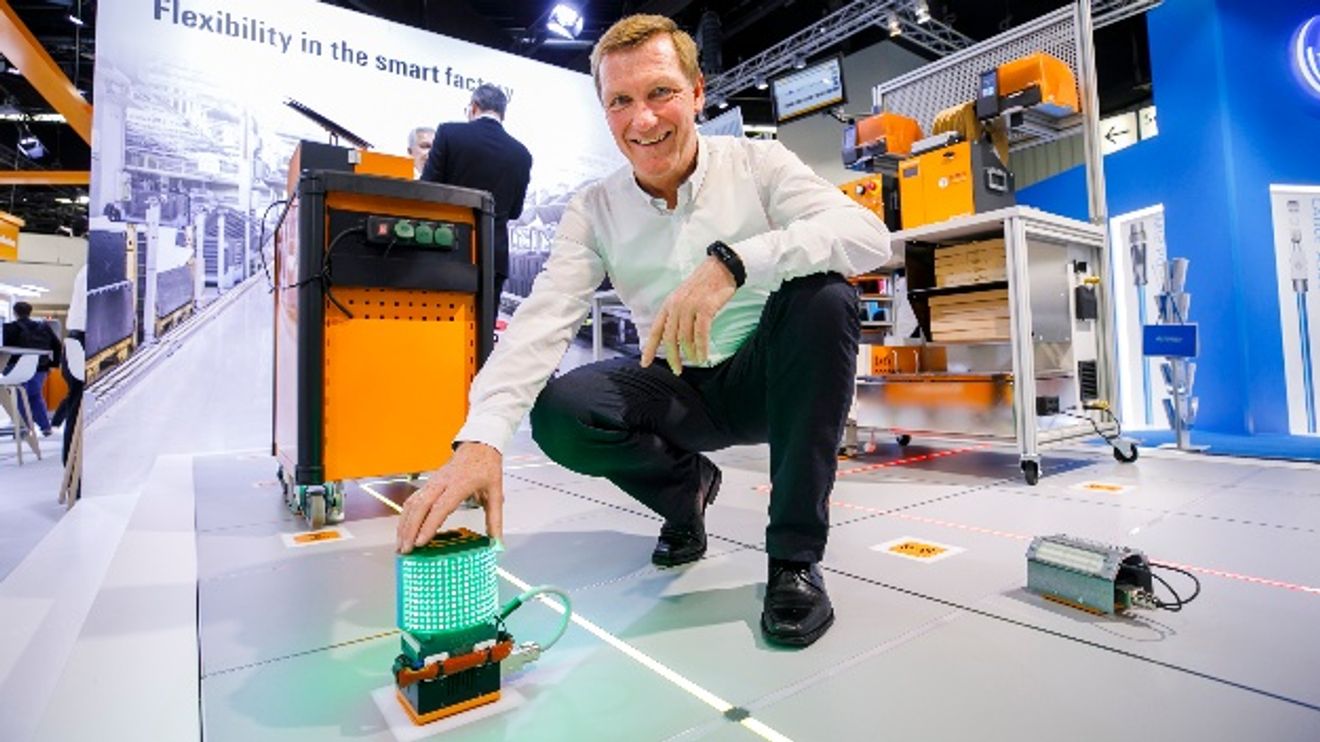
Many experts are convinced that only the outer walls will be fixed in the factory building of tomorrow. Instead of rigid production lines, machines and systems will move freely and communicate with each other in the IIoT to continuously improve production processes. And intelligent networks will take the place of central control mechanisms.
An important prerequisite for implementing this vision is a decentralized supply and data infrastructure. With the intelligent floor, Bosch Rexroth has developed a corresponding system consisting of panels measuring one square meter, each with its own control system. Weidmüller laid twelve square meters of these at its own stand at this year's SPS. The reason for this: The components and solutions from the Detmold-based company ensure both the decentralized and at the same time modular supply and automation of the individual panels as well as the contactless transmission to the consumers on the floor. As Christian Deppermann, Key Account Manager at Weidmüller, explains, the system is designed as a raised floor: "This not only provides space for the cabling of the control units, but also for the supply of cooling water, compressed air or lubricants."
In concrete terms, production in the factory of the future looks like this: A higher-level system in the production hall or in the cloud evaluates the upcoming order batches. It then moves and places the devices and machines accordingly. Ad hoc changes to logistics routes are also possible. The changing work zones are marked by light strips so that operators and vehicles can always move safely through the factory.
Rexroth has implemented the necessary modular and decentralized plug-and-play provision of the required 400-volt supply and 24-volt control voltage on the basis of Weidmüller's FieldPower concept. This also brings intelligence to the floor: In addition to the control and network technology, load cells and a nutrition sensor system are also integrated into the decentralized functional units.
When devices, machines or automated guided vehicles (AGVs) move on the floor, they are supplied with power and data via contactless transmission units. According to Deppermann, the key advantages of this are: "Firstly, the consumers no longer have to be in a fixed location where their supply is guaranteed. Instead, they can be arranged flexibly or move themselves. Secondly, contactless energy transmission prevents expensive production downtimes caused by wear and tear on devices. This is because defective contacts are often the reason for time-consuming repairs." With the FreeCon contactless system from Weidmüller, up to 240 watts are transmitted via a 5 mm air gap. This ensures a particularly high power density compared to similar solutions on the market with an efficiency of up to 93%.
According to Deppermann, it is also possible to initially introduce the intelligent floor in partial areas of a production facility: "If the entire room does not require contactless energy transmission, tiles without functions are laid in peripheral areas or on defined paths. This enables the user to gradually switch to flexible production concepts and thus reduce investment costs. Together with Bosch Rexroth, we are now working on making the intelligent floor ready for series production.


You might also be interested in
The Chief Financial Officer changes
André Sombecki is the new Chief Financial Officer of the Weidmüller Group in Detmold. He succeeds Jörg Timmermann, who is leaving the company at his own request on February 29, 2020.
 read more...
On the way to the world library
The vision has been in place since the end of 2014: OPC UA is to achieve the status of a globally recognized standard for the Industrial Internet of Things IIoT by 2019 at the latest. During the press conference at SPS, the Foundation took a stand...
read more...More investment in software expertise
The economy is leaving its mark: compared to the previous year, Turck expects total sales of around 640 million euros for the 2019 financial year, a decline of 3%. Nevertheless, Managing Director Christian Wolf is optimistic.
read more...A look back at the fair
The 30th SPS was the highlight of the automation industry at the end of November. The keywords 'digitization' and 'digital transformation' were visible right through the halls. The main trends can be seen in the film below.
read more...SPS 2019 in retrospect
The 30th SPS, the trade fair highlight of the automation industry, took place at the end of November. The buzzwords 'digitalization' and 'digital transformation' were visible throughout the halls - the most important things in the film.
read more...Dynamically driving high speed motors
Under the name SD4x, Sieb & Meyer is developing a new generation of frequency inverters for high-speed applications. The first of these is the SD4S version, which is designed for small high-speed spindles and motors with a power output of just a...
read more...Individual standard products
Prime Cube' is a product brand for IPCs and HMI solutions introduced ten years ago. Matthias Klein, Managing Director of Schubert System Elektronik, reports on how the brand is kept fresh.
read more...Industry 4.0 'off the shelf'
iniNet Solutions has developed an automation architecture based on web server-supported SCADA and programming software, which is intended to bring manufacturing companies more easily than ever to industry 4.0 level. This architecture can be seen at...
read more...Plug and play into any cloud
A year ago, Cloudrail unveiled the 'CloudRail.Box' for the first time - a gateway that connects plug-and-play to IO-Link sensors and masters and sends the data to any cloud platform. Now it also handles OPC UA and Edge Computing.
read more...