

Research
The choice of funding
Research projects can be funded either through traditional project funding from the state, federal government or EU or through the research allowance. When does what make sense?
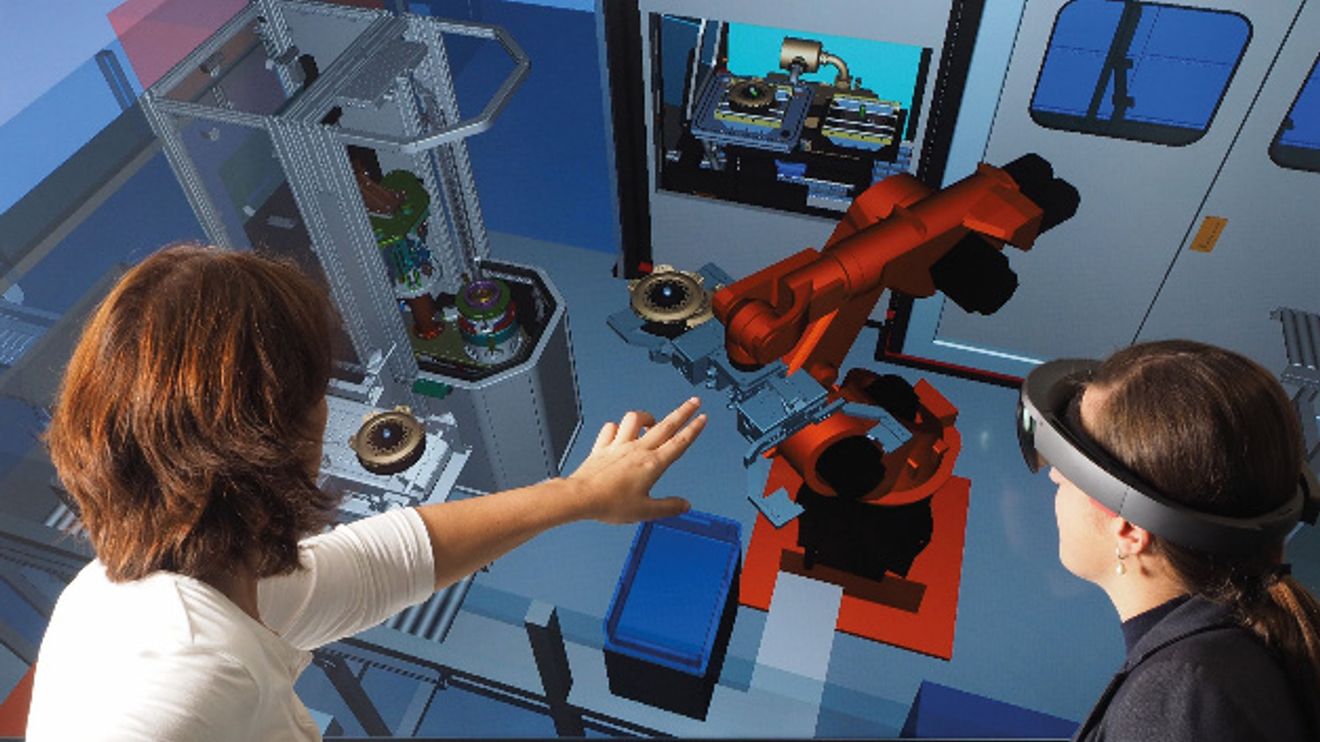
Traditional project funding has a catch for many projects - especially in the IT sector: completed in three to nine months with a large workforce, such projects are too short-term for the lengthy application process. However, the so-called research allowance has been available since the beginning of 2020. Innovative companies can claim a quarter of their R&D personnel costs against tax. The advantages of this new subsidy are that the requirements for development projects are low, as they involve applied, product or process-related developments that exceed the technological status quo in the company. As an example of a funded development, ISG has developed an open simulation platform based on a digital twin, in which even external simulation models can be integrated, as well as virtual controls and real hardware, so that a real-time simulation is created under full control. The application process is relatively unbureaucratic and, above all, the application can also be submitted retrospectively. This means that ISG has the prospect of around half a million euros in additional liquidity, which can be invested in further innovative projects.
The Stuttgart-based company ISG has been working together with the funding provider Partner für Innovation und Förderung (PFIF) for around ten years. In the early years, only one project was funded each year, but this has now increased to four, split equally between ISG's two specialist areas of simulation and CNC. They meet twice a year to exchange ideas, and there is an almost weekly telephone call between Stuttgart and Lahr. This is necessary because PFIF advises its customers with its background information on specific funding pots and emphasizes aspects of content so that they fit exactly with the tender - whether in mechanical engineering, electromedicine or the textile industry, whose projects all become more digital.
Research allowance: the chances of success are higher
As projects can only be funded either through traditional project funding from the state, federal government or EU or through the research allowance, an assessment by a specialist is extremely important. For example, a training program with the digital twin is funded by the BMBF as a grant project because it is a long-term, strategic project. In future, the twin will not only be used for faster commissioning, but also for virtual training before commissioning or for new employees. To this end, the Stuttgart-based company is working with the University of Bamberg to develop a didactic concept that allows error scenarios to be run through easily, just like in a flight simulator. No mechanical engineer would allow such delicate situations to occur on his real system - emergency stops, machine downtime or even deliberate errors.
Although project funding offers higher grant rates of up to 60 percent, the time and bureaucratic effort involved is higher and the chances of success are lower than with the research grant. In contrast, this is practically made for IT companies, because it is aimed more at short-term projects with a lower degree of innovation.
The author: Jens Gieseler is a freelance journalist


You might also be interested in
The e-paper special: looking for products of the year 2024
They've earned it: all 96 nominated products from 12 categories in their own e-paper. Browse through the individual areas and make your personal selection. You can also find out more about the companies and their solutions in the accompanying video...
 read more...
Create digital twins easily
ISG Industrielle Steuerungstechnik will be presenting current developments such as the ISG-virtuos simulation software, the ISG-kernel control kernel and the ISG-dirigent test automation tool at the SPS.
read more...Real-time simulation of plants and factories
ISG Industrielle Steuerungstechnik has further developed the ISG-virtuos simulation platform. Machine and plant manufacturers use it to create simulation models, particularly for virtual commissioning, but also throughout the entire life cycle of a...
read more...Acceleration thanks to prefabricated component models
ISG Industrielle Steuerungstechnik is launching two innovations on the market: Firstly, the ISG-virtuos simulation platform has been completely revised to cover the entire life cycle of a system. Secondly, the provider is bringing the TwinStore to...
read more...SPS Connect 24.11. - 13:50 - 14:10
Digital value creation - virtual commissioning as an enabler
VIBN is now an established phase of the engineering process for leading suppliers of automation solutions. The benefits of VIBN can also be seen financially as a short-term ROI based on "best practice" implementations.
read more...SPS Connect 24.11. - 16:00 - 16:20
Project planning Digital twin for virtual commissioning
The benefits of virtual commissioning (VIBN) are well known on the market: Shorter project lead times, higher software quality, optimized system performance, working from home.
read more...SPS Connect 24.11. - 16:40 - 17:00
TwinStore for component models for virtual commissioning
Increasingly, component manufacturers are looking for solutions to provide certified digital twins of their hardware products to enable their customers to virtually commission (VIBN) automation solutions. The TwinStore makes this a reality.
read more...News from the Software & IT sector
Software & IT is also becoming increasingly essential for manufacturing. As a result, numerous products with this focus are coming onto the market - as the following series of images shows.
read more...Automate the test
Machine and system manufacturers are increasingly moving towards simulating control software before commissioning in order to correct any errors in advance. Instead of carrying out the tests manually as before, it is advisable to switch to an...
read more...