

Phoenix Contact
PLCnext becomes tangible
At SPS IPC Drives 2016, Phoenix Contact presented PLCnext, a concept for the controller of tomorrow. One year later, it is now becoming tangible in the truest sense of the word.
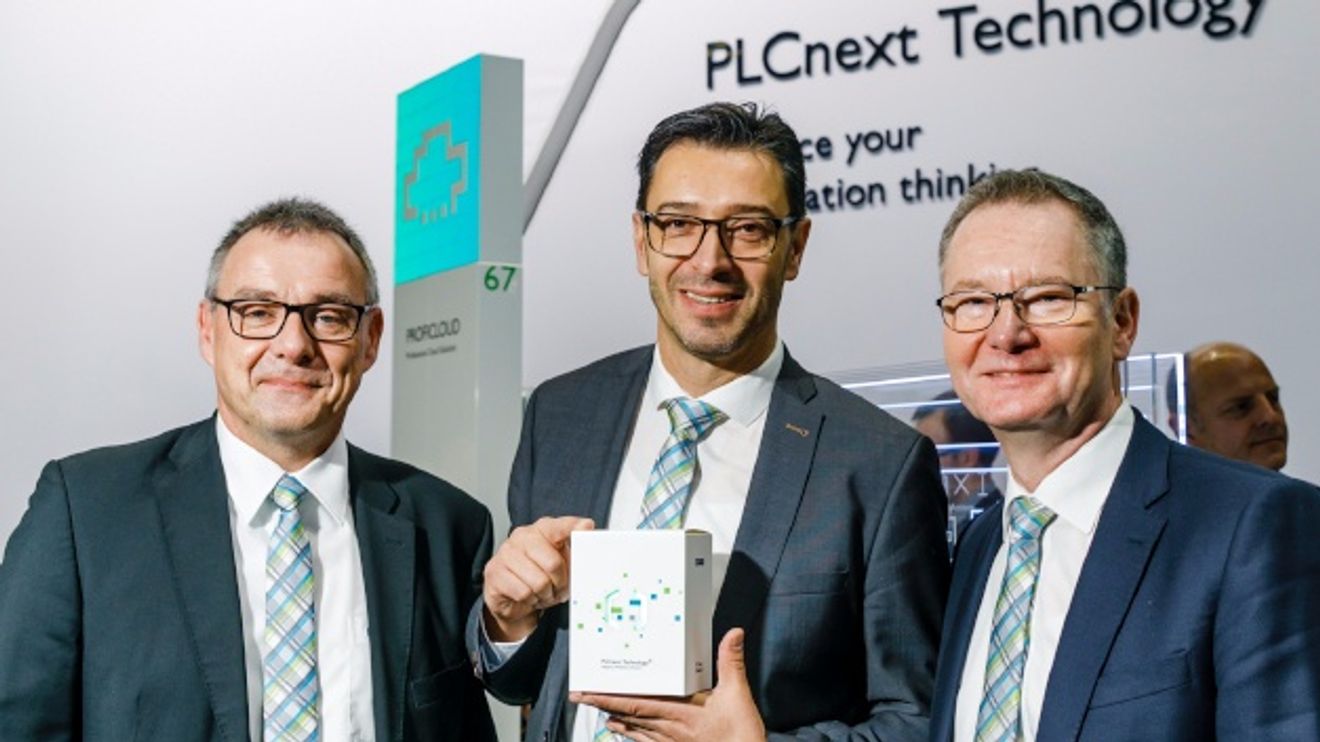
Under the name 'AXC F 2152', the Blomberg-based company is presenting the first industrial controller based on PLCnext technology at the trade fair: The controller family starts with a dual-core hardware architecture with 512 MByte memory and 800 MHz system clock and initially serves primarily the market for decentralized, modular small controllers. According to Ulrich Leidecker, Managing Director of Industrial Management & Automation at Phoenix Contact, the first controllers in the high-end series and the integration of safety technology will follow in 2018.
What is special about PLCnext? First of all, the controller is based on an embedded Linux architecture that has been expanded to include real-time capability. However, the core of the technology is located one level higher in the system architecture. Until now, control programming - assuming determinism as the basis - was only possible using defined PLC programming languages. By providing an open platform on which several developers from different generations and programming disciplines or domains can work on a control program in parallel, Leidecker says that engineering is simplified considerably.
The different program sequences do not have to be integrated into an IEC 61131 task, as was previously the case, so that they run deterministically. Instead, the patent-pending Execution Synchronization Manager (ESM) allows programs from different development environments to be combined with each other and within tasks, but behave like a homogeneous IEC 61131 code. This would also make high-level language programs automatically deterministic. The second technological aspect is the consistency of the data in the process image, which PLCnext's "Global Data Space" (GDS), for which a patent application has also been filed, provides. Using sophisticated mechanisms with internal port and data buffer structures, the GDS ensures that the individual program elements receive exactly the consistent data image that is absolutely necessary for successful program execution.
In addition to the core elements ESM and GDS, an OPC UA server is implemented in the controller as well as a system, user and fieldbus manager, diagnostic logger, trace controller, PC Worx-Engineer HMI and automatic access to the Proficloud, which is free of charge for the first year.


You might also be interested in
SFC - PLCopen publishes 'do's & don'ts'
Today, guidelines for structuring software exist for many programming languages. As far as the IEC 61131-3 languages and their PLCopen extensions are concerned, there have long been deficits here. PLCopen has now rectified these - including the...
 read more...
Control technology of tomorrow presented
With Industry 4.0, automation technology must become more adaptable and communicative - this is the conviction of Phoenix Contact. In Nuremberg, the Blomberg-based company lifted the curtain on PLCnext - its upcoming open control technology - for...
read more...Safety in sensor technology
What do sensor manufacturers currently offer in terms of safety? At SPS IPC Drives, there were a number of clever concepts on show - including from Sick, Pepperl+Fuchs and Leuze electronic.
read more...Video flashback of the three days of the fair
New hall, new topics and a new name in 2019 - the SPS IPC Drives 2018 in seven minutes.
read more...The review in the movie
New hall, new topics and a new name - that was SPS IPC Drives 2018 in seven minutes.
read more...OPC UA and TSN - a major trade fair topic
The OPC UA and TSN communication standards are major topics of discussion in the industry. This could not be overlooked at SPS IPC Drives 2018.
read more...Smart transport - three approaches in the video
How can material and product transport in machines and systems be reorganized in the age of Industry 4.0? Beckhoff, B&R and Bosch Rexroth presented interesting approaches in this regard at SPS IPC Drives 2018.
read more...'Software & IT' in focus
Last year, SPS IPC Drives bundled the topic of 'Software & IT in manufacturing' in Hall 6. In response to high demand, this concept was extended to Hall 5 in 2018.
read more...The 'Automation Hackathon'
At the 'Automation Hackathon' at SPS IPC Drives 2018, seven start-ups had the chance to develop new business models for selected companies in the automation industry in 48 hours. Winner: the start-up Othermo in collaboration with Wago.
read more...