
Flecs
Industrial Control as a Service
Four companies have set out to completely virtualize the infrastructure and control of a production plant in a development project. The first results are now available.

The process industry is currently facing a number of challenges that are having a significant impact on its competitiveness and innovative strength. A key concern is reducing the time-to-market for new systems. In the face of rapid technological change and intense global competition, the ability to develop products quickly and bring them to market is crucial for success. At the same time, increased flexibility and scalability of production facilities is required in order to be able to react to market changes. This requires systems that can be adapted quickly and cost-effectively to changing production volumes and specifications.
Another trend is the application of IT patterns in the OT area (operational technology), which results in greater integration of IT (information technology) and OT. This integration promises not only new capabilities, but also cost savings through synergy effects. However, it presents the industry with the challenge of adapting existing systems and processes accordingly. These challenges call for solutions that are not only technologically advanced but also economically viable in order to increase efficiency, productivity and ultimately competitiveness in the process industry.
Four companies - one project
Under the term Industrial Control as a Service (ICaaS), four companies have come together in 2023 to form a development project with the aim of creating a scalable automation platform: Copa-Data, Flecs and Software Defined Automation are each contributing their automation expertise. As a user, Boehringer Ingelheim is contributing the practical use case and verifying that the solutions developed meet the real requirements of the process industry.
Copa-Data contributes central automation components with its IEC 61131 Runtime zenon Logic and the zenon Service Engine. They are also contributing their web-based HMI (Human-Machine Interface) and the zenon Engineering Studio, which includes a specially developed IEC 61131 IDE, to the project. Flecs complements the project with its Marketplace, which serves as a central source for all control components to be virtualized, as well as a cloud stack that fully virtualizes the infrastructure and control. Software Defined Automation extends zenon Engineering Studios to a web-based IDE (IDEaaS) and DevOps functions such as source code management and continuous deployment. In addition, SDA Secure Remote Access enables a secure connection between virtualized control and web-based engineering, bridging the gap between these two worlds. Everything together functions under the term Industrial Control as a Service (ICaaS). The first technical proof of concept developed in the course of 2023 has proven to be functional.
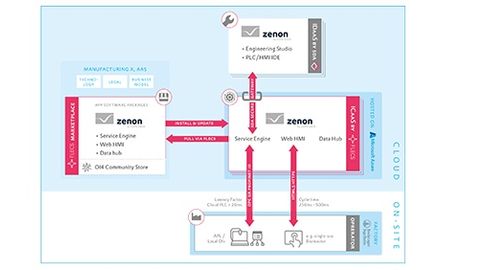
The automation architecture of the pilot project with the user Böhringer Ingelheim. The project is set to be expanded in 2024.
© Copa-DataIn a demonstration project at KIT - Karlsruhe Institute of Technology - the remote IOs of the demo machine were connected to the ICaaS platform via a suitable router. This made it possible to execute the entire control logic in the containerized COPA-DATA zenon Logic. Project planning was carried out entirely in the IDEaaS, the zenon Engineering Studio from Software Defined Automation. The demonstrated savings potential thus results from the replacement of all physical controllers as well as the widely used programming stations and their maintenance. This approach also demonstrated that there is indeed considerable potential to reduce the set-up time of an automation platform for a new system from up to 12 months to ideally one to two weeks.
Virtualized test environments
What are the specific benefits of virtualized control technology, i.e. the use of ICaaS? First of all, it enables the early testing of automation systems in a highly automated and virtualized environment. This approach transforms the traditional multi-stage process - from development to implementation in the production system - by using virtual models and simulations. The advantage lies in the significant reduction in the need for physical infrastructure, which in turn saves costs and time. Developers can test software and system updates in a controlled, simulated environment before they are applied to the real system. This not only increases security, but also enables more flexible and efficient troubleshooting and optimization. In addition, ICaaS offers the best conditions for operating a digital twin, the underlying system, thanks to the virtualized test environment. In order to realistically test possible scenarios and processes without affecting the productive system.
Hybrid operating mode
The concept of ICaaS does not exclude the use of physical controllers. Rather, it supports a hybrid operating mode in which both real and partially virtualized control systems can be used in parallel. This is particularly advantageous in situations where physical control systems are indispensable, such as in safety-critical applications or for equipment in remote locations. The zenon Service Engine with its more than 300 different drivers offers very good prerequisites for this, and this hybrid approach makes it possible to utilize the advantages of ICaaS while at the same time guaranteeing the integrity and reliability of the physical control systems.
Seamless integration and deployment

The automation architecture of the pilot project with the user Böhringer Ingelheim. The project is set to be expanded in 2024.
© Copa-DataAnother technical aspect of ICaaS is the seamless integration and deployment of systems. Developments and tests carried out in the virtualized environment can be transferred directly to physical control systems without extensive infrastructure changes or significant modifications. This process enables fast and efficient commissioning of new or updates to existing systems. The integration of standardized interfaces and protocols facilitates communication between the virtualized and physical environments, which in turn minimizes maintenance and updating efforts.
Security aspects and compliance
In an ICaaS solution, the consideration of security aspects and compliance is central. Virtualization offers the possibility of executing security updates and compliance requirements in the test environment before they are implemented in the real production environment. This also includes checking and adapting to current standards and laws, such as the Cyber Resilience Act. Security protocols and data encryption in the virtualized environment ensure the protection of sensitive information and the integrity of the control systems.
Optimized use of resources
The use of ICaaS allows optimized use of resources and offers excellent scalability. This is particularly relevant when expanding systems or integrating new technologies. The virtualized environment makes it possible to quickly adapt different configurations and capacities without having to replace or expand physical hardware. This supports an agile and adaptable production environment that is able to respond efficiently to changing requirements and market conditions.
The project status
As mentioned at the beginning, an initial technical proof of concept was carried out in the course of 2023. An ambitious expansion of this concept is planned for 2024. This extension aims to further expand continuous integration/continuous deployment (CI/CD) capabilities for automation engineers through the consistent use of cloud technologies familiar from IT. A particular focus is on simplifying processes for automation engineers to enable more efficient and user-friendly access to the creation of ICaaS. In the context of virtualization, Copa-Data plans to enrich its central components with additional functions in order to further optimize their operation in the cloud.
In addition, the integration of AI algorithms is planned at the engineering level. These are intended to help automation engineers analyze existing source code more effectively and develop new software components based on AI. These measures promise a significant increase in efficiency and user-friendliness in the automation industry. Over the course of this year, further companies are to be won over to the innovation project in order to demonstrate its capabilities beyond the process industry.
| The advantages of ICaaS |
|---|
|
The implementation of Industrial Control as a Service (ICaaS) marks a paradigm shift in the speed at which automation platforms can be set up. Unlike traditional systems, which often take months to implement, ICaaS allows this process to be dramatically accelerated, potentially to less than a week. This is achieved through the rapid deployment and configuration of virtual automation components in the cloud. Another time advantage is the efficiency of updates and maintenance: Central management via a web portal eliminates the need for physical access to each control unit, which significantly speeds up the roll-out of patches and security updates and can also be synchronized across the company. The process of testing and quality assurance is also significantly accelerated, as different instances of a system can be tested and evaluated in parallel. This leads to faster consolidation of the test results and speeds up the development process. In addition, ICaaS enables automation engineers to be highly agile in development, as they can work in a virtual environment and quickly adapt and optimize automation processes without having to reconfigure physical hardware. On the financial side, ICaaS offers significant advantages, which are primarily reflected in the reduction of initial investment and operating costs. As ICaaS is based on cloud or server systems, high acquisition costs for physical PLC hardware are eliminated, allowing companies to avoid large investments in hardware and infrastructure. Furthermore, the centralized and automated management and maintenance of the systems means that fewer resources are required for maintenance, which reduces the need for specialized personnel and thus lowers ongoing operating costs. The scalability and flexibility of costs are another significant advantage of ICaaS: companies only pay for the resources and services they actually use, which allows costs to be flexibly adjusted to actual requirements, especially in phases of fluctuating demand. In addition, the automation of routine tasks such as updates, maintenance and tests leads to considerable cost savings, as the time required for these tasks is significantly reduced. Overall, ICaaS thus offers an efficient, flexible and cost-effective solution for automation that enables companies to react quickly to market changes and optimize their operating costs at the same time. |


You might also be interested in
The virtual safety controller
In a two-part series of articles, we shed light on the PLC's path to virtual control. In this second part of the article series, the focus is on functionally safe controllers - i.e. safety controllers. Can they also be virtualized?
 read more...
Manage and secure assets
In today's fast-paced industrial environment, it is essential that production processes run smoothly and efficiently. However, one critical aspect that is often overlooked is the importance of PLC backup and restore procedures.
read more...Update brings support for TIA V19
Delta Logic has updated the 'Accon OPC UA Server' software to version 1.4.0.0. The new features include support for TIA Portal projects of version V19 and for the latest firmware for CPUs of the Siemens S7-1200 and S7-1500 controllers.
read more...Increase in orders for the German electrical and digital industry
The German electrical and digital industry started the second half of 2024 with a fifth more orders (+20.8% year-on-year).
read more...Branch office opened in Norway
The Austrian company Bachmann electronic, which specializes in automation technology for maritime applications, renewable energies and industry, is opening a branch in Norway.
read more...Automation meets innovation
SPS - Smart Production Solutions will take place in Nuremberg from November 12 to 14. Once again this year, organizers and exhibitors will pick up on the trends in the automation industry and present suitable solutions. The introduction of IT into...
read more...Shorter changeover times with pick & place robots
Short changeover times are crucial when processing different workpieces. A pick & place robot is designed to help with optimization. The same standardized interface between the robot and higher-level control system is used for all robot...
read more...Virtualized control systems using TSN backbone
The major challenges in implementing virtualized control systems are scalability and connectivity to the field level. An implementation at the ISW shows that this can already be achieved today using a TSN network.
read more...Expansion of the Management Board
The Supervisory Board of Siemens has announced personnel decisions at Managing Board level in order to further expand its position as a leading technology company and to accelerate the increase in value.
read more...