

Computer systems
With ARM and SQL into the IoT
Good networking options and performance, plus integrated safety functions: Embedded modules and system solutions based on ARM have many advantages in the IoT environment - including for important data handling.

With the advent of networking as part of Industry 4.0 and IoT, a new era of automation has dawned. In order to implement this project in reality, all the necessary data must be available. From a global perspective, there would not be enough energy and storage capacity to store all the data in a cloud. The implementation of this vision therefore depends on sensible concepts. Important prerequisites for this are the localization and networking of all systems and the use of energy-efficient systems on the one hand and the transfer of necessary information instead of complex and large amounts of data on the other. Another important aspect is an adequate security concept for the networking of machines, systems and devices as well as the transmission and networking of safety-critical information. Who wants to risk their information and data being made available to the public or even to competitors due to global hackers, security gaps or inadequate protection?
Companies are therefore faced with numerous tasks for which a solution must be found according to the project-specific requirements. Embedded modules and system solutions based on ARM are one solution. They offer a coherent system and security concept. In addition to the hardware-based security functions integrated in the CPU, there are already many software solutions for implementing secure and reliable systems. In terms of energy efficiency, ARM-based embedded systems in particular are an ideal platform for implementing projects based on the requirements of IoT and Industry 4.0.
High performance
A significant advantage: ARM has the highest performance per chip area compared to other architectures such as Intel, AMD or Power PC and is the leader in chip technology. In addition, ARM-based CPUs from several manufacturers are currently undergoing rapid further development: In terms of performance, in addition to the current computing cores with 32-bit architecture such as Cortex A7, Cortex A8 and Cortex A9, ARM also offers computing cores based on a 64-bit architecture, such as Cortex A53 or Cortex A72. Despite the increase in performance, these can still offer a very good ratio between computing power and power loss.
ARM chip manufacturers are exploiting this advantage and integrating the appropriate application-specific interfaces for almost every market in order to meet the new market requirements, particularly in the area of networking, taking into account high security standards. A price- and function-optimized derivative based on various ARM computing cores is available for almost all sectors, whether for the automotive industry, networking, automation or control and regulation technology.
It is also becoming apparent that further security functions will be integrated in the future. Another point is the area of data transmission. In addition to WiFi and Zigbee, it is becoming apparent that LoRaWan (Long Range Wide Area Network) is gaining ground in the industry.
The advantage of LoRaWan is that a greater range (around 15 km in urban areas and up to 40 km in rural areas) can be achieved. Another advantage is that it can be used inside buildings, as the frequency band ensures good penetration. And the power consumption of LoRaWan end devices is only around 10 mA in operation and around 100 nA in sleep mode. This also allows them to be used in battery-powered devices. Communication between the end devices and the gateways takes place on different frequency channels with different data rates of between 0.3 kbit/s and 50 kbit/s. These features in particular make wireless networking easier and more cost-effective in the IoT sector. A LoRaWan module can be easily connected via USB, SPI or PCIe. Good driver support is offered for LoRaWan solutions for ARM-based CPUs and supported operating systems such as Linux and QNX.
Versatile interfaces
With ARM-based CPUs from various manufacturers, many interfaces such as graphics, Ethernet, CAN, ADCs, SPI and digital IOs are already integrated into the CPU. This means that due to the versatility of the interfaces, most system requirements for connecting suitable sensors and systems for data acquisition can be implemented without much additional effort.
Due to the variety of interfaces and the free choice of operating system, the ARM-based processors can be used universally. Driven by the CPU manufacturers' good application support for various market segments, more and more devices are being developed on the basis of this architecture.
Operating systems specially adapted to the processor type are used for ARM CPUs. Depending on the project requirements, an appropriate OS such as Linux, QNX, VxWorks or a real-time OS from Green Hills or Bare Metal can be selected. This has the advantage of providing the user with optimum performance. This means that even complex control systems in the field of automation can be implemented with very attractive graphics performance without the major overhead of an operating system.
The embedded specialists at TQ have made use of the advantages of the ARM architecture in terms of power loss, range of functions, safety concepts and price advantage: based on available CPUs, they have developed and planned new embedded modules and systems in order to continue offering customers innovative products for applications in the areas of IoT and Industry 4.0. To this end, TQ is offering two new platforms, one based on the i.MX6UL processor and the other on the LS1012A processor.
Data handling for ARM systems
In addition to secure and robust hardware, software is a key component of an IoT/Industry 4.0 solution. This results in the requirement that generated data can be accessed anywhere and at any time. It should also be securely protected against attacks or misuse. One option is a private cloud to which only a certain user group has exclusive access.

However, this requires increasing computing power and therefore an undesirably higher power loss. Databases that meet these requirements are now also available for small computing cores in the ARM sector: With little computing power, all the information required for users and authorized users is made available from the generated data.
In the IoT, sensor devices generate an immeasurable volume of data that is distributed across countless decentralized networks. While much of this data is sent to centralized cloud services, routers, gateways or edge devices are empowered to store and manage data for local analysis and queries. Relying on back-end or cloud services would limit the amount of information that can be captured and pose serious security risks.
Use of an SQL database
For less powerful embedded systems, an SQL database allows raw data to be compressed into meaningful information. By identifying recurring information and comparing specific patterns across different data sources, an embedded system can make intelligent decisions and provide helpful suggestions on how to keep the information available. Database indexes ensure that data can be processed with consistent performance and without overhead, regardless of the volume of data recorded on each individual device.
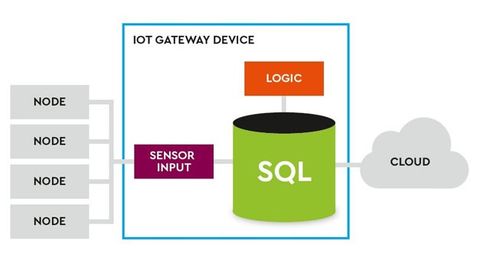
Database transactions protect the data at the same time and prevent corruption after an unexpected system failure. The use of an SQL database enables several accesses to be carried out simultaneously thanks to a multitasking process. A single database file is shared securely and efficiently.
If possible, users should not implement a customer-specific data management framework, as this can usually be very costly and often does not produce the desired result. A market trend can be recognized here: The requirements are preferably implemented using a well-supported library solution that has already been tried and tested by the manufacturer. This offers simple development and maintainability in conjunction with an embedded ARM module. If developers rely on a TQ module or a platform with an already adapted ITTIA SQL database solution for development, they can concentrate primarily on their application development and rely on a solution module to obtain the best data management configuration for the planned application.
Especially in the area of embedded solutions, the ARM architecture with its eco-system geared towards this area represents a reliable, robust and long-term available platform for solutions of the future.
Author:
Konrad Zöpf is Product Manager for ARM devices at the TQ Group.
Partnership with ITTIA
The technology company TQ and ITTIA entered into a partnership at the end of February. In future, they will jointly offer a combination of embedded hardware and database software solution. The aim is to make it easy to manage and link data in industrial automation, the automotive industry, smart metering and other areas. The ARM architecture platforms and the database software from ITTIA DB SQL are characterized by their scalability.
In combination with TQ Group's hardware portfolio, ITTIA's embedded SQL database software offers advantages such as easy development, high performance and integrated data management capabilities without the need for a database administrator. The data is stored directly in each device and managed via the device itself. The flexibility provided by ITTIA and TQ adds value and reduces the need for engineering resources to develop device solutions that reliably link and manage data.
Thanks to the partnership between ITTIA and TQ, customers are now able to utilize significant memory and storage resources to execute full SQL queries with special attention to standards and connect to other embedded systems and the cloud. By integrating ITTIA's SQL database software, TQ's embedded systems can collect, store and analyze data internally, providing only the necessary information for both local processing and remote analysis. The devices can communicate directly with each other, retrieve data on demand and execute SQL queries over a local network with the SQL database server. In addition, the ITTIA software ensures the protection and replication of critical data for TQ applications across multiple network nodes.


You might also be interested in
The e-paper of issue 06/23
How can digitalization and artificial intelligence help to make production processes sustainable? How can cobots and automated guided vehicles bring variety to everyday working life and how can they support people? Starting points in this issue.
 read more...
COM Express modules with Intel hybrid technology
With the COM Express Compact module series 'TQMx120' and 'TQMx130', the TQ Group is expanding its range of embedded modules in the 15 W, 28 W and 45 W CPU power ranges.
read more...Four new module series
There are four new module series from TQ: TQMa243xL, TQMa64xxl, TQMa117xl and TQ110EB. TQMa243xL and TQMa64xxL (image) are pin-compatible with each other and are based on the Sitara AM243x and AM64xx series from Texas Instruments.
read more...3 questions for ... Edge Computing experts
Mastering the data flow
No one can avoid edge computing at the moment. What advantages does the technology bring to the manufacturing industry? What do users need to be aware of? We asked selected industry experts these questions, among others, and here are the answers.
read more..."A modular hardware approach is an advantage"
The high volume of data combined with the increasing complexity of the data at the edge places certain demands on the hardware. Harald Maier from TQ knows what users need to look out for when making their selection.
read more...IPC & Embedded Computing - the winners!
Which products came out on top in the 'IPC & Embedded Computing' category? Here you can find an overview of the winners.
read more...Housing-less lightweight
The ILM-E from TQ-RoboDrive, a division of TQ, is a variant of its predecessor 'ILM' and represents the next generation of frameless motors.
read more...First industrial robot based on the modular principle
With the ILM-E frameless motor, the TQ Group supplies the heart of the world's first modular industrial robot. The plug&play robots from Kea Robotics are assembled according to the modular principle.
read more...TQ-Group supplies Kea Robotics
First industrial robot based on the modular principle
With the ILM-E frameless motor, the TQ Group supplies the heart of the world's first modular industrial robot. The plug & play robots from Kea Robotics are assembled according to the modular principle.
read more...