
Launch of 'Invent a Chip 2020'
Good ideas wanted
"Who has the best idea for a microchip?" is the task for the 'Invent a Chip' school competition initiated by VDE and BMBF for the 19th time. Young talents who enjoy technology, science and mathematics are in demand.
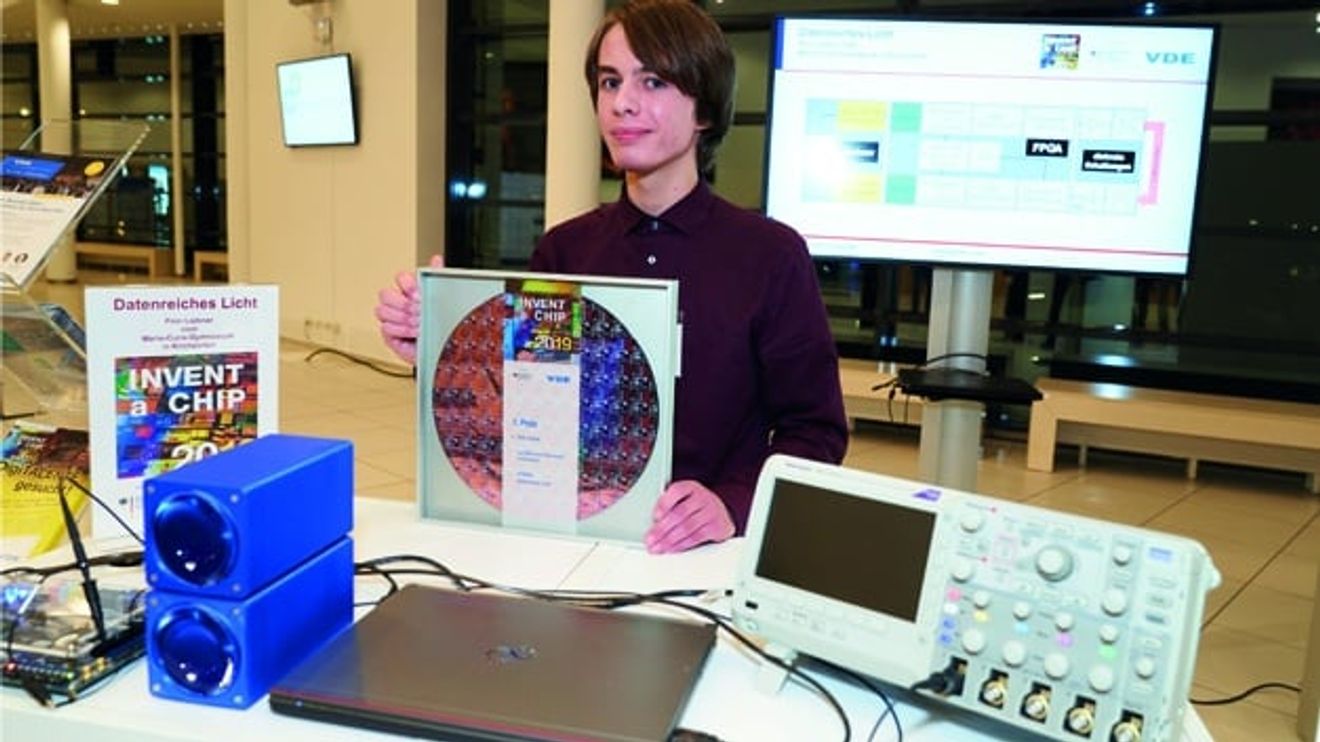
To take part, the young people have to answer a questionnaire with 20 questions about the world of microelectronics and submit their own chip idea to the VDE by March 29, 2020. "The young people don't need any previous technological knowledge; we teach chip design in the practical part of our competition at a camp at Leibniz Universität Hannover. They can also apply as teams," explains VDE CEO Ansgar Hinz.
Last year, around 2,000 pupils took part, with ideas ranging from a robot that recognizes and collects garbage to intelligent drug management, a smart cat flap and secure data transmission via light.
Focus on "secure microchips"
Microchips play a central role in many electronic applications today. They can be found almost everywhere, in kettles, smartphones, intelligent driver assistance systems in cars or they can even control the entire smart home. Burning batteries, hacker attacks on digitally networked devices or e-scooters that veer off course due to radio waves - new technologies can be susceptible to faults and therefore also dangerous.
"The chips must function safely and reliably. We have taken the 100th anniversary of the VDE mark as an opportunity to place Invent a Chip under the motto 'Safe microchips' this year. The questionnaire provides an initial insight into various aspects of safety and the world of microchips," says VDE boss Hinz.
"Fit for Chips"
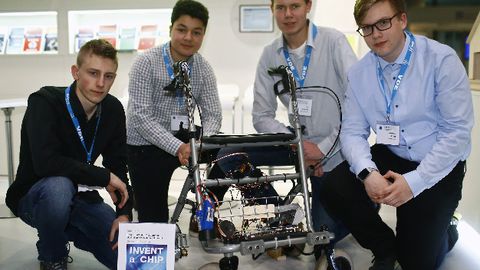
In 2019, the Federal Ministry of Education and Research's special prize of 2,000 euros went to Robin Breitfelder (15), Tim Jungnitz (16), Maximilian Krebs (16) and Jamal Lkhaouni (15) from Lindlar Grammar School. They developed an intelligent rollator. It can recognize obstacles, detect its position and has an emergency function. "If the rollator tips over and its user falls, a fall alarm is triggered," is how the jury described the concept of the award-winning microchip.
© VDETen teams with the most interesting chip ideas will attend a camp at the Institute of Microelectronic Systems at Leibniz Universität Hannover from May 7 to 10. "There they will learn first-hand about chip design from experts. They will read sensors, control actuators or learn how to implement their projects with freely programmable logic gates," reveals the VDE boss. The practical teams will then have until September to work on their projects and will be in close contact with each other and the university experts. The winners will present their microchip applications to the public at the Microelectronics Symposium on November 3 in Berlin. In addition to attractive cash prizes, they can expect contacts with industry and universities as well as trade fair presentations or internships.
Participation and documents
Who can take part?
Pupils in grades 8 to 13 from general and vocational schools throughout Germany.
How can you take part?
Stage 1: Fill in the questionnaire online: You will receive an individual certificate of participation for your application portfolio.
Stage 2: Apply with your own chip idea for the practical phase - complete the questionnaire and also upload a description of your idea. A jury selects the ten best ideas for training in chip design. Participation possible for one person or teams with a maximum of four people.
The deadline for submitting the reply form and the chip idea is March 29, 2020.
For inspiration, we recommend the ideas and their winners from previous years:


You might also be interested in
Looking back: Award winners at 'Invent a Chip 2016'
The 'Invent a Chip' student competition organized by the VDE and the BMBF took place for the 15th time. An intelligent rollator and a burglar alarm chip were among the most innovative microchip ideas from the 2,600 participants.
 read more...
Award winner at 'Invent a Chip 2015'
Microchips, which are used as wearable devices close to the body or in clothing, were the focus of this year's 'Invent a Chip 2015' competition. 2,700 young people submitted their ideas. Four have now come out on top.
read more...Safety for smart factories
With the increasing networking of manufacturing processes, embedded security is becoming indispensable in the production environment. Hitex and Escrypt have joined forces to offer their customers the security they need.
read more...The CPU benchmark
PLCopen is currently working with Intel, AMD and ARM on a CPU benchmark. Eelco van der Wal, Managing Director of PLCopen, explains the background to this.
read more...New date for Light + Building
Messe Frankfurt has announced the new date for Light + Building. The planned date is now 27.9. to 2.10.2020.
read more...'Invent a Chip 2019' school competition
Original chip ideas chosen
Chips that transmit data via light, control cat flaps or monitor the dispensing of medication - over 1600 students submitted their innovative chip ideas to the 'Invent a Chip 2019' competition. The VDE and the BMBF have now awarded prizes to the...
read more...'Invent a Chip 2018' school competition
Ideas wanted for the jobs of the day after tomorrow
How will digitalization, robotics and artificial intelligence change people's everyday lives? How and what will the next generation work on? The new round of the 'Invent a Chip' school competition organized by the BMBF and the VDE is looking into...
read more...'H2Eco Award' presented
At the Hannover Messe, Federal Minister for Economic Affairs Robert Habeck visited selected companies whose technologies support the transition to climate-friendly production. On Tuesday afternoon, he presented the 'H2Eco Award'.
read more...Psychosocial aspects of human-robot collaboration
How can robots be used outside of production? Kuka is researching this in collaboration with the BMBF, the German Sport University and RWTH Aachen University. The RoboGym shows what it can look like in reality.
read more...