
Fan cooling
For a long life
Fanless industrial computers are commonplace in today's manufacturing environment. However, there are reasons that speak in favor of the renaissance of active cooling.

Due to the numerous components, which are also located in ever smaller spaces, very high temperatures can develop in industrial PCs - which has an impact on the reliability and longevity of the systems. The processor and graphics card are the main contributors to heat build-up within a PC. Powerful high-end hardware in particular requires a lot of power and generates a lot of waste heat. In order to increase the speed of processors and graphics cards, manufacturers are packing more and more transistors into the small chips. Some manufacturers have 3.4 billion transistors on board in their processors - in an area of just a few square centimetres. Each transistor generates heat as it works, because the current flows through the lines of the computing units at almost the speed of light; the resistance in the copper lines causes heat. And so the surface of the chip heats up. The fact that there are millions of lines close together on the small surface area of the chip further increases this effect. PC manufacturers must therefore find solutions to cool the systems.
Due to their mechanical robustness, fanless embedded computers are the first choice for harsh industrial conditions - but they also have their limits. In addition to free convection as in fanless systems, forced convection - i.e. active cooling - is used in many cases: realized by an integrated housing fan. This transports cool ambient air into the interior of the enclosure or directs the heated internal air to the outside. A positive side effect: the fan also reduces the thermal resistance from the internal air to the external housing. This reduces the overall temperature of the system. The ambient air simply cools the system via the outer walls.
The advantage of active cooling is that it is much more efficient than a fanless system. Heat dissipation in a PC system plays an important role, as the overall operating temperature of the device has a direct influence on its service life. An optimal cooling concept - close to the ambient temperature - is advantageous for every electronic system, as the temperature has a direct influence on the failure rate and can therefore optimize the service life of PCs or displays.
As a general rule, the lower the operating temperature of an electronic component, the longer its service life. The service life decreases exponentially as the temperature rises.
The most sensitive parts
Individual components are particularly sensitive to an increase in system temperature. In addition to hard disks, these include, for example, the power supply for the CPU on the mainboard or the ball bearings of rotating parts. However, the power supply units have the highest failure rate due to the electrolytic capacitors.
An important rule of thumb states that a reduction in the ambient temperature of 10 °C results in a doubling of the service life. Therefore, in many cases, active cooling of a system is preferable to passive cooling, as the thermal load on the components is significantly lower and this increases the service life. This means that fresh, cool air keeps the system young - in comparison to a fanless counterpart.
The widespread opinion that a fan has a negative effect on the service life of a system is no longer correct. With a service life of more than 95,000 hours at 20 °C, current fans are no longer by far the weakest PC system component. Thanks to advances in technology, fans are also becoming increasingly durable. They have special ball bearings and are intelligently controlled. This means that the speed can be adapted to the thermal conditions and no longer runs permanently at full load as in the past. This leads to a longer service life for the fans.
Keeping an eye on costs
In addition, the actively cooled industrial PC is generally cheaper to implement, as large heat sinks, the connection of the heat sinks to the CPU and chipset, as well as heat pipe solutions are significantly more expensive than high-quality fans. This also reduces the number of failures, which often result in expensive service calls.
Active cooling is particularly worthwhile when a system with more powerful components is used, such as in image processing. Passive cooling, on the other hand, makes sense for lower processor performance, extremely harsh environmental conditions (dust and IP protection) or very low ambient temperatures. But even here, the use of a fan can be worthwhile: In these cases, internal fans are often recommended to avoid hot spots.
Whether you need a fanless or actively cooled PC depends on the environment and the required computing power. In other words, the better a system is cooled, the more fail-safe it is and the less maintenance and component replacement it requires.
Author:
Ulli Uffhausen is Public Relations Manager at Inonet.
Passive cooling

Various elements play a role in passively cooled systems - such as installation position, heat sink size and arrangement. Ultimately, the decisive factor in cooling is the heat flow: it ensures that warm air is transported away. The free, natural heat flow (convection) depends on the flow length of the body (e.g. the height of a heat sink) and the flow speed, which in turn is generated by the temperature difference and influenced by the distance between the cooling fins. The chimney effect that can be generated can therefore be efficiently planned for cooling the system. The heat transfer is determined by the thermal conductivity of the air and the thermal boundary layer thickness.
The thermal boundary layer is made up of all materials that are located between a heat source (e.g. a computer core, processor) and a heat sink (e.g. outside air) and through which the heat energy to be dissipated is conducted. The thermal resistance at the transition from a heat sink or a housing to air depends on the heat transfer coefficient and the size of the corresponding surface.
For example, a passively cooled system that is positioned on edge dissipates heat much better than a flat device of the same dimensions. This is made possible by the optimized flow length of the cooling fins in upright systems. As the warm air rises upwards, the heat in an upright system can be dissipated more quickly thanks to the chimney effect. This alone can reduce the internal temperature in the device by more than 5 °C, as the gases transported by the heat flow take the heat with them.
Embedded systems from Inonet make deliberate use of this physical effect by tailoring the heat sink design to the respective device specification. For this reason, Inonet attaches great importance to the cooling fins in order to achieve perfect thermodynamics that allow the best possible heat dissipation.
Two fans for optimum performance
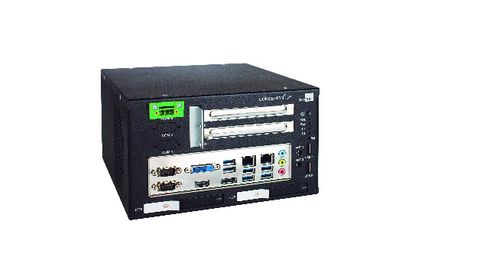
Inonet has set itself the task of developing an embedded system that is compact and at the same time has the performance of a high-end workstation. To meet this challenge, Inonet specifically opted for active cooling.
The system, called Concepion-tXf, has a powerful XEON-E3-1200-V5 processor from Intel and is based on a current C chipset. The embedded PC, which is operated with two fans, combines a robust and compact housing which, thanks to rack mounting brackets that can be ordered separately, allows two systems to be installed next to each other in a 19-inch rack without any problems. An optionally available air filter, which can be mounted quickly thanks to its modular design, ensures that the embedded PC can be used in harsh industrial environments. Thanks to active cooling, it can withstand temperatures of up to +55 °C.
The system is rounded off with hot swapping. An internal 2.5-inch hard disk and two external 2.5-inch hard disks are available in the removable frame. These can be replaced quickly and easily during operation. Thanks to the two PCI Express x8 slots, the computer can be flexibly expanded with plug-in cards.
The LED display, the system's power button and two USB 2.0 ports can be positioned either vertically on the rear or horizontally on the front, allowing a wide variety of installation situations to be realized. Whether WLAN module or interface cards for connecting cameras for image processing - the flexibility of the system is guaranteed thanks to optional expansion options.
The Concepion-tXf has an automotive power supply unit and is therefore also popular in the automotive and aviation industries. Thanks to its flexibility - also in the power supply - the system can be used very individually.


You might also be interested in
The knowledge hub of the embedded community
The embedded systems industry will meet from March 11 to 13. In seven exhibition halls, exhibitors in Nuremberg will provide information on hardware, software, services and tools. Two accompanying conferences, expert panels and exhibitor forums will...
 read more...
Customized Single Board Computer
Helbling has developed a flexible embedded vision platform based on an ARM processor that can be used as a reference design for the development of customized single board computers (SBC).
read more...Secure embedded PC for industrial applications
According to the manufacturer, the 'ReliaCOR 54-13' embedded PC from Inonet is one of the first embedded computers made in Germany to be certified for AI applications in accordance with IEC 62443-4-2. It therefore meets the requirements of...
read more...Operation via touch, glove, pen or digitizer
Getac launches the next generation of 'F110' and 'K120' tablets: The new F110 is suitable for use in a variety of harsh outdoor and indoor scenarios.
read more...IPC for IIoT gateway
The compact and energy-efficient industrial PC 'DA-1200' from Cincoze is suitable for IIoT gateways in modern industrial applications.
read more...Two new surface-mounted keyboards
Wöhr is expanding its 'Surta' industrial keyboards with versions 15 and 16, which have been specially developed for environments such as medical and dental areas, the pharmaceutical, clean room and food industries, as well as general industry and...
read more...New threat to industrial control systems
FrostyGoop is the name of a new malware variant that specializes in industrial control systems (ICS). It poses a threat to critical infrastructures worldwide. OT cyber security expert Dragos has identified FrostyGoop.
read more...Edge rack server in robust
The trend towards hyper-convergent infrastructures is not stopping at the manufacturing and automation industry. Siemens has now launched the first edge rack server in robust industrial PC quality. How is the inner workings of the server designed?
read more...Available in four sizes
KEB Automation has launched the 'Web HMI C6 X1'. The panel can be flexibly attached anywhere on the machine thanks to various mounting options.
read more...