
Edge computing
Computing power on site
Companies are increasingly outsourcing basic processes to the cloud. However, not all applications can be centralized there in a meaningful way. Data security and reliability, real-time reactions or a lack of bandwidth require computing power close to the system.
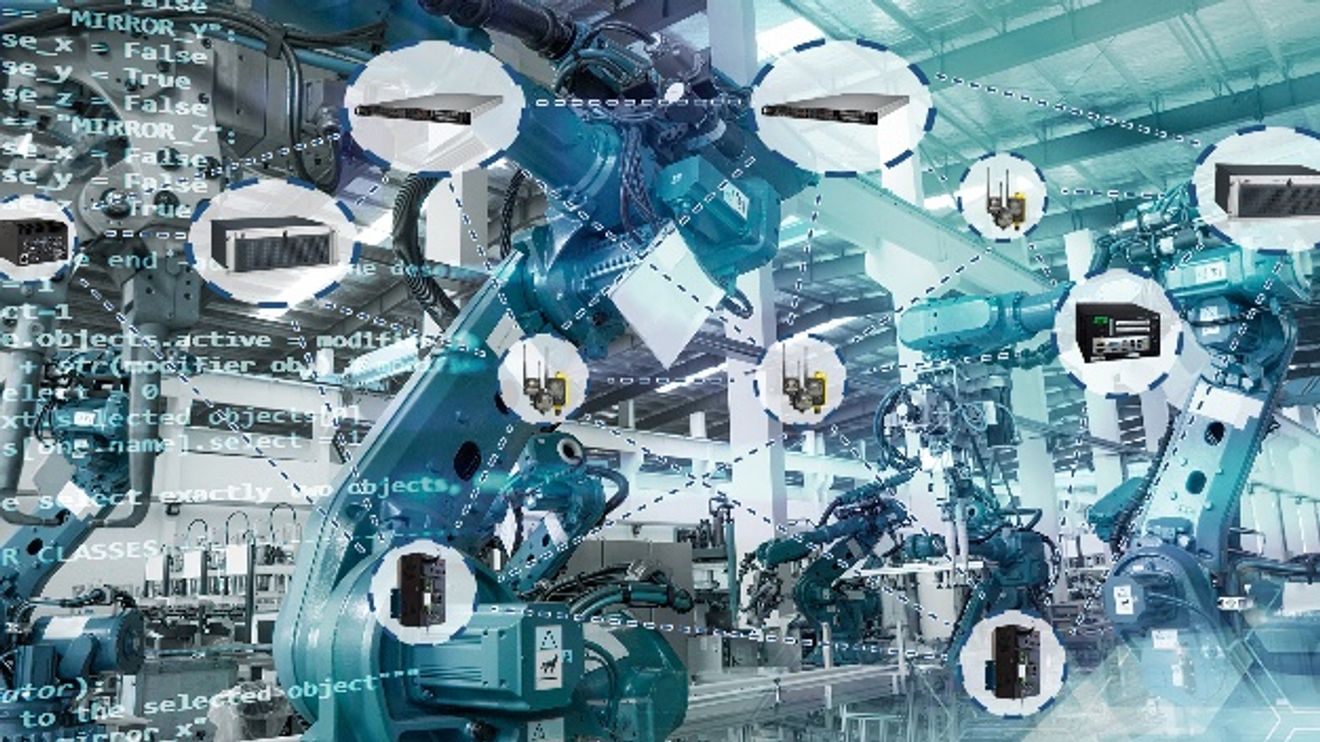
Over the past 20 years, the concept of cloud computing has gradually evolved from an IT virtualization concept to a permanent fixture in the industrial environment. Manufacturing companies have long recognized that numerous processes, data and analyses can be mapped much more efficiently using centralized structures than processing them on site. However, with the growing intelligence of production systems and processes, a parallel trend is emerging that is once again demanding more computing power close to the machine: so-called edge and fog computing, i.e. hardware that works within the local network of a production facility. In this context, a distinction is made between 'on-premise' and 'off-premise' computer architectures, which are either located on the (company) campus in the network or at a remote location. The data-based integration of all value-added processes is one of the decisive factors for the competitiveness of the manufacturing industry.
The reasons for the increasing demand for system-related computing power lie primarily in the constantly growing volume of data to be processed due to increasingly intelligent sensor technology on the machine. This results in measurement data in several dimensions per case under consideration - such as sound pressure, temperature and vibrometry data - which must be processed together. At the same time, the speed at which data-based processes are carried out in digitalized industrial applications is increasing. Delays or even downtimes due to fluctuating transmission or latency times are thus becoming a bottleneck for efficient manufacturing processes and must be circumvented by means of computing architectures that perform their work in real time within the respective network. This places high demands on the systems: They must function in a fail-safe manner under harsh environmental conditions and at the same time offer server-like performance in order to cope with the growing complexity of their areas of application.
Edge computing offers the advantage of absolute independence from external infrastructures as well as autonomous operation - even if connectivity to the outside world is limited or not available at all. For many companies in the industrial environment, this leads to the following principle: only the essentials in the cloud, as much as possible locally.
In concrete terms, this means that processes that need to be scalable for multiple locations or ongoing analyses of large volumes of data are therefore in the right place in the cloud. On the other hand, all processes in which data needs to be transmitted at high transfer rates or high volumes of data need to be processed in real time require local processing.
Requirements in edge computing
The use of computer systems in industrial environments places extremely high demands on the devices. One of the most important aspects of an industrial PC in edge or fog computing is fail-safe continuous operation. To avoid application downtimes, the computer systems are equipped with industrial power supply units designed for continuous operation. For additional fail-safe requirements, redundant power supply units are used, in which two power supply plug-in units are mounted together in a power supply cage and each connected to a separate phase. If one power supply module fails, the second one takes over to prevent a system failure in the device. An uninterruptible power supply (UPS) offers the highest level of security in terms of power supply. This is used to ensure the supply of critical electrical loads even in the event of faults in the power grid.

In edge applications, the computer systems often have to withstand extreme conditions - for example in industrial steel processing.
© InonetIn addition to the power supply unit, the industrial hardness of the other components used in plant-related applications should not be neglected. The components used in industrial environments often have to withstand high temperatures. To ensure reliable operation of the system here too, a generous cooling concept is necessary. Either active cooling by fans or passive cooling by heat dissipation via copper pipes and cooling fins on the outside of the housing can be used. Passive cooling concepts are ideal for industrial computers that are used close to machines, as passive cooling usually involves a closed housing. This means that the industrial computer is better protected against the ingress of dust and splash water.
In order to reduce the total cost of ownership (TCO), companies use the same software over several years, which was developed precisely for the respective application. As a result, the hardware must also be able to be obtained with the same revisions over several years in order to ensure complete compatibility. For this reason, the long-term availability of individual components plays a major role in the procurement process for industrial computers.
In order to ensure the efficient operation of applications within the Industrial Internet of Things, numerous aspects relating to data processing, data analysis and data storage must be considered in addition to the pure industrial-grade hardware. For example, applications that control essential machines in the production process in real time and process large amounts of data can only rarely be sensibly outsourced to the cloud.
An industrial computer used in the context of edge computing must exhibit real-time behavior in order to ensure that the application runs smoothly. A long transfer of data to the cloud would significantly limit the reaction time of the application and thus an efficient process.
Data throughput makes the difference
In machine vision applications, such as optical quality control using high-resolution cameras, high data rates are recorded that have to be processed within a very short time - sometimes within milliseconds. The result of the calculation, such as the command to remove a workpiece from the production process due to poor quality, must be immediate in order to enable a smooth process. Processing such data volumes within the cloud would never be possible with the same precision and speed due to the average transfer rates and times that can be achieved. In such applications, Inonet relies on embedded systems with server-like performance such as the Concepion-txf-L: a compact industrial computer with dimensions of just 215 mm × 131 mm × 297 mm, which can be equipped with powerful XEON D processors with up to 16 cores and graphics cards to handle computing and graphics-intensive tasks directly on the production line.
Avoid latency
Another major challenge in data transfer is latency. The closer the industrial computer is connected to the application, the lower and less frequent the latency problems. The fastest and most secure connection for smooth data traffic in an industrial environment is the wired variant. This enables a large bandwidth for the data flow - in addition, wired applications located in a self-sufficient on-premise network are protected from unwanted external access.
Avoiding latency times is particularly crucial when the safety of personnel depends on the smooth control of the production system - for example, in the case of collaborative robots that perform their work together with humans. A command to stop the ongoing process in the event of danger to humans has no tolerance for latency times or even connection interruptions due to uncertainty in the quality of service of the Internet connection. Instead, deterministic response times are crucial, i.e. absolute reliance on processing and transmission times within an application. Robust and fail-safe 19-inch industrial PCs from Inonet's Mayflower series are used in such applications, as they can be supplied with redundant and powerful components and soft PLC systems that can map the machine control system at computer level.
Cloud for advanced applications
Once the complex analysis and processing of the data has been completed close to the machine, the data can then be archived via a cloud solution. This provides an ideal basis for further applications such as data analysis and data visualization. Storing large volumes of data using an off-premise solution makes perfect sense, as it allows for almost unlimited scalability in terms of storage volume. A cloud can also demonstrate its advantages in terms of cross-location, global access to data.
The ideal solution for an efficient and secure IT infrastructure ultimately depends heavily on the area of application, the requirements and the data volumes involved. "As much as possible locally, as much as necessary in the cloud" - this phrase describes the desirable mixed concept of the hybrid cloud, which combines the advantages of both worlds, on-premise and off-premise, in the best possible way.
Author: Benedikt Merl is Head of Marketing at Inonet.


You might also be interested in
The knowledge hub of the embedded community
The embedded systems industry will meet from March 11 to 13. In seven exhibition halls, exhibitors in Nuremberg will provide information on hardware, software, services and tools. Two accompanying conferences, expert panels and exhibitor forums will...
 read more...
Customized Single Board Computer
Helbling has developed a flexible embedded vision platform based on an ARM processor that can be used as a reference design for the development of customized single board computers (SBC).
read more...Secure embedded PC for industrial applications
According to the manufacturer, the 'ReliaCOR 54-13' embedded PC from Inonet is one of the first embedded computers made in Germany to be certified for AI applications in accordance with IEC 62443-4-2. It therefore meets the requirements of...
read more...Operation via touch, glove, pen or digitizer
Getac launches the next generation of 'F110' and 'K120' tablets: The new F110 is suitable for use in a variety of harsh outdoor and indoor scenarios.
read more...IPC for IIoT gateway
The compact and energy-efficient industrial PC 'DA-1200' from Cincoze is suitable for IIoT gateways in modern industrial applications.
read more...Two new surface-mounted keyboards
Wöhr is expanding its 'Surta' industrial keyboards with versions 15 and 16, which have been specially developed for environments such as medical and dental areas, the pharmaceutical, clean room and food industries, as well as general industry and...
read more...New threat to industrial control systems
FrostyGoop is the name of a new malware variant that specializes in industrial control systems (ICS). It poses a threat to critical infrastructures worldwide. OT cyber security expert Dragos has identified FrostyGoop.
read more...Edge rack server in robust
The trend towards hyper-convergent infrastructures is not stopping at the manufacturing and automation industry. Siemens has now launched the first edge rack server in robust industrial PC quality. How is the inner workings of the server designed?
read more...Available in four sizes
KEB Automation has launched the 'Web HMI C6 X1'. The panel can be flexibly attached anywhere on the machine thanks to various mounting options.
read more...