
Advertorial
Automation via the artificial intelligence of things
The Artificial Intelligence of Things (AIoT) combines two powerful technology concepts and opens up new opportunities for companies of all sizes. How does the AIoT work? Examples of corresponding implementations in practice.

Edge servers play a key role in the collection and processing of data in the AIoT.
© OnLogicArtificial intelligence (AI) and the Internet of Things (IoT) are two of the most dazzling buzzwords in technology. But what happens when you combine them? The Artificial Intelligence of Things (AIoT) may sound like it was invented by an AI algorithm itself. However, it represents an exciting potential for users in the field of automation, especially when using the right tools, such as the industrial computer hardware from the company OnLogic.
What does AIoT mean?
The AIoT combines AI with the IoT to enable networked devices to process and learn information. This in turn can help predict future patterns or events and determine the way they react and adapt over time.
Smart factory solutions, autonomous vehicles and even predictive texting on smart devices are all examples of AI in action. The Internet of Things (IoT) is a collection of devices that communicate with each other via the internet. This also includes wearables and cloud-connected sensors for smart cities and industrial plants. These devices have the potential to harness the power of AI to optimize a wide range of systems and tasks. In the world of industrial automation, the AIoT can help improve processes, avoid downtime or respond in real time to production demands or unexpected changes in operating conditions.
How is AIoT already being used?

The hardware for AIoT ranges from palm-sized gateways and compact, fanless computers to industrial panel PCs and servers.
© OnLogicThere are many applications that already take advantage of AIoT. However, the most common include vision solutions and machine learning. These applications require special industrial hardware that can be easily integrated into existing systems. It must be able to collect and process data from numerous sensors and inputs and work reliably with little downtime.
Vision solutions with AIoT
AIoT vision works by defining parameters for a camera system so that it can detect anomalies and act quickly. When the system detects a potential hazard, there may not be enough time to send the data to an analysis center for decision making; the decision to act must be made immediately.
With the help of a well-developed AIoT infrastructure, the cameras on site and the supporting software can use pattern recognition algorithms to identify potential security risks. If the cameras see an object that could pose a safety risk (for example, an object or person coming too close to the machines), the machines can be programmed to stop automatically. This process is known as "inference at the edge".
With edge inference, machines can process data in real time and make decisions in a fraction of the time it would take cloud computing to make the same decision. When it comes to security, milliseconds matter. That's why the use of powerful, reliable hardware for industrial data processing is so important.
Vision systems can also be optimized to detect personal protective equipment such as high-visibility clothing, hard hats and safety glasses. If a person enters a hazardous area without the required protective equipment, the system performs the assigned task, such as locking an entrance door to the hazardous area, stopping a machine or triggering an alarm.
Machine learning solutions with AIoT
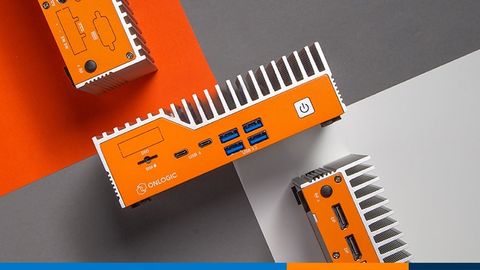
The Helix 401 is a powerful fanless industrial computer from OnLogic that is ideal for AIoT applications.
© OnLogicMachine learning in artificial intelligence focuses on the optimization of processes through the use of data fed in by pre-programmed algorithms. This continuously updates models of the desired behavior or results. The goal is to enable systems to analyze patterns in the data and draw conclusions without explicit additional programming.
The seven steps of machine learning are
- the collection of data
- processing the data
- Selecting a model
- Training the model
- Evaluating the model
- Adjusting the parameters
- making predictions
These steps allow machine learning to recognize images in real time based on data fed into the system. Some examples of image recognition and machine learning in industrial automation are
- Predictive maintenance - operational data from numerous sensors can be used to recognize patterns that indicate potential equipment failures or maintenance needs in a facility. By predicting and addressing maintenance needs before they become a problem, companies can minimize downtime, reduce overall maintenance costs and create a safer working environment.
- Energy management - By monitoring the use of building systems, machine learning models can be created to identify patterns and trends in energy consumption. Systems can then be programmed to adjust in real time to reduce energy waste and save on utility costs.
- Supply chain optimization - Machine learning can also be used to optimize processes that extend far beyond a specific facility. To respond optimally to instabilities in the supply chain, AIoT solutions with machine learning can be fed, for example, with data from weather forecasts, supplier performance metrics, component throughput rates or assembly or quality assurance processing times. This information, combined with product demand models, helps to identify potential disruptions. In addition, inventory costs can be reduced and lead times improved.
The opportunities of AIoT vs. its challenges
The convergence of AI and IoT brings many benefits, but as with any new technology, there are challenges to overcome. Before deciding on an AIoT solution, it is important to understand the benefits and limitations of the technology.
The key benefits of AIoT include:
- improved physical security in industrial environments
- automated processes through machine learning
- reduced maintenance costs
- Increased operational efficiency
- improved risk management
Although the promise of AIoT is enormous and growing, it is not perfect. It can only be as effective as the data it provides. Therefore, it is important to maintain a degree of control when implementing AIoT solutions. It is extremely helpful to work with experts when building an AIoT implementation to ensure the selection of the appropriate hardware and software for the planned application.
OnLogic and the AIoT
AIoT has already proven its value in numerous industries. The right hardware for your AIoT solution is therefore of paramount importance. Due to the requirements for processors and AI accelerators, edge servers are a popular option for these types of applications. However, every AIoT project is unique.
Expert help for working on individual AIoT projects is provided by OnLogic.
More information www.onlogic.de.
Phone +49 (0) 322 2211 2221
Email [email protected]
Follow OnLogic in the social networks


You might also be interested in
Sovereign edge-to-cloud platform for the industry
Hilscher Gesellschaft für Systemautomation and Schwarz Digits have announced a cooperation to provide sovereign European edge-to-cloud solutions for the industry.
 read more...
Marco Geiser becomes new Vice President Secure Power DACH
Marco Geiser has held the position of Vice President of Secure Power DACH since April 1, 2026. In this role, he will strategically develop the Secure Power business in Germany, Austria and Switzerland, strengthen it operationally and focus it on...
read more...Cloud security often inadequate
According to Red Hat's "State of Cloud-native Security" Report 2026, 97% of the companies surveyed with hybrid cloud environments reported security incidents within a year. This is based on data from around 600 IT specialists.
read more...Partnership for edge AI in industry
Nota AI and SiMa.ai have agreed on a strategic collaboration to develop AI solutions for industrial applications. The aim is to optimize AI models for use directly on devices at the network edge, where high computing power and energy efficiency are...
read more...Edge AI HPCs for Vision AI and GenAI
Advantech has announced the 'AIR-410' and 'AIR-420', next-generation compact Edge AI high performance computers (HPCs). Combining AMD Ryzen 7000/8000/9000 series processors, scalable GPU support and Advantech's 'Edge AI SDK' software, the systems...
read more...Virtualization shapes factory automation
With the new version of its 'Software Defined Automation' platform, Logiccloud shows how virtualization and AI are changing industrial automation. An integrated AI assistant enables the rapid creation of complete automation apps.
read more...ESTIA to strengthen Europe's cloud
New tech alliance for EU sovereignty
Twelve companies, including Dassault Systèmes, are founding the European Sovereign Tech Industry Alliance (ESTIA). The initiative aims to strengthen Europe's technological independence and define requirements for sovereign cloud services. The start...
read more...Companies increase AI investments - focus on digital sovereignty
A Red Hat survey shows: German companies prioritize digital sovereignty, rely heavily on open source and are planning significant increases in investment in artificial intelligence - despite a shortage of skilled workers and limited customer...
read more...Control portfolio expanded
AkYtec has new controllers, process displays and cloud services for industrial and building technology applications in its portfolio. The focus is on compact devices with integrated visualization and extended communication functions.
read more...