
CANopen FD
Tips for device and network design
A higher transmission rate and more user data per message - with this goal in mind, the classic CAN protocol has been expanded to include the FD version. Developers are now faced with the question of the ideal design for corresponding devices and networks.

The CAN FD protocol has been standardized in ISO 11898-1 since 2015. However, this standard does not contain any requirements for device manufacturers. Rather, it is intended exclusively for chip manufacturers who want to cast the CAN FD protocol in silicon. The same applies to the ISO 11898-2 standard, which describes the driver components. The international user and manufacturer association CAN in Automation (CiA) therefore publishes general recommendations for the development of CAN FD interfaces and CAN FD networks (CiA 601). This multi-part series of documents is still partly in draft status. In addition, the CANopen FD specification (CiA 1301) contains some recommendations for setting the bit timing.
The selection of 'small' microcontrollers with integrated CAN FD controllers is still small. However, this will change in the near future. As a high level of interoperability is required in industrial applications - especially in 'open' networks - the device developer should ensure that the selected CAN FD controller can be operated at a frequency recommended by the CiA - i.e. 20, 40 or 80 MHz.
Otherwise, the microcontroller should also comply with the recommendations of CiA 601-2 - particularly with regard to the width of the bit timing registers. ISO 11898-1 only requires a small width of up to 80 time quanta, which is not always sufficient for robust data transmission. This is because the more time quanta a bit consists of, the smaller the unavoidable quantization error. A wide register is therefore required to set many time quanta. Specifically, CiA 601-2 recommends a setting of 256 time quanta for TSEG1 (before the sampling time) and 128 time quanta for TSEG2 (after the sampling time) for the arbitration bit rate. For the fast phase of the CAN FD frame - the data phase - the controller should allow a maximum setting of 32 (TSEG1) or 16 time quanta (TSEG2).
To facilitate maintenance and troubleshooting, CiA 601-2 also recommends the use of interrupt vectors for warnings and detected errors. These include readable error counters for received and transmitted frames.
The right building blocks
When choosing a transceiver, it is generally advisable to always opt for components that are qualified for 5 MBit/s. They have significantly better symmetry (see ISO 11898-2) and give the system developer more leeway in the network topology. In other words, they can allow more 'ringing' on their lines. The connector must have the same impedance as the transceiver (nominal 120 Ω). This must be guaranteed over the entire permitted temperature range and also over the specified service life (keyword: ageing effects) of the device.

The index clearly identifies the pair of arbitration or nominal and data bit rates; the listed bit rate pairs must be supported, others are optional.
© CiAIn addition, the device developer should ensure that the delay times between the output signal and the input signal of the CAN FD controller are as short as possible. It should be noted that the internal multiplexers in the microcontroller and the individual pins can already generate relevant delays. Particularly with high bit rates - currently up to 5 MBit/s - it can happen that slow CAN FD interfaces do not have a stable signal at the time of sampling. This results in error frames, which abort the transmission of the CAN data frame. The transmission is repeated automatically, but as this is a systematic design error, it continues until the device goes into the bus-off state.
If galvanic isolation is required between CAN FD controllers and transceivers, the device developer should select very fast components. Furthermore, care must be taken to ensure that there is no additional asymmetry with regard to the falling and rising edges. One measure is to route the TxD and RxD lines in parallel; this applies both to the bus lines (CAN-H and CAN-L) and to any angled connectors. Remember: Any inaccuracies in the device design must be ironed out by the system integrator. This means that he has less 'margin' for inaccuracies in the network design.
To give the user as many degrees of freedom as possible, the CAN open FD device should ultimately support all bit rates recommended in the CAN FD specification (CiA 1301). For transmission rates of 1 Mbit/s and higher, the CiA 601-2 specification recommends activating the transmitter loop delay compensation implemented in the CAN FD controllers. With this function, the controller measures the delay between the transmitted edge between the FDF bit and the res bit (recessive-to-dominant) in each data frame and compensates for this so that the controller compares the 'correct' bits with each other. Theoretically, this compensation could also be calculated and configured.
The choice of sampling times
One of the main tasks of the system developer is to select the two bit rates for the arbitration and data phase. This also includes selecting the sampling times. These must then be set in all devices. To make this task easier, the classic CANopen specification (CiA 301) contained corresponding recommendations for predefined data rates (from 20 kBit/s to 1 MBit/s). These still apply to CANopen FD. However, a few rules have now been added:
In accordance with the general recommendations in CiA 601-3 (to be published in fall 2018), the time quantum (the atomic time unit in the network) should have the same length in the arbitration phase and in the data phase and should also be as small as possible. In any case, all devices in the arbitration phase must determine the bit value (e.g. 80% at 500 kbit/s) at exactly the same time. Previously, there was a sampling range - for example 85 % to 90 % at 500 kbit/s.
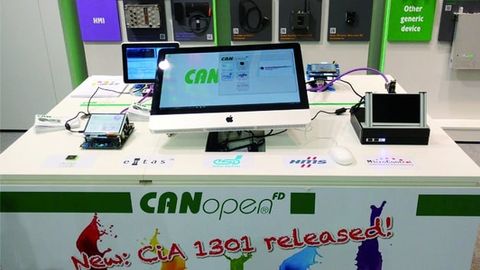
At the recent Hannover Messe, several manufacturers showed the interoperability of their CANopen FD software and demonstrated the faster transmission using the example of graphic files.
© CiAIn the data phase, too, all devices must sample the bit at exactly the same time (e.g. 75% at 2 Mbit/s). In this respect, the recommendations of the CANopen FD specification (CiA 1301) must be followed. In addition to the combination of 500 kBit/s (arbitration phase) and 2 MBit/s (data phase), CANopen FD devices must support the following bit rates: 1/5 MBit/s, 250 kBit/s / 1 MBit/s and 250 kBit/s / 2 MBit/s (further combinations of bit rates are optional).
The system developer is responsible not least for the design of the network topology and the cables. Both are very application-specific, as the areas of application for CANopen-FD range from control cabinets to embedded machine controls and deeply embedded backbone bus systems in devices. A daisy-chain bus topology is preferable from a general communication technology point of view. Depending on the application, however, short unconnected spur lines are sometimes required. This usually leads to unwanted reflections on the lines and can ultimately result in there being no stable signal at the sampling time in the data phase. This can be remedied by changing the cabling to the optimum bus topology, i.e. with spur lines in the range of a few centimeters.
The robustness, i.e. the susceptibility of the transmission to interference, depends heavily on the required temperature range. Cables in particular - or more precisely: the insulation material - can be highly temperature-dependent. PVC sheathing is not recommended, as the impedance of these cables can drop dramatically depending on the temperature. This leads to reflections and thus to an unstable signal.
The CiA 601-5 specification describes the cable parameters and their measurement in order to make the manufacturers' data sheets more comparable. In any case, there will be no dedicated CAN FD cable specification, as the application requirements are too different.
In summary, it can be said that Since the participants are not synchronized in the data phase, the maximum network length results only from the design rules of the arbitration phase. In this respect, there is no difference to classic CAN-open networks. When selecting CANopen FD devices, the system developer must above all ensure that the preset sampling times for the desired bit rates (arbitration phase and data phase) are identical in all devices.
Author:
Holger Zeltwanger is Chairman of CAN in Automation (CiA).


You might also be interested in
Hans Seifert to Become Chief Sales Officer
Sigmatek has appointed Hans Seifert as Chief Sales Officer (CSO). His area of responsibility includes international sales, marketing, application engineering, and support.
 read more...
CC-Link certification for modular I/O system
Weidmüller has received the CC-Link Partner Association (CLPA) certificate for its modular I/O system 'u-remote'. This makes u-remote the first modular I/O system with official CC-Link IE safety certification for CC-Link IE TSN.
read more...Profibus & Profinet International
MTP Specification 2.0 published
Profibus & Profinet International (PI) announces the official release of the Module Type Package (MTP) Specification 2.0. The MTP 2.0 standard creates the basis for true cross-industry interoperability as well as more flexibility and efficiency...
read more...New analog input modules
MicroControl is launching the next generation of compact analog input modules. The new modules are µCAN.4.ai-BOX for voltage/current, µCAN.4.sg-BOX for strain gauge sensors and µCAN.4.ti-BOX for temperature sensors.
read more...Profibus & Profinet International
Profinet leads the field in industrial Ethernet protocols
A recent analysis by the market research institute Omdia confirms that Profinet is the leading technology in the field of industrial Ethernet protocols. In addition to its broad market penetration, Profinet's consistent focus on security is...
read more...Dual leadership in Shanghai
Stefan Becker has been appointed Managing Director of Eckelmann Automation Technology in Shanghai and will manage the subsidiary together with Zhongwei Huang.
read more...Smart control cabinets thanks to new Ethernet/IP technology
Rockwell Automation is launching an Ethernet/IP control cabinet solution. The aim of this further development is to meet the growing demand for smarter, faster and better networked production processes.
read more...Softing Industrial Automation takes over Delta Logic
Softing Industrial Automation has acquired 100% of the shares in Delta Logic Automatisierungstechnik in Schwäbisch Gmünd.
read more...Single-axle drive module for high performance
The modular, dynamic multi-axis servo system 'DIAS-Drive 2000' from Sigmatek has been reinforced: The 'MDP 2200-L-01' single-axis module for controlling synchronous servo motors provides up to 20 A rated current.
read more...