
Part 1 of the new TSN series
The status quo
Time-Sensitive Networking (TSN) has an impact on the automation industry and the IT world like no other standard. What is the status quo?
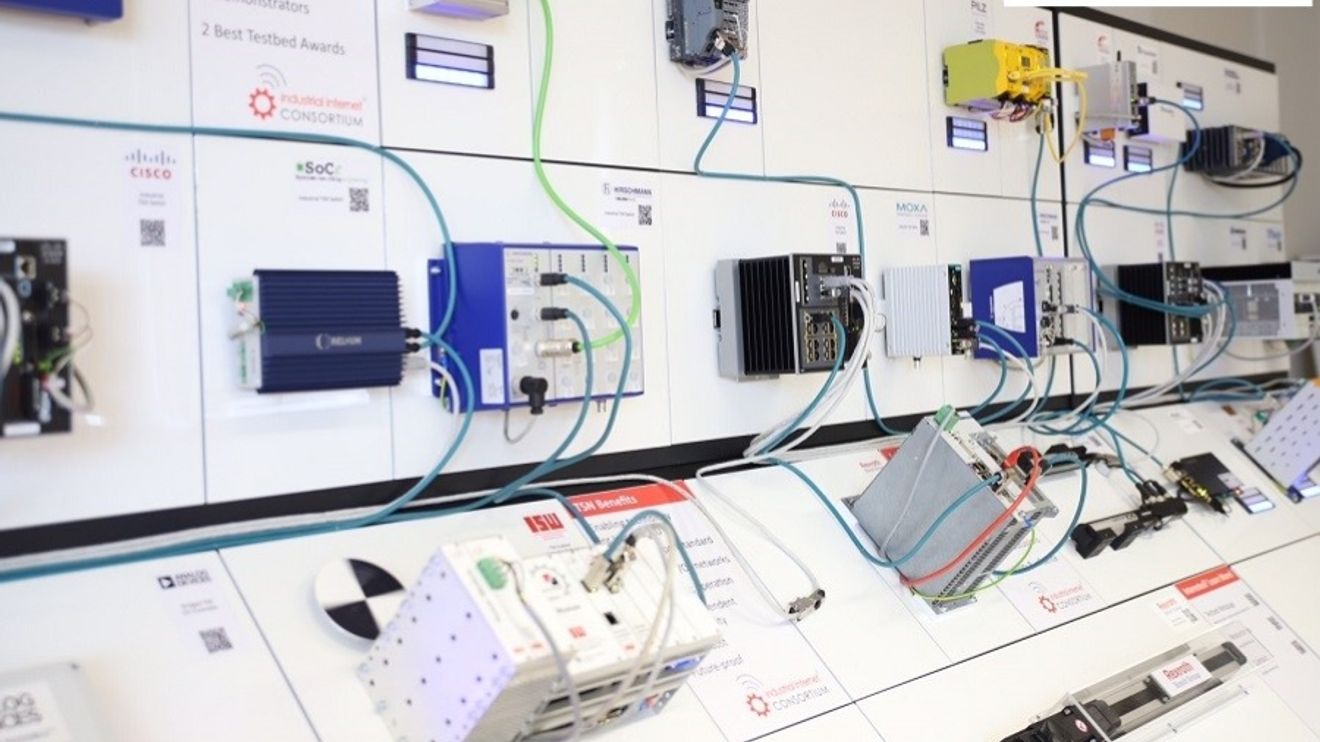
The first part of this series of articles provides an overview of the current status, the open challenges and the associated opportunities of the new Ethernet standard.
Real-time capability is the traditional unique selling point of industrial communication and the most significant difference to IT communication. This key requirement was one of the drivers for today's prevailing variety of fieldbus standards that are incompatible with each other and with IT. Ethernet according to IEEE 802.1, the dominant standard for IT communication, offered no guarantees with regard to deterministic communication.
With increasing digitalization, the need for real-time communication increased across all industries, including audio/video, transport, finance and industrial automation. This led to the establishment of the Time-Sensitive Networking Task Group, which aims to extend the quality of service mechanisms of Ethernet with deterministic guarantees by means of new and improved sub-standards. Accordingly, TSN is not a new technology, but an evolutionary stage of Ethernet.
The potential of real-time-capable standard Ethernet for industrial communication has been recognized throughout the industry, with two goals in particular being pursued:
- To reduce the variety of fieldbus standards in order to solve the associated costs and problems (creation of a uniform fieldbus).
- To create convergent IT/OT networks, which are seen as a key technology for a variety of Industry 4.0 visions.
While the vision of a unified fieldbus leads to obvious improvements to the current situation, convergent networks are of much greater strategic importance.
Comparing TSN with fieldbuses is only valid to a limited extent: Fieldbuses are usually complete communication solutions and cover the complete OSI layer model. TSN Ethernet, on the other hand, covers layers 1 and 2 as well as the real-time aspect, which extends vertically through all layers. Accordingly, applications will always use other protocols on the higher layers in addition to TSN, although there are fundamentally different approaches here.
For industrial communication, the added value of TSN results from the emerging ecosystem. Therefore, in addition to the TSN standards as such, current developments in the protocols on higher layers and the status of available hardware and software solutions must be considered in order to assess the current status.
TSN standards within the framework of IEEE 802.1
TSN is not a single new standard, but a collection of new sub-standards as well as extensions and additions to existing ones. Some of these have already been ratified and are available, others are under development, while the need for others has only just been identified. Unlike many industrial standards, it would not be expedient to wait for a standard to be finalized, as Ethernet is constantly evolving. It is therefore important to understand which standards are relevant for your own products and which will only have an impact on the ecosystem. Most TSN sub-standards can be categorized into time synchronization, influencing data traffic and configuration.
Time synchronization is a core function of TSN networks. Unlike many fieldbuses, synchronization is carried out using a common time base and is not event-driven. The IEEE 802.1AS standard, which is based on IEEE 1588, is being updated as part of TSN and is referred to as AS-rev in its working version. After years of waiting, an accepted draft is now available, the final publication of which is expected in the course of 2020. It can be assumed that this version of AS will be the dominant time synchronization standard in TSN networks.
The standards for controlling data traffic, in particular the time-slot-based method standardized in IEEE 802.1Qbv, have already been available for some time and can be considered stable.
Efficient use of the TSN mechanisms to ensure deterministic communication requires a suitable configuration. The IEEE 802.1Qcc standard is of fundamental importance for this, although in many places it provides a framework rather than enabling concrete implementation. Other standards are therefore still missing in order to be able to use 802.1Qcc sensibly. These include communication between the Central Network Controller (CNC) and the Central User Controller (CUC) in the centralized approach, which is specified in 802.1 Qdj, as well as the standards for decentralized configuration, for which the LRP and RAP protocols are standardized.
Protocols of the higher layers
TSN only covers layers 1 and 2, which is why additional protocols are always required on the upper layers. Typically, these are increasingly application-specific as the layer increases. Industries such as audio/video have their own solutions; in the standard IT environment, tried-and-tested protocols such as TCP/IP on layers 3 and 4 or HTTP on the application level will continue to dominate in the future, but potentially now deterministically.

There are currently two factions in the industrial environment: The 'fieldbus-over-TSN' faction and the faction that wants to achieve standardization through all levels and has come together within the OPC Foundation under the acronym OPC UA FLC (Field Level Communication).
Fieldbus-over-TSN has the advantage of bringing along and preserving the established ecosystems. Very different degrees of interoperability are aimed for. There are already operational solutions, but a significant proportion of these are based on proprietary solutions, particularly in terms of configuration.
The idea of a standardized solution up to the application layer has long been
long been considered a pipe dream but also essential for the digitalization of production. A clean decoupling and abstraction of real systems, hardware and real-time communication is a prerequisite for efficient software development as well as many software-based business models, for example services in the field of data science or artificial intelligence. In the context of FLC, a large number of key players in the automation industry are now working on a standardized solution that extends to the field level. The FLC Group intends to publish an initial minimal version in the near future, potentially as early as this year. However, the big vision will not be lost sight of, but will keep those involved busy for another year or two.
The joint IEC-IEEE working group 60802 is working on making TSN usable for the various industrial approaches and still ensuring interoperability. The industrial profile for TSN that is currently being developed is also intended to provide guidelines for the TSN functions to be supported in products. Similar profiles for other industries such as automotive and audio/video are being developed by other organizations.
The topic of cross-industry interoperability is the subject of much controversy, as is the question of the extent to which there needs to be a common basis for this below the profiles and who defines this. The Avnu Alliance, for example, is trying to create solutions here.
TSN solutions
TSN has an impact on the hardware and software architecture of end devices and the network infrastructure. Depending on the application and requirements, these can vary greatly - especially for endpoints. Some applications require special hardware, others can manage with hardware that is already available today or only require a software update. Even devices without any TSN capabilities can benefit from a convergent network, as this enables direct access to sensor data from an IT system, for example.
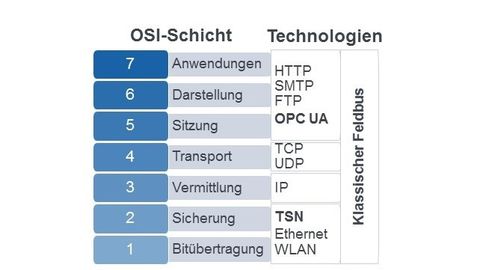
IT and OT protocols in the OSI layer model, all of which will play a role in industrial applications over a longer period of time.
© ISWOn the network infrastructure side, for example with switches, there are already a large number of protocol types and initial products. Many of these products promise upward compatibility with the evolving TSN standards through corresponding updates.
Hardware solutions for single-port and switched endpoints are increasingly available, both in the form of ICs or IP cores and in the form of integrated products such as network cards for PCs. Software support is also improving thanks to open and prioritized solutions for individual aspects such as time synchronization or entire operating systems.
Challenges
TSN is accepted across all industries, but there are still significant technical, organizational and political challenges. The following five points are currently the most relevant and will be the focus in 2020:
Standards
A number of standards are still being worked on, both the actual TSN standards and the higher-level standards that build on them. The work of the FLC group, which is expected to make significant progress, is very much in focus. However, the standards developed over the last few years, which are due for publication in 2020, will also have a strong influence on the community. The transition to 802.1AS-rev, known as AS-2020 from the release date, will take place. All existing TSN products and stacks will be affected by this and will have to implement the newly standardized functions, such as redundant master clocks.
Configuration and interoperability
The configuration
The configuration of TSN networks is equally challenging in technical, organizational and political terms.
configuration of TSN networks. The IEEE standards, above all IEEE 802.1Qcc, are not specific enough to be implemented directly. The standard already specifies several different approaches - centralized, distributed and hybrid configuration. Each of these is a challenge in itself; the use of these types of configuration in combination with each other is still completely unclear! Further standards are therefore required on the one hand, but also an agreement on a common interpretation on the other.
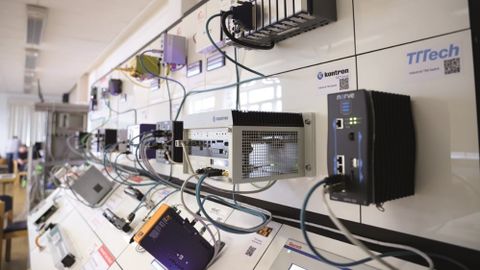
The TSN demonstrator of the 'IIC TSN Testbed' at ISW. Testbeds in particular play an important supporting role in the introduction of TSN technology.
© ISWThe convergence of IT and OT means that industrial devices are also becoming IT devices. Therefore, in addition to the special TSN configuration mechanisms, they require a configuration process like any standard IT device. As these mechanisms differ greatly from the usual processes in the industrial environment and in some cases even have contradictory requirements, new, cross-industry solutions must be found. This involves redistributing tasks that were previously in one hand. Whereas the network and applications were previously configured with a single engineering tool, in future this will have to be split between the network, application and potentially other players.
Interoperability
TSN - and Ethernet according to IEEE 802.1 in general - is not a standard that can be implemented directly and leads to interoperable devices. On the one hand, there are many options that can be combined; on the other hand, many sub-standards require further specifications in order to lead to an interoperable implementation. However, consistent interoperability is a prerequisite for the realization of convergent networks.
For industrial use, the IEC-IEEE 60802 profile is an important step in the right direction, but there is still no cross-industry consensus on this. This also means that questions regarding testing and potential certification still need to be clarified. However, testbeds, in which interoperability is already tested at the prototype stage of products, are already making an important contribution to this.
Solutions for convergent networks and systems

Florian Frick is group leader for real-time communication and control hardware at ISW Stuttgart.
© ISWHardware, software and infrastructure solutions are increasingly available, but many elements are still missing in order to implement convergent networks industrially and develop the appropriate end devices. On the software side in particular, solutions for simple use and abstraction are needed; on the network side, solutions for management and configuration, such as CUCs and CNCs, are required. In order to fully utilize the advantages of convergent communication, the
convergence must be guaranteed right down to the application level of the end devices. Among other things, this requires the ability to run several deterministic applications in parallel.
Security and safety
Safety and security are issues that have hardly played a role to date, but must be addressed before convergent networks can be used productively. Connecting an unsecured network to standard IT is not acceptable. Safety solutions are indispensable for many applications in the industrial environment.
Recognizing and exploiting potential
Up to now, there has been a very strong focus in the industrial environment on the idea of a standardized fieldbus. This is very desirable, but only an intermediate step towards the overarching goal of convergent networks.
Even if there are still many challenges, as shown above, this is no reason not to start with innovative solutions at application level. The reason for the very hesitant progress is certainly the lack of understanding and experience with convergent networks. Technically, however, getting started is easier than it seems in many cases. Available, often open solutions can already be used today. Testbeds or the TSN for Automation technology transfer initiative driven by the ISW can provide important support here!
The TSN article series

'TSN instead of fieldbus' was the provocative slogan emblazoned above the first technology demonstrator from the Institute of Control Engineering at the University of Stuttgart at SPS Drives 2016. For many trade fair visitors, this was their first ever contact with TSN - with very different reactions. Hardly anyone had heard of TSN at the time, let alone had any idea of its significance and impact.
Interest in TSN grew rapidly over the following years, culminating in the announcement of FLC activities by the OPC Foundation at the end of 2018. However, TSN could not escape the course of the 'technology hype curve' either: once the - long and arduous - path to the ambitious goals of TSN networking became clear, some players and potential users were in a hangover mood.
The current situation is that while some players are working hard to make the TSN vision a reality and are actively involved in an almost unmanageable number of committees, groups and initiatives, the majority of the industry is still confused about the future of industrial communication.
Very often, the slogan mentioned at the beginning is taken literally and TSN is reduced to a 'standardized fieldbus'. Even though TSN is a prerequisite for this, the actual innovation is overlooked: TSN is the key technology for convergent networks, which are nothing less than an essential prerequisite for the vision of Industry 4.0. To neglect this would be tantamount to reducing the innovation of the smartphone to a "standardized operating system for making phone calls". A large part of the industry is currently in a waiting position and is overlooking the fact that now is the right time for innovative developments. SMEs in particular now have the opportunity to secure their long-term competitive advantage with innovative solutions beyond the ecosystems dominated by a few big players.
Admittedly, it is currently quite difficult to maintain an overview and recognize where the technology still needs to mature and where developments can be started now. The TSN series starting with this issue is therefore intended to shed light on TSN in all its facets over the course of the year: discussing the technology, highlighting trends and developments and not neglecting the controversial organizational and political aspects.
Florian Frick, florian.frick(at)isw.uni-stuttgart.de and Meinrad Happacher, mhappacher(at)weka-fachmedien.de, will be happy to answer any questions or suggestions you may have.


You might also be interested in
TSN alone is nothing!
Yes, TSN is the new basic technology for convergent real-time communication. But which protocols will actually be based on the TSN layers and become established on the market has not yet been decided. In this article, four protagonists have their...
 read more...
The protocols of the upper layers
TSN only covers the lower OSI layers. There are various protocol approaches for the upper layers. Due to the deterministic requirements, these also have an impact on TSN itself - unlike in the past.
read more...Prototyping and testing of TSN
Very high demands are placed on TSN in terms of interoperability. What contribution do cross-manufacturer testbeds make here? How can the implementations of TSN standards and interoperability be tested?
read more...Open solutions for TSN
Time-Sensitive Networking (TSN) is regarded as the key technology for convergent IT and OT networks. Open solutions can contribute to the development of the ecosystem, but which software functions are actually required and which solutions are...
read more...Switches for Ethernet and Profinet
The unmanaged Ethernet switches from Helmholz are just 49 mm wide in the 5-port version and 65 mm for 8 ports, making them suitable for a wide range of industrial applications thanks to their compact design.
read more...IIoT communication from the sensor to the...
Data exchange from IO-Link via JSON and MQTT becomes possible
The IO-Link community has published a specification that describes how data from IO-Link can be exchanged via JSON REST and MQTT - in the sense of transparent communication in the IIoT.
read more...5G or Wi-Fi 6?
We hear everywhere: 5G will change the world! But what about Wi-Fi 6? Has the IEEE hit the jackpot with the new WLAN standard? Will 5G and Wi-Fi 6 vie for pole position as the future wireless standard for the Industrial Internet of Things (IIoT)?
read more...The new e-paper is now available
Our latest issue 4 is now available as an e-paper. Read now what's happening in the automation industry in April.
read more...Control up to 250 CNC axes
With the current software version of the MTX CNC system, Bosch Rexroth is expanding and simplifying the digital engineering of machine tools through to 3D machining simulation.
read more...