

Flecs
The flexible app-based PLC
Installing or updating applications on a PLC usually costs machine manufacturers a lot of time and money. Flecs is now automating this process - which should result in savings of at least 40 percent.
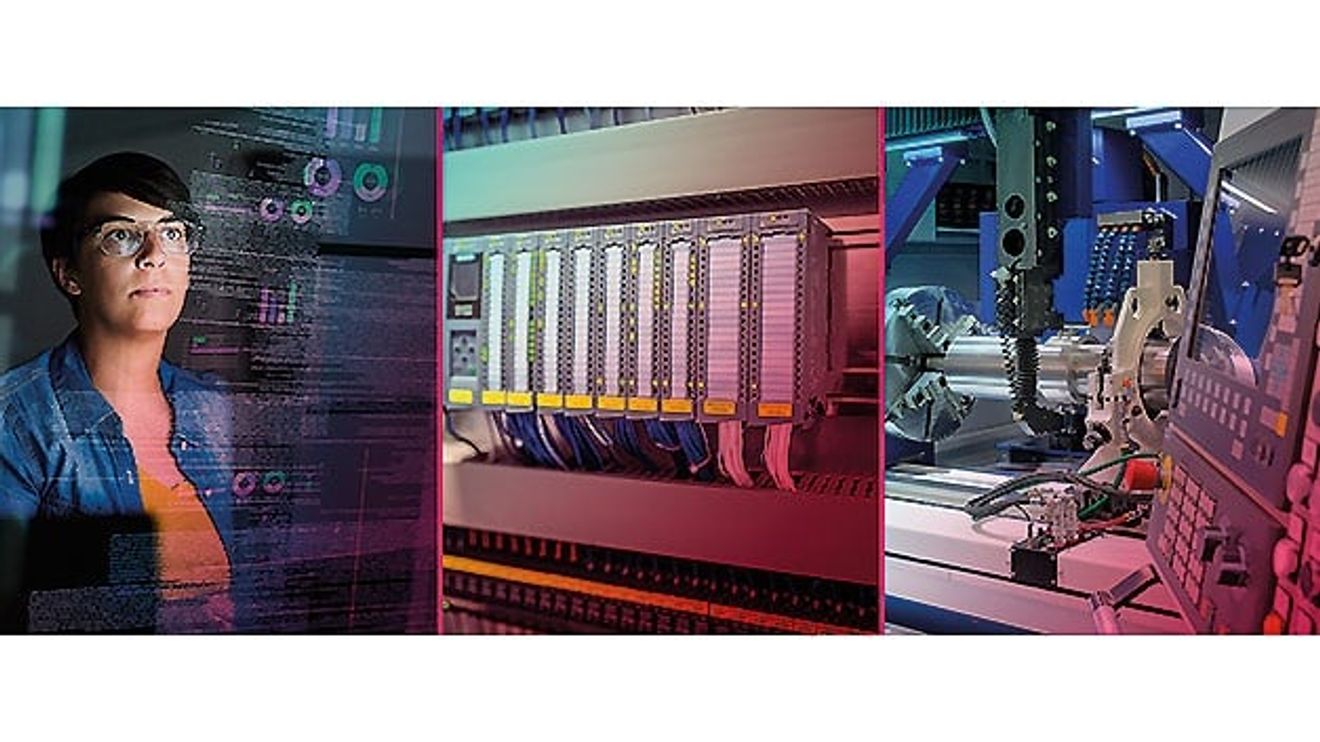
A scenario that is still relevant today: An IT employee of a large manufacturing company is walking through the production hall because he has repaired a PC at a workstation. A machine operator stops him with a request: "We have a new machine and the manufacturer says the machine needs an Internet connection. We've now connected the machine to the network, but it's not working." But why isn't it working?
The initial situation: the PLC as a black box
The first big problem is the computer in the machine, the PLC. As a rule, this is a closed system with an unknown operating system on it, which the employee could not log into. The machine manufacturer simply says: "This is what we buy and the PLC supplier guarantees that it is secure." But the IT department needs to know more precisely: Which operating system does the controller use? And in which version? How do you keep the PLC version up to date and how does the controller fit into the IT landscape? - And these are just the basic questions. What if the user wants to cover more functions with the machine than the PLC manufacturer has planned for its controller: for example, integrate an ERP system, connect an internal database or a cloud service? Nowadays, there are hundreds of apps for a wide range of tasks relating to the automation of a machine.
The ideal solution
Ideally, the machine manufacturer will select the apps that are best suited to the machine and install them on a PLC that is best suited to the machine. This is exactly how an automation layman imagines it, after all, we are used to this concept from other devices such as smartphones.
Unfortunately, the reality is different: Because, as a rule, there is no way to extend the functionality of the PLC. Often, only the app for control is pre-installed on the controller. Additional apps can either not be installed at all or only with a great deal of effort by the machine manufacturer. These installations require in-depth knowledge of Linux and IT technologies such as Docker. Typical software teams at machine manufacturers comprise three to five people and do not have these skills today. Costly customization services are therefore often the rule.
How do the apps get onto the PLC?
Another idea that often occurs to the machine manufacturer in this context is that the PLC manufacturer should pre-install the apps for their machine. The PLC manufacturer's answer here is usually a clear "no". It is a great effort for the manufacturer to provide such a service and, especially for small to medium purchase quantities, this is not economically feasible. The question therefore remains as to how the machine manufacturer manages to get the apps they need for their machine onto the PLC.
The marketplace
The company Flecs is pursuing a new approach. The start-up provides a marketplace through which users can make apps of interest to them available on the PLC of their machines. One click and the app is installed. The installation and updating of apps, as well as the entire system itself, is fully automated using a web interface. This allows the machine manufacturer to create completely customized PLCs with minimal effort.

This platform also offers completely new possibilities for the individual PLC manufacturers. In future, the apps required by the machine manufacturer can be stored during the ordering process. During production or after delivery, these will be automatically installed on the ordered devices. The Marketplace is based on a freely selectable Linux operating system and offers real-time behavior in combination with extensions such as the OSADL Realtime-Preempt Kernel Patch. It scales from a small PLC, a standard industrial PC through to use on large servers. Flecs is based on open source software and is therefore an open and hardware-independent approach.
The integrated application layer takes care of the automatic installation and updates of apps and ensures that they are configured correctly. It monitors the runtime of the apps, shuts them down in a controlled manner if necessary and starts them automatically after system startup. Using the Docker Engine, the apps can be used completely separately and without affecting each other. Docker containers also offer a common format that most apps already support natively today. This enables a rapidly growing range of apps in the Marketplace.
As of September 2022, more than 20 apps can be installed in this way. The offer ranges from open source apps such as Node-Red or Grafana to commercial apps from Influxdata, Inosoft, Mirasoft and Softing. All apps are checked by Flecs for security vulnerabilities and the trustworthiness of the provider before publication. If there are doubts about either of these factors, the app is not released for installation and the app provider is asked to rework it.
The Mesh service provides a communication layer that allows all apps to communicate with each other. It does not use its own protocol, but integrates the existing protocols used in many apps, such as MQTT or OPC UA. This means that no additional effort is required to integrate an app. A native connection via C or C++ is available for real-time data exchange. This can be used to connect I/Os, for example. Once these are connected, they are automatically available to all apps and can be processed in real time.
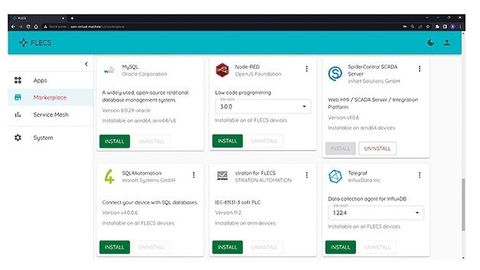
The Marketplace branch in the company network
Back to the initial scenario: if the IT employee were dealing with a Flecs-based machine, it would at least be clear which operating system and apps are running on it and how to update them. However, there is still the problem of Internet access, which the machine operator has set up himself. In future, Flecs-based machines will not require internet access for app installations and updates.
A so-called branch of the Flecs Marketplace can be set up in the production network. This obtains the apps and updates from the central marketplace on the Internet and makes them available to the machines in the local network. This allows machines to be operated even more securely separately from the internet. A branch can also be used to set which apps should be available in which version. This prevents misconfigurations and the installation of unwanted apps.

The question of retrofitting
Machine manufacturers and operators often need to expand their machines and systems. In practice, such retrofits usually involve predictive maintenance, AI-based process optimization and technical upgrades. The machine manufacturer uses an edge device on which the new software is set up, data exchange with the PLC is configured and an internet connection is usually created. Here too, Flecs provides support by installing the system itself and offering a wide range of apps for connectivity with controllers from different manufacturers such as Siemens, Rockwell Automation or Schneider Electric.
There is no need to search for suitable connectors and a data connection can be set up quickly with these. The data from the PLC is immediately available to the apps on the Edge device via the Service Mesh. This saves machine manufacturers 40% time in engineering and maintenance compared to the previous approach. The first well-known PLC manufacturers have already decided to use the open source software. They will be showcasing their new Flecs-based controller generations at the SPS in November.


You might also be interested in
Check with Bernd Hantsche, Rutronik
Advantage of scalability
Edge and cloud computing play a central role in industrial IoT. But when should which technology be used? How can edge and cloud synergies be best utilized? Bernd Hantsche from Rutronik provides the answers.
 read more...
The consistent opening
In September 2019, Bosch Rexroth announced ctrlX Automation for the first time: an open software architecture combined with a new hardware platform. Now comes a step that is unprecedented for controller manufacturers: giving up hardware exclusivity.
read more...Digital production system
German Edge Cloud has developed the Oncite Digital Production System (DPS). This system bundles and expands the industrial IoT applications of the Oncite Industrial Suite.
read more...Embedded community votes for favorites
In addition to the coveted 'embedded award', the 'community choice award' will also be presented for the first time at embedded world. The special feature: The award winner is determined by the embedded community.
read more...Preview on embedded world 2024
Inference can be as Compute Intensive as the Training
With CPUs, GPUs and FPGAs, AMD has all architectures that are used for AI. embedded world Keynote Speaker Dr. Salil Raje shares his view on AI.
read more...International meeting places for the embedded community
From April 9 to 11, the embedded industry will meet in Nuremberg - but not only there, because embedded world will also take place in China and the USA in 2024. How did it go in China? What can we expect in Nuremberg? And a look ahead to the 1st...
read more...In focus: Artificial intelligence
The e-paper of the January 2024 issue
ChatGPT has given artificial intelligence a huge boost over the past year - especially in terms of public perception. In this issue, we want to take a closer look at AI and categorize it in more detail for potential industrial users.
read more...AI boosts the performance of software engineers
New "superpower" for software developers: An AI-supported programming assistant is set to revolutionize the development landscape.
read more...ERP trend forecast for 2024
Unit4 forecasts the most important ERP trends for the year 2024. Claus Jepsen, Chief Product and Technology Officer, names nine points that he considers relevant.
read more...