

Rohde & Schwarz
Private 5G networks
Some companies are already planning to set up their own private 5G networks. These must be integrated, approved and maintained in the existing communications environment. The framework conditions have already been defined. The first test and monitoring solutions are already available.

Mobile network operators around the world are currently expanding their networks for 5G. The new mobile communications standard not only brings higher data rates for smartphone owners, but also offers specifications for special applications in the Internet of Things, for autonomous driving and for the smart factory sector. These technologies are also suitable for local private wireless networks, for example for companies' production networks.
The benefits of private 5G networks
Modern manufacturing companies already generate large amounts of data, the evaluation of which is becoming increasingly important in the course of digitalization. Above all, the need to design the production line flexibly and to be able to reconfigure it at any time requires reliable wireless communication. This is particularly advantageous, for example, when automatic guided vehicles (AGVs) are in use. There are also numerous other applications such as remote Human Machine Interfaces (HMI) or automated software updates for moving, e.g. rotating machines. Reliable and secure communication is a basic requirement for all these applications. An in-house communication network, possibly based on an interference-free private spectrum, offers the necessary reliability here.
Spectrum for private networks
Some countries such as the UK and Japan have already allocated local spectrum for industrial applications, and many others are considering doing so. In Germany, companies and agricultural and forestry businesses have been able to apply to the Federal Network Agency for local spectrum in the 3.7 to 3.8 GHz range since November 21, 2019. In return for a fee, they are then allocated private spectrum for the duration requested. However, the use of this frequency band is not mandatory. The public operators also offer their spectrum for use for local industrial applications or campus networks with the help of so-called network slicing technology. This means that both the frequency bands of the public operators and the private spectrum from 3.7 to 3.8 GHz are available in Germany.
The net variants
When planning a private 5G network, the decisive factor is whether it is a purely indoor network or an outdoor network. An indoor network is understood to mean coverage by a communication technology within a building or building complex. If there is a requirement for good coverage with radio signals, for example to control machines on a production line, a dedicated indoor implementation of a communication network is a good option. This can already be achieved to some extent via WLAN connections. Communication networks such as LTE or 5G can be used in the same way and are particularly suitable for applications that focus on mobility and short latency times. Both are important criteria for the use of AGVs or machine control systems.
Outdoor networks, on the other hand, cover a specific area. In the case of Industry 4.0, this can be a large company site, an industrial area or even an entire city district. Planning an outdoor network is more complex and can include the indoor supply of buildings. Coexistence with other communication networks in the region must also be considered.
The most important parameters
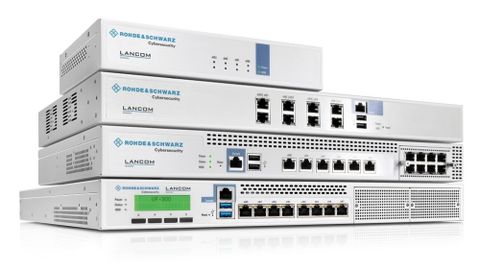
The unified firewalls from Rohde & Schwarz subsidiary Lancom Systems have a deep packet inspection engine and other mechanisms to protect against complex cyber attacks and malware.
© Lancom SystemsFor all communication networks, the basic performance parameters are crucial. Sufficient coverage must be ensured. To do this, the absolute performance values must be measured, such as the reception strength of broadcast signals. It is also important to check the signal-to-interference/noise ratio (SINR). In principle, it must be verified that the spectrum to be used is free of interference.
In the case of TDD networks, this requires gated trigger measurements. TDD networks separate the downlink, i.e. the transmission from the base station to the terminal device, and the uplink, i.e. the transmission from the terminal device to the base station in the time domain. With the help of gated trigger measurements, the downlink is masked in the correct time window in order to make the potentially smaller but significant disturbances in the uplink visible. In addition, the performance of the connection must be checked, which in the case of data connections is done by measuring the achievable data rate. In the Industry 4.0 environment, latency (delay) is an important parameter that is determined using one-way latency measurements. Accordingly, the measurement of the absolute delay from a control unit that sends a command to the executing process or machine part is crucial for machine control. The absolute latency achieved is important here, where values of less than one millisecond may be required. In addition, the jitter, i.e. the variance of the average delay achieved, is often decisive.
Device tests before implementation
Last but not least, the end devices and base stations used in communication must be checked for the necessary performance. This is usually done before implementation in the field. A series of suitable test cases must be carried out in a laboratory environment using dedicated test devices. In the cellular environment, a successful certification environment - operated and organized by the Global Certification Forum, for example - ensures the performance of the end devices. The credo here is: test once and use everywhere. Rohde & Schwarz is in favor of establishing such certification mechanisms, especially for Industry 4.0 applications.
Mobile Network Testing
Regardless of the wireless or wired communication technology used, the constant monitoring of communication networks against external attacks is of great importance. The continuous functioning and security of communication solutions can only be ensured if problems are detected at an early stage and countermeasures can be taken immediately. Appropriate monitoring solutions are available for this purpose.
5G-ACIA
In addition to various research projects, the 5G Alliance for Connected Industries and Automation (5G-ACIA) was founded in April 2018 to drive forward 5G technology for industrial applications. This committee brings together the OT players (Operational Technology) with the ICT players (Information and Communication Technology), i.e. the potential users of 5G technology for industrial applications with the companies that provide the 5G communication technology. The aim is to incorporate the needs of Industry 4.0 use cases into the further development of 5G technology in the best possible way. Rohde & Schwarz has been active in the 5G-ACIA since fall 2018 and is primarily involved in the 'Validation and Tests' working group. The fact that there is a dedicated test group in the 5G-ACIA shows the importance of measurement technology for Industry 4.0. The high demands placed on communication technology in terms of reliability, latency and security require the development of effective and efficient test metrics.
Biggest challenges
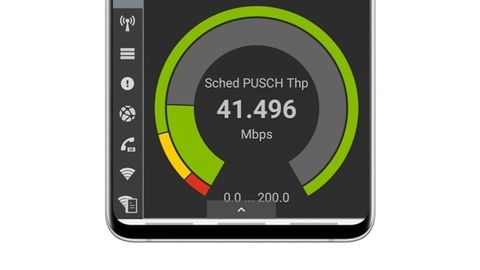
The QualiPoc handheld troubleshooter from Rohde & Schwarz Mobile Network Testing will measure the quality of service of mobile networks up to 5G in the future. One-way latency measurements are already in the prototype phase.
© Rohde & Schwarz Mobile Network TestingAfter selecting the most important individual use cases (AGV, machine control or logistics), the biggest challenges in realizing a 5G communication network for Industry 4.0 use cases are good coverage planning for the specific environment and careful implementation of the infrastructure components.
In general, 5G technology should be integrated into an existing productive environment. This means that 5G integration into an existing wired (Ethernet) or wireless (WLAN) network poses a particular challenge. The interfaces to the existing networks must be defined individually.
Last but not least, the reliability of communication must be ensured when switching from wired to wireless communication technology. To this end, the use of efficient measurement and monitoring solutions is essential, not only when setting up the network, but also during ongoing operation. Suitable monitoring solutions allow potential disturbances/interference in the RF spectrum to be detected at an early stage, enabling suitable countermeasures to be initiated.
Available test solutions
Rohde & Schwarz already has the necessary test solutions for 5G, but also for LTE, WLAN and other communication technologies in use today. Mobile
network testing solutions include, for example, the precise measurement of supply parameters such as power and signal-to-interference ratios as well as the measurement of connection parameters such as data rates based on a 5G terminal device. However, Industry 4.0 applications place high demands on communication technology, particularly in terms of latency, reliability and security. The company is therefore continuously developing its measurement technology in relation to this use case. The Mobile Network Testing division, for example, can already determine the one-way latency with a prototype of a QualiPoc end device. The subsidiaries Ipoque and Lancom Systems offer various solutions in the field of cybersecurity. The R&S PACE 2 deep packet inspection engine from Ipoque, for example, can be used to classify IP data and analyze communication endpoints.

Rohde & Schwarz already uses this technology in its own factories to monitor communications. Lancom Systems has also equipped its R&S Unified Firewalls with this engine to protect communication networks against external attacks. With R&S PRISMON.cloud, the company has a 'monitoring as a service' solution in its program that was developed for professional media services. For mobile network operators, the company offers not only the necessary measurement technology, but also services including the determination of the performance of a mobile network. This solution is also available for setting up and operating local LTE and 5G networks in the Industry 4.0 environment.


You might also be interested in
Demand is rising
90 applications for industrial 5G campus networks have already been submitted to the Federal Network Agency. Automation technology plays an important role in the market maturity of 5G standardization.
 read more...
The reality of Industrial 5G
5G has developed into hype. However, with 5G, many of the promised functions are either not yet available or the assumptions about possible applications are based on unrealistic conditions. The status quo.
read more...TeamViewer takes over Ubimax
TeamViewer will acquire Ubimax, a manufacturer of wearable computing technologies and augmented reality solutions. An agreement to this effect has been signed.
read more...How to successfully digitize business processes
The pace of digital transformation is rapid and represents a massive upheaval for industrial companies. In order to remain competitive in the future, it is not only necessary to optimize individual processes, but also to modernize the entire value...
read more...The quantum computing revolution
Unlimited computing power offers German key industries enormous competitive opportunities on the way to an Industry 4.0 data economy.
read more...Cabling - still the safest option!
5G is creating new opportunities for manufacturing companies to network system components and processes. What potential does 5G have to implement viable business models? Stefan Ehrlich, CEO of SQL Projekt AG, gives his forecast.
read more...The Industry 4.0 hype - an opportunity?
The number of successful Industry 4.0 implementations is still relatively small. Why is it that the industrial revolution that was touted years ago is not really making progress?
read more...The second phase
The BMBF project 'Basissystem Industrie 4.0' came to an end a year ago. Now, small and medium-sized companies are to be supported in the introduction of Industry 4.0 on the basis of the project. Project manager Dr. Thomas Kuhn explains the...
read more...The e-paper of the June 6 issue has arrived
The new issue 6 is now available for you as an e-paper or for download. We have lots of practical examples, exclusive reports and product presentations for you.
read more...