
Siemens
The reality of Industrial 5G
5G has developed into hype. However, with 5G, many of the promised functions are either not yet available or the assumptions about possible applications are based on unrealistic conditions. The status quo.
Is 5G ready for industrial use or not? This question cannot be answered with a simple 'yes' or 'no', as there are many things to consider. 5G is already available today - but with limitations.
Non-stand-alone or stand-alone networks
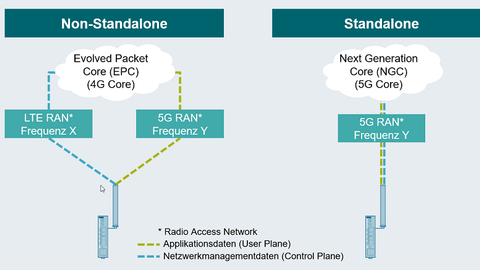
In 5G non-stand-alone networks, part of a 4G network is used for device management. 5G spectrum and technology are only used to transmit the application data. In contrast, in a 5G stand-alone network, both the application data and the network management data are transmitted using 5G. As of today, stand-alone 5G networks are not available on a global scale. These 'real' 5G networks are not expected in large numbers until 2021.
The main scenarios of 5G
5G brings with it three main scenarios: enhanced Mobile Broadband (eMBB),
massive Machine-Type Communication (mMTC) and Ultra-Reliable Low-Latency Communication (URLLC). All scenarios serve different application areas: eMBB is bandwidth-oriented and mMTC serves applications where low power consumption and a large number of connected devices are required. URLLC supports the requirements of industrial IoT applications such as low latency times with the best possible reliability.
However, these main scenarios cannot be fully realized with the same network at the same time. A network can only be designed and configured to fully support one scenario. For example, it can either offer the highest possible data rate or the lowest possible latency. Both are not possible at the same time.
The 5G standard itself is also not yet complete. Today, we are only at release 15. Many functions and even complete scenarios will only follow in future releases 16, 17 and others. Release 15 of the 5G standard has been available since December 2018. It focuses primarily on the main eMBB scenario. The upcoming Release 16 - planned for summer 2020 - will focus on URLLC; Release 17 will focus on mMTC and should be available at the end of 2021.
Enhanced Mobile Broadband (eMBB)
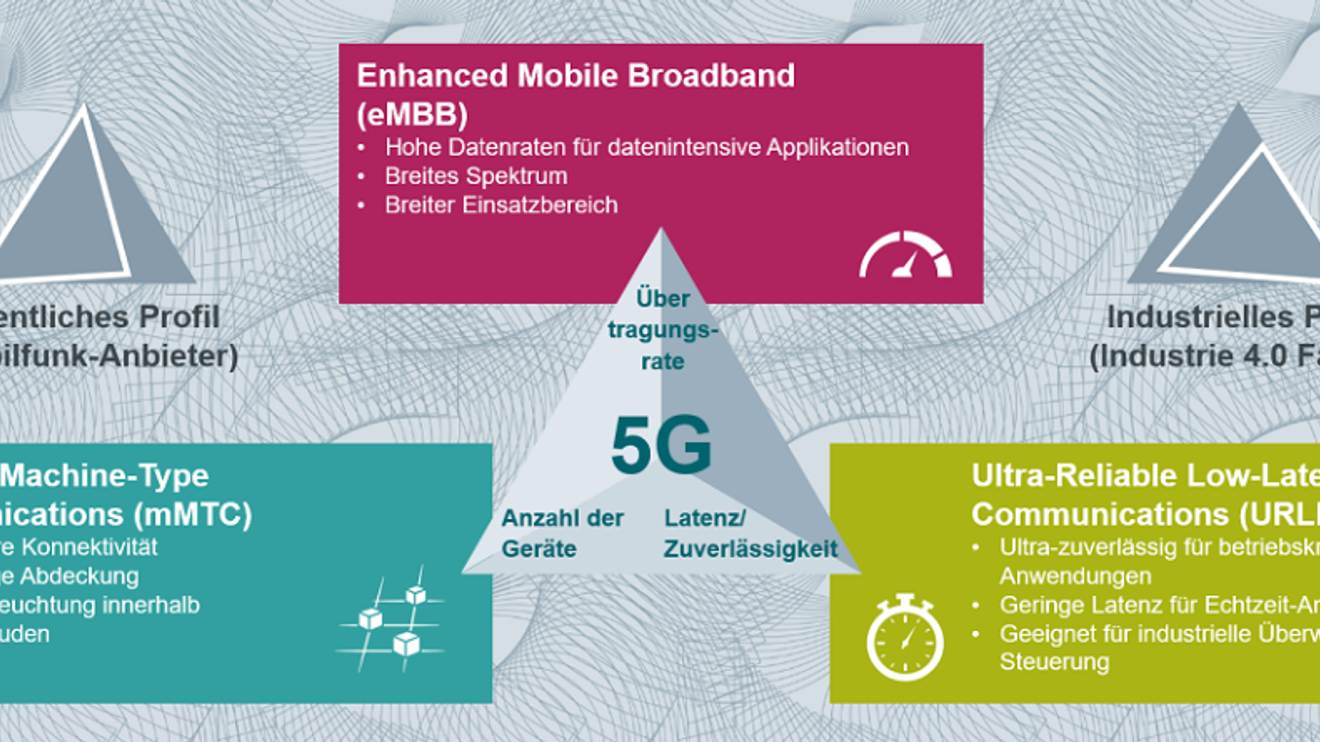
The three main scenarios of 5G: Only one scenario can be used to its full extent in a network.
© SiemensToday's 5G is based on Release 15. It is mainly focused on consumer needs and is supported by currently available handheld devices as well as some mobile network operators. eMBB aims to achieve peak data rates of 20 Gbit/s and real-world data rates of 1 Gbit/s per device. This is around 10 to 20 times faster than 4G.
To achieve this, 5G is adopting and improving the modulation scheme that 4G already uses, Orthogonal Frequency-Division Multiple Access (OFDMA). With OFDMA, information is sent via several sub-carriers. One of the main features is the sub-carrier spacing (SCS), i.e. the distance between two sub-carriers. There is a relationship between the symbol duration and the sub-carrier spacing. The connection between the sub-carrier spacing, the symbol duration and the slot-per-frames is called numerology and is indicated by the Greek letter µ. In contrast to 4G, 5G carrier spacing is dynamic. This allows it to be adapted to the needs of the user. As a result, 5G uses the spectrum more efficiently than 4G. The efficiency increases from 90 to 95%.
Each sub-carrier can be modulated using different modulation methods: QPSK (Quadrature Phase Shift Keying), 16-QAM (Quadrature Amplitude Modulation), 64-QAM and 256-QAM. The latter is not part of 4G. With higher modulation orders, more bits can be sent via an OFDM symbol, with a corresponding increase in the data rate. However, this requires better connection quality.
Depending on the number of available carriers, carrier aggregation is also possible. If a network uses two 20 MHz blocks, for example, two data streams can be sent to a terminal device at the same time, one via each carrier. The end device then recombines the data into one data stream.
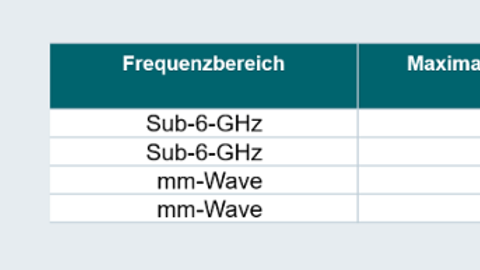
The downlink data rate as a function of the frequency range: The values shown represent the maximum peak data rates theoretically achievable in a network with a single user.
© SiemensThe use of MIMO (multiple input multiple output) antennas is also possible with 5G. This means that a receiver can receive several data streams simultaneously via several antenna signals, which it recombines. The available frequency also has an influence on the achievable data rate. For 5G, this is currently 3.4 to 3.8 GHz - also known as the sub-6 GHz frequency spectrum - and the millimeter wave range around 26 GHz. Most of the frequencies already allocated for 5G in Europe are in the sub-6 GHz range.
In summary, this means that the maximum data rate depends on the number of carriers (carrier aggregation), the modulation, the number of MIMO layers and the frequency range. The data rates are calculated for the downlink under the assumption that the 256-QAM modulation method, the maximum eight MIMO layers and all slots for the downlink are used for a single user. They represent the theoretical maximum achievable peak data rates in a network with a single user.
In the current implementation of 5G, only Time Division Duplex (TDD ) is currently taken into account. This means that the allocated spectrum must be time divided between uplink, downlink and control channels, potentially reducing the above theoretical maximum throughput in a realistic environment.
It is true that 5G can reach around 20 Gbit/s in the downlink, but only at a bandwidth of 400 MHz, which will only be available in the millimeter wave spectrum. In the 3.7 to 3.8 GHz range, which has been allocated by the German government for private local applications, no more than 4.6 Gbit/s can be expected.
The most important scenario for the industry is URLLC. This main scenario will meet the demanding requirements of industrial IoT applications. It offers highly reliable communication with the lowest latency times and is intended to support applications ranging from automated guided vehicles (AGV) to wireless safety applications (e.g. emergency stop). These can be implemented with minimal latency.
Ultra-Reliable Low-Latency Communication (URLLC)
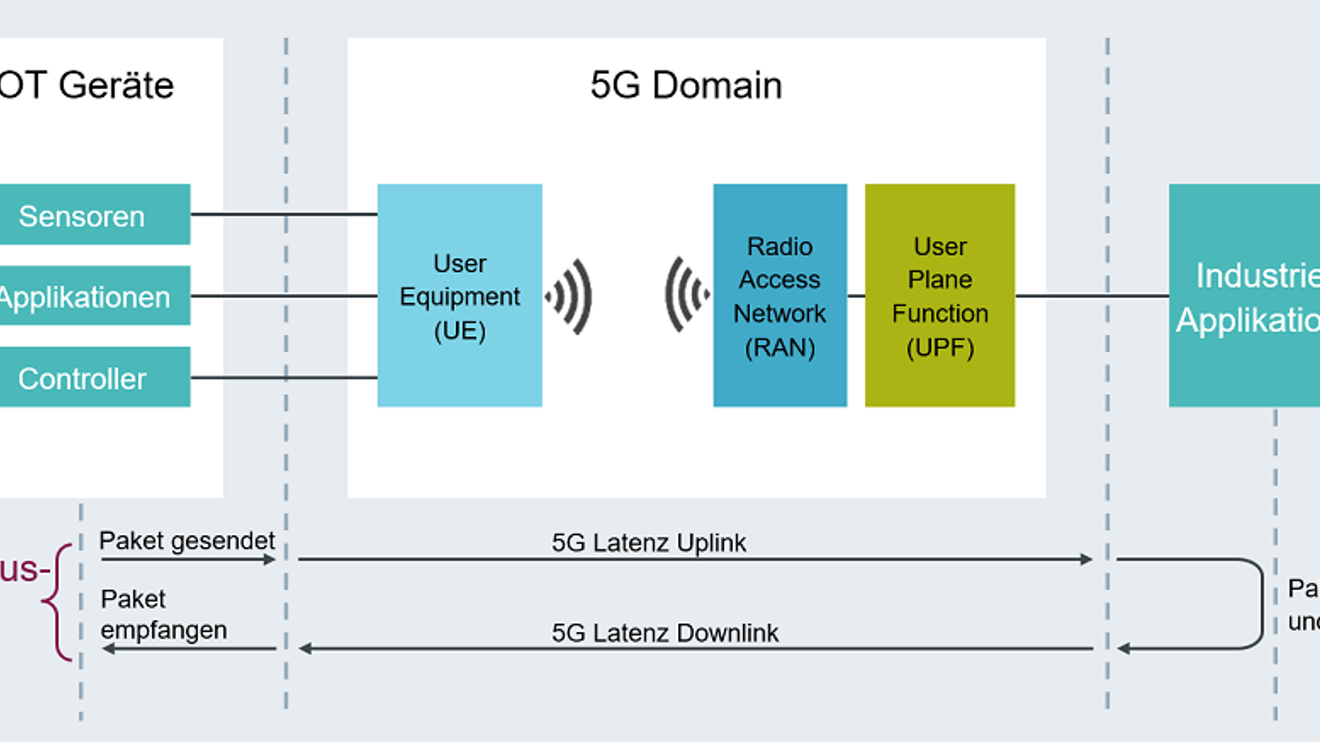
Latency is defined as the time it takes for a data packet to reach the user equipment (UE, end device) and be transmitted from the user plane function (UPF) to an external network or application. This is the end-to-end delay of the entire 5G system.
In 5G, flexible numerology (µ) can reduce the air transmission latency. To do this, an information slot is sent in less time. Self-contained slots and mini-slots within the slots are used. The 5G radio interface protocol is structured in frames of 10 ms. Each frame comprises 10 subframes of 1 ms each, which in turn are divided into slots containing 14 OFDM symbols. Depending on the selected numerology, a slot can last from 1 ms to a minimum value of 125 µs. In all cases, the number of symbols per slot is always 14, which means that in a subframe with an SCS of 30 kHz, a total of 28 symbols are transmitted within 1 ms. In a 60 kHz SCS slot, 56 symbols can be transmitted and so on.
These values apply to theory. Real values must be measured in a real stand-alone 5G network and only concern the physical part of the radio transmission. This delay must be added to all delays caused by the processing of the radio protocol and the delay in the core network.
Unlike the network nodes in older mobile radio technologies, the 5G core network is based on virtual functions. The advantage of virtual functions is that they can be easily deployed on an edge device, for example the software of the RAN (Radio Access Network), the UPF and possibly also as an application on the same machine, which results in lower latency.
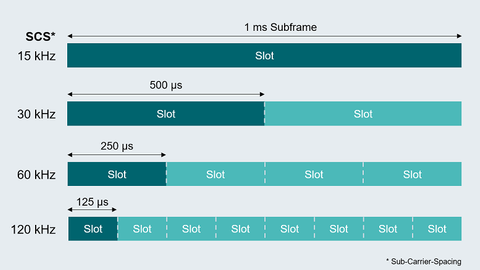
Sub-carrier spacing and slot duration: The values mentioned are theoretical values. Real values must be measured in a real stand-alone 5G network and only relate to the physical part of radio transmission.
© SiemensIndustrial applications require communication latency to be as low as possible. A delay in communication leads to higher cycle times for the applications. The cycle time is the time required by a client application or device to send a request to a controller application and return the response. For deterministic and mission-critical industrial applications, it is therefore essential to keep the cycle time to a minimum. The 5G network introduces a delay in both the uplink and downlink, which does not necessarily have to be the same. The applications also require a certain processing and response time. The sum of all these factors is the cycle time.
Latency times and cycles
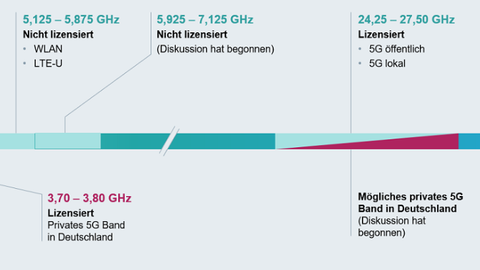
The 5G spectrum in Germany: The Federal Network Agency has reserved 100 MHz from 3.7 to 3.8 GHz for local use.
© SiemensWith 5G, several points contribute to latency: processing in the end device, wireless transmission, 5G protocol processing, the connection between the RAN and the core and the delay in processing the core network protocol. The overall performance also depends on the implementation of the 5G network.
In addition, the latency in private and public networks can be very different. If a company uses a public mobile network, it must expect higher latency times, as the data has to travel long distances outside the plant to reach the core network. In comparison, private networks are installed entirely on site. As a result, there are no long distances between the various network elements and the delay in the backbone is reduced to a minimum. In addition, the implementation of the 5G network can be optimally adapted to the applications. A private network therefore achieves better latency times by default.

According to the specifications of 5G, the shortest Packet Delay Budget (PDB) has an upper limit of 5 ms, which is to be guaranteed by the use of 5G quality of service classes. However, there are currently no known measurements that prove such values. A realistic latency value of around 10 ms can therefore be assumed, at least for the first 5G deployments.
Advantages of private networks

Sander Rotmensen is Head of Product Management for Wireless Industrial Communication at Siemens.
© SiemensPrivate 5G networks enable companies to take advantage of the benefits of 5G. A private network is more secure than a public network, as the wireless signal is only available where it is needed. In a privately owned network, the data remains on site and users can decide which data is processed where - in a cloud, for example. In addition, users can control their private 5G network themselves and are able to adapt it depending on the application. Sufficient spectrum must be available to the industry for such private networks.
Many countries are considering making local spectrum available either in the sub-6 GHz range or in the millimeter wave range or even in both. In Germany, the Federal Network Agency (BNetzA) has already reserved 100 MHz from 3.7 to 3.8 GHz for local use. This gives companies the opportunity to rent spectrum for a low annual fee.


You might also be interested in
SPS Connect 24.11. - 15:10 - 15:30
Continuously optimizing with the Digital Enterprise
As a result of advancing industrial digitalization, machine and plant manufacturers need flexibility in order to reliably meet requirements. A consistently digitalized value chain makes this possible: the digital company with the digital twin.
 read more...
SPS Connect 25.11. - 12:00 - 12:20 p.m.
Industrial Artificial Intelligence - Future of Automation
Artificial intelligence helps us in every area of our lives, whether we're trying to read our emails, get directions, get music or movie recommendations. The bottom line: it makes our lives easier.
read more...The tool-supported proof of safety
The relevant standards for functional safety in the process industry - IEC 61508 and IEC 61511 - are over 1000 pages long. For users, calculating and creating standard-compliant safety verifications is a challenge. Special tools offer assistance.
read more...The tuned 5G
The 5G network is under construction and yet research is already working on its optimization. The EU project Ariadne aims to develop a new type of wireless system architecture to reliably transmit extreme data rates in the 100 Gbit/s range with...
read more...Better than expected
Siemens performed better than expected in the third quarter of 2020 due to a higher earnings contribution from the Digital Industries division.
read more...The e-paper of the summer issue 7/8 for you
The current issue 7/8 is now available as an e-paper or for download. Once again this month, we have special features, practical examples, interviews, exclusive reports and product news for you.
read more...How to successfully digitize business processes
The pace of digital transformation is rapid and represents a massive upheaval for industrial companies. In order to remain competitive in the future, it is not only necessary to optimize individual processes, but also to modernize the entire value...
read more...Private 5G networks
Some companies are already planning to set up their own private 5G networks. These must be integrated, approved and maintained in the existing communications environment. The framework conditions have already been defined. The first test and...
read more...Implement 5G now!
Should the factory data be stored in the cloud or rather on site in your own data center? The next generation of mobile communications should be taken into account in these considerations. After all, 5G can make a decisive contribution to the...
read more...