

ISW Stuttgart at the SPS 2023
On the way to Manufacturing-X
The Manufacturing-X initiative is driving forward the digitalization of supply chains in industry. But what does a factory that can handle this need to look like? The ISW at the University of Stuttgart provides answers to these questions.
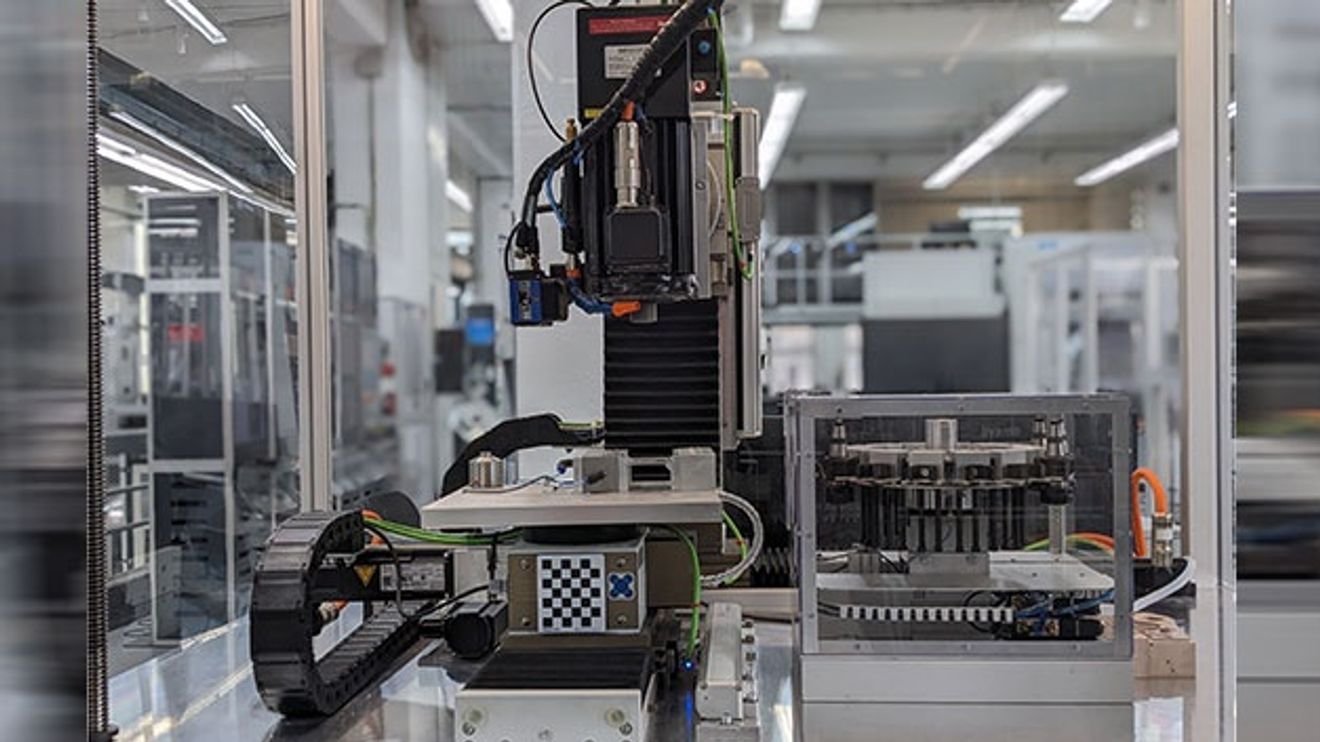
In order to bring Manufacturing-X from vision to implementation, technologies are needed to realize cross-company data spaces. It is particularly relevant that these are interoperable and freely accessible to all companies that want to be part of such a data ecosystem. Manufacturing-X can already be experienced today at the Stuttgart Machine Factory, an ISW research platform. Technologies such as the Eclipe Dataspace Connector (EDC), the Asset Administration Shell (AAS) and OPC UA are used here. EDCs are used to implement cross-company communication, including contract processing. The data sent is modeled according to the AAS standard of the Industrial Digital Twin Association (IDTA). In order to unleash the full effect of Manufacturing-X, end-to-end networking within the company must be realized in addition to communication between companies. ISW's answer to this is the software-defined factory. The production systems are also managed by the AAS and addressed via OPC UA. Virtualized controllers are used on the store floor, which run in so-called edge clouds, which in turn are connected to the machines in real time via TSN. In addition to established methods such as virtual commissioning, solutions based on mixed reality are used to safeguard the machines and visualize data. At the SPS trade fair, this will be demonstrated on four machines: two milling machines, a laser machine and a robot.
On the milling machines, the ISW will also show how the dynamic accuracy of machines can be increased by combining analytical models and machine learning to create so-called grey box models. Data plays a particularly important role in the development of such models, which can be shared and made available more easily using Manufacturing-X.
The laser machine, on the other hand, is characterized by CNC-based control and redundant axes, which ultimately enables simple data aggregation and dynamic processing.
The special feature of the robot on display is that it can not only be controlled from the Edge Cloud, but also regulated. This enables process-dependent adaptive switching between different controllers and the flexible deployment of these controllers. End-to-end digitalization and networking from the drive controller to the cloud can be seen at the trade fair stand.
ISW Stuttgart at the SPS 2023: Hall 6, Stand 340


You might also be interested in
Forum Manufacturing-X founded
In the VDMA Forum Manufacturing-X, the association bundles all activities on this topic for member companies and stakeholders. With the forum, the association is building on what has been developed over the last 10 years by the VDMA Industry 4.0...
 read more...
Virtualized control systems using TSN backbone
The major challenges in implementing virtualized control systems are scalability and connectivity to the field level. An implementation at the ISW shows that this can already be achieved today using a TSN network.
read more...TSN in combination with EtherCAT
TSN is an important building block for convergent communication in flexible production. Mastering and integrating existing fieldbus technologies such as EtherCAT is an important part of the transition. An inventory of what is already possible.
read more...TSN - backbone for virtualized control systems?
It is currently a major vision: the virtualization of control systems. This and the next article in this series will address this topic. The decisive prerequisite and content of this article is the connectivity of the control system right down to...
read more...The e-paper of issue 07/2024
Read in the current issue of Computer&Automation how ChatGPT can provide support in the conception phase, how LLMs are used in code analysis and whether TSN can be considered as a backbone for virtualized control systems.
read more...TSN application engineering
How can the decoupling of network configuration and application engineering work in TSN applications? What could future workflows look like and how will engineering tools be affected? A proof of concept based on open source solutions points the way.
read more...Enabler of SW-defined production?
Digitalization is often reduced to the addition of digital services to traditional systems. However, the real potential lies in a digital ecosystem that needs to be established as part of software-defined manufacturing - TSN plays an important role...
read more...TSN - The current state of affairs
TSN is the extension of the IEEE Ethernet standards to include deterministic quality-of-service mechanisms and is therefore a key enabler for the digitalization of production. This article summarizes current developments and places them in an...
read more...Continuity - the new paradigm
Flexible, adaptable, dynamic and digital - tomorrow's production technology should be all of these things. The software-defined manufacturing research project aims to turn this vision into reality for the vehicle and supplier industry.
read more...