
Industrial communication
More power for WLAN transmission
How can the potential of wireless communication in industry be fully exploited? In addition to choosing the right antenna, there are various other optimization options that are worth knowing about.

Choosing the right antennas plays a decisive role in the design of a WLAN installation (Fig. 1). Omnidirectional antennas radiate their signal in all directions and therefore pick up the signal of the other party from all directions. Directional antennas mainly radiate in one direction and amplify the opposite signal coming from this direction significantly more than an omnidirectional antenna. For this reason, directional antennas are 'deaf' in all other directions.
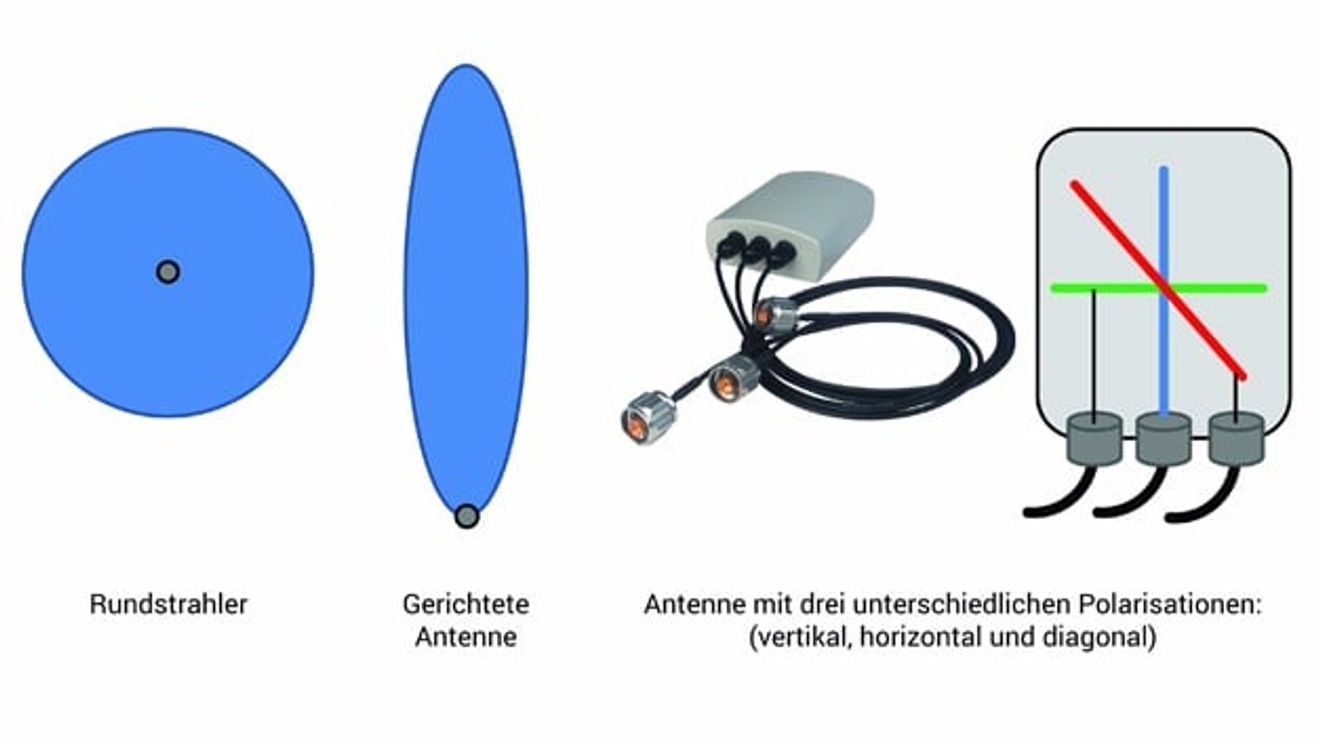
Figure 1: Different antenna characteristics: omnidirectional antennas radiate in all directions, directional antennas amplify in one spatial direction. Antennas with multiple polarization axes transmit radio signals simultaneously in MiMo mode.
© Belden/HirschmannWhile small rod antennas usually only provide a gain of between 2 and 3 dB, higher-quality directional antennas can achieve gains of 10 to 20 dB. As the antennas provide a significant proportion of the amplification of the transmitted signal, they contribute significantly to the signal-to-noise ratio and therefore to both the range and the speed of the network.
Some antennas are suitable for both the 2.4 GHz band and the 5 GHz band, whereas other antennas only develop their full gain in one of the two frequency ranges. Particular attention is required here when changing the frequency band to be used, as otherwise the coverage and quality of the network may suffer due to unsuitable antennas.

Ultimately, however, the choice of antenna usually depends on the intended function of the WLAN network. If two access points are to act as a WLAN bridge (Fig. 2) and only talk to each other, directional antennas are best suited. A directional antenna is also ideal for illuminating an area in one direction. Directional antennas are also ideal for mobile applications in which a client moves along a specified route in order to create greater spatial coverage along the route.
Omnidirectional antennas are used wherever it is not clear in advance which direction a signal is coming from. For this reason, an omnidirectional antenna is generally used for industrial trucks, as the vehicle can turn in any direction without losing the connection.
Improved throughput thanks to Adaptive Noise Immunity (ANI)
In addition to the basic optimization steps, various WLAN systems offer a number of further options for increasing performance. These require either special hardware or software and are therefore only available on certain products.
In industrial environments, electromagnetic signals often occur in the frequency bands used. Sources of these signals can be other wireless transmission systems (Bluetooth, ZigBee, ISA 100). Emissions from machines and devices installed in the systems are also conceivable.
As a consequence, subsequent transmissions may be missed by the receiver in these cases, as it is still in the process of decoding the interference signal incorrectly as a WLAN transmission. The receiver unit is then busy processing meaningless interference pulses and thus misses the actual transmissions. Furthermore, its own transmission processes can be delayed because the search for a free transmission time as part of the CSMA/CA media access procedure incorrectly perceives the medium as busy. This results in reduced data throughput, even though the transmission channel could provide more capacity.
Activating the 'Adaptive Noise Immunity' mechanism (ANI) ensures that such interference is suppressed in high-quality access points, thereby improving the possible throughput. The suppression of interference is achieved by means of adaptive control of the reception sensitivity, with the WLAN radio module continuously providing measured values for interferers in the active channel. This reduces both the number of missed transmissions at the receiver and the occurrence of delayed transmissions, thereby optimizing the utilization of the transmission medium.
Adaptive RF Optimization
To minimize external interference, it is advisable to adapt the choice of radio channel on an access point to its surroundings.
Interference can be caused, for example, by neighboring access points on the same channel whose radio ranges overlap. In this case, the participants in this area must share the entire available bandwidth (shared medium), which increases the probability of mutual interference in transmissions. Depending on the environment of the installed system, external interference may change dynamically and the configuration may have to be adjusted accordingly.
Modern access points provide an automatic function that evaluates the interference in the current environment and switches to a better quality channel if necessary. In this way, optimal operation is ensured even without manual administrative intervention. However, this automation can also be undesirable if there is manual frequency planning for the various radio networks in a production plant.
Band steering and client steering
Especially in scenarios with many clients, it makes sense to distribute them across different available frequency ranges (Fig. 3). An example of this could be an access point on a factory floor that supplies various tablets with network connections. If this access point has several WLAN modules, it makes sense to direct the clients that are able to communicate in the 5 GHz band to this frequency band - even if they would normally prefer a connection to the WLAN module in the 2.4 GHz band. Such a shift reduces the load on the traditionally more heavily used 2.4 GHz band and enables systematic use of the often less heavily used 5 GHz band.

Figure 3: Band steering directs multi-band-capable devices to less frequented frequency bands.
© Belden/HirschmannIn networks controlled by a controller with many access points, client steering achieves a similar effect to band steering. However, clients are not steered from a full frequency band to a less congested frequency band, but are shifted from overloaded access points to less congested access points in the vicinity. This is achieved by a selective response from the less congested access points to connection requests from the client. This ensures that the radio load in the network is evenly distributed and there is less interference due to interfering transmissions. This mechanism can automatically ensure better network quality, especially when covering large areas (e.g. factory halls or refineries).
Airtime Fairness
Neighboring clients in a WLAN network often compete for the available bandwidth. A high density of clients not only means that more bandwidth is required than is actually available, but also that 'slow' clients can slow down 'faster' clients with the transmission of their data. Clients are described as slow if they can only send/receive signals encoded at a low data rate because, for example, they do not yet support the IEEE 802.11n wireless standard or the signal quality (SNR) is not sufficient for a higher data rate. A packet coded with a low data rate will therefore occupy the channel for a correspondingly longer time.
The WLAN media access procedure is intended to give each participant an equal opportunity to access the channel. However, it does not take into account how much time a subscriber actually needs to transmit. As a result, the medium is occupied longer by transmissions to and from slower clients than by transmissions that can be completed very quickly using high data rates. A more efficient use of the available bandwidth for communication from the access point to the clients is ensured by the 'airtime fairness' method. This method is implemented by intervening in the queue of packets to be sent at the access point. Slow clients are served with correspondingly fewer packets, so that access times are approximately the same as for connections with fast clients. This allows fast clients to pass more data downstream as they can use the channel for longer.
Parallel WLAN connections
Packet loss occurs time and again during transmissions using radio technology, as the packets either do not arrive with sufficient quality or are disrupted by simultaneous transmissions from other subscribers.
By using the Parallel Redundancy Protocol (PRP), however, the reliability of transmissions can be significantly improved by transmitting packets via two independent radio links simultaneously. With interference-free transmission over both links, packets received twice are sorted out before they are forwarded.
A calculation example: Assuming that the loss rate without double transmission on both links would be identical and 0.1 %, the rate of the overall PRP system is only 0.0001 % (0.0001 × 0.0001 = 0.000001) - a 1000 times better value. In practice, depending on the loss rates of the two individual sections, improvements in the region of 500 times can be achieved! PRP not only improves the reliability of WLAN connections, but also reduces latency and jitter, as the faster of the two duplicates is forwarded. If one WLAN link is not ready for transmission, transmission can take place directly on the other link if necessary. The resulting latency with PRP via WLAN networks is therefore just as good or better than the latency of the better of the two radio links. The same applies to the jitter with the variance in the transmission delay.
Fast roaming
Fast and reliable roaming (Fig. 4) is an important quality requirement for industrial WLAN systems, especially in application scenarios with mobile clients, such as autonomous industrial trucks. Ideally, neighbouring access points with overlapping radio coverage on different channels should be operated without interference to optimize the bandwidth. A mobile client can then automatically connect to the access point with the best signal. Interruptions of less than 50 ms can be achieved when switching access points in the 2.4 GHz band - however, even faster roaming or roaming in the 5 GHz band requires a few technical tricks. Two problems need to be solved to ensure both fast and secure switching: How can the mobile client switch from access point to access point as quickly as possible? And: How can the time required to negotiate the security parameters be minimized?

Figure 4: A mobile client moves through the wireless networks of various access points.
© Belden/HirschmannWhen roaming, a client must first identify the target access point before changing the access point. To avoid mutual interference between neighboring access points, the target access point is usually operated on a different channel. However, a client can only receive the access points on the current frequency. The client must therefore disconnect its current communication link when changing access points in order to be able to search for suitable access points on other channels/frequencies. A mobile client must therefore periodically scan all possible channels/frequencies in order to get an idea of the signal strengths to be received from all access points in its vicinity.
Depending on the mobility of the client and the associated changes in the environment, the scanning processes must be carried out correspondingly often. As the active connection cannot be used during these scans, it is not possible for the client to forward the packets from the industrial application during the scan. The network is not available during this time. The scan processes should therefore be as short as possible.
One way to keep the scanning time short is to use active scanning. The client uses a probe request on each channel to query the presence of the access points in question. The client repeats this process for each channel to be scanned. In this way, the client recognizes all potential roaming targets in its environment in a very short time. However, if channels are also used in which radar detection is required, this results in a difficulty: active scanning with probe requests is prohibited in these channels, as the proper operation of radar stations could be disrupted by the sending of probe requests. Therefore, it must first be determined whether there are primary users on the corresponding channel.
As this process must always be carried out again and this determination requires one minute of passive listening, this is not an option for fast roaming outdoors. The client is therefore forced to listen on all available channels until an access point reports itself. The access point carries out this process periodically using so-called beacons. The scan duration for these channels is therefore determined by the period of the beacon messages sent by the access point and the corresponding maximum waiting time of the client. Ultimately, this quickly results in an interruption to roaming of several seconds - a value that is usually unacceptable.
The faster the access points repeat their beacons, the faster the client can switch to the next channel without overlooking an access point. It is therefore a great advantage for an operator not only to be able to configure the period duration for sending beacon messages at the access point, but also to adjust the maximum waiting time at the client accordingly. With access points and clients specially optimized for fast roaming, the beacon and scan times can be set particularly finely.
The security of a connection can only be guaranteed if a client is correctly authenticated at the access point when the connection is established and a key valid for this connection is negotiated to encrypt the data packets. This takes time and - unless special techniques are used - must be repeated for each roaming process. Fast roaming is therefore only possible using a fast authentication mechanism.
Last but not least, modern access points support faster roaming by pre-distributing key information in the network. A coordination center (the WLAN controller) distributes all the information required for fast authentication of clients among all access points in the network. This process is called opportunistic key caching. Thanks to this technology, every access point can authenticate every client in the network quickly, securely and unambiguously via 'WPA2 Enterprise'. This allows roaming times of 50 ms to be achieved with full security features.
Authors: Prof. Dr. Tobias Heer works on future technologies at Hirschmann Automation and Control and Dr. Bernhard Wiege works in the Embedded Software Development department at Hirschmann Automation and Control.


You might also be interested in
Hans Seifert to Become Chief Sales Officer
Sigmatek has appointed Hans Seifert as Chief Sales Officer (CSO). His area of responsibility includes international sales, marketing, application engineering, and support.
 read more...
CC-Link certification for modular I/O system
Weidmüller has received the CC-Link Partner Association (CLPA) certificate for its modular I/O system 'u-remote'. This makes u-remote the first modular I/O system with official CC-Link IE safety certification for CC-Link IE TSN.
read more...Profibus & Profinet International
MTP Specification 2.0 published
Profibus & Profinet International (PI) announces the official release of the Module Type Package (MTP) Specification 2.0. The MTP 2.0 standard creates the basis for true cross-industry interoperability as well as more flexibility and efficiency...
read more...New analog input modules
MicroControl is launching the next generation of compact analog input modules. The new modules are µCAN.4.ai-BOX for voltage/current, µCAN.4.sg-BOX for strain gauge sensors and µCAN.4.ti-BOX for temperature sensors.
read more...Profibus & Profinet International
Profinet leads the field in industrial Ethernet protocols
A recent analysis by the market research institute Omdia confirms that Profinet is the leading technology in the field of industrial Ethernet protocols. In addition to its broad market penetration, Profinet's consistent focus on security is...
read more...Dual leadership in Shanghai
Stefan Becker has been appointed Managing Director of Eckelmann Automation Technology in Shanghai and will manage the subsidiary together with Zhongwei Huang.
read more...Smart control cabinets thanks to new Ethernet/IP technology
Rockwell Automation is launching an Ethernet/IP control cabinet solution. The aim of this further development is to meet the growing demand for smarter, faster and better networked production processes.
read more...Softing Industrial Automation takes over Delta Logic
Softing Industrial Automation has acquired 100% of the shares in Delta Logic Automatisierungstechnik in Schwäbisch Gmünd.
read more...Single-axle drive module for high performance
The modular, dynamic multi-axis servo system 'DIAS-Drive 2000' from Sigmatek has been reinforced: The 'MDP 2200-L-01' single-axis module for controlling synchronous servo motors provides up to 20 A rated current.
read more...