

Membrain
Holistic digitalization on the store floor
For holistic digitalization on the store floor, machines and control systems must be seamlessly networked with IT systems. This requires a strategic approach that goes beyond the traditional automation pyramid.

Especially in the manufacturing sector, companies have had to face extremely dynamic changes in recent years. In addition, topics such as Industry 4.0, automation and mobility have become an integral part of IT roadmaps and are already an integral part of corporate strategy. Various areas of work in the industrial environment, which for a long time were completely analogue and did not require software-supported processes, are now firmly reliant on digitalization. However, in order to ensure holistic digitalization, all IT systems, machines and control systems must be seamlessly networked with one another. This requires a universal Industry 4.0 platform (IoT platform) as a communication data hub. The corresponding strategic approach can best be described using the automation pyramid, which represents the conceptual structure of a manufacturing company in its hierarchical structures(Figure 1).
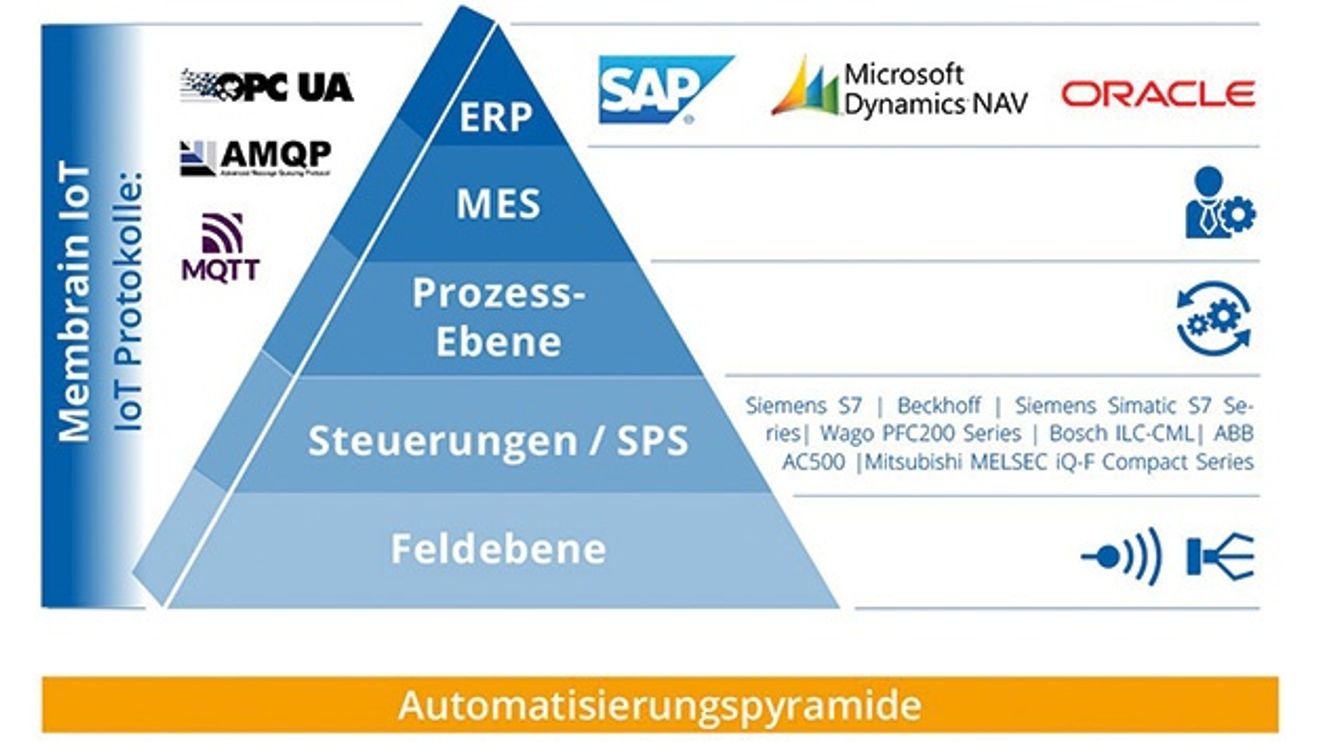
The automation pyramid is a hierarchical representation of the control and automation levels in industrial processes. It describes a
structure and serves to categorize technologies and systems per level.
The basis is formed by the field level, which contains sensors and actuators that interact with the environment and machines. Thanks to the control units of the second level, data from the field level can be made available to the third level and processed systemically accordingly (SCADA system and MES through to the ERP system). Communication between the levels of the pyramid is based on point-to-point connections. Due to the structure, this communication is slow, as it has to be run through level by level - from bottom to top and back again if necessary. Likewise, expansion (systems, sensors, actuators) is only possible by creating new point-to-point connections. However, this severely restricts use in terms of flexibility and performance. This is why this architectural approach is a thing of the past; it is also referred to as the 'Industry 3.0 approach' in specialist literature.

As a counter-concept, the Industry 4.0 approach aims to eliminate point-to-point connections and link all levels of the entire automation pyramid independently and flexibly. This is achieved with the help of a universal Industry 4.0 platform that provides relevant data where it is needed. In architectural terms, this means that the individual components of the automation pyramid are broken down into their individual parts. The structure is thus softened and a new one is created(Figure 2).
At the center of this new structure is a universal platform (Industry 4.0 platform) that directly links the individual systems and hierarchical levels. This approach has clear advantages. First of all, the system can be expanded easily and as required. For example, mobile applications can be easily and quickly integrated into this Industry 4.0 structure. SQL databases, time series databases, etc. can also be integrated as required. Algorithms, machine learning and artificial intelligence, for example, can also be easily applied on the basis of this data. Communication between the individual components in this eco-system and the central Industry 4.0 platform is bidirectional. This means that it is possible to both read and write data. For example, decisions can be made with the help of AI modules and made directly available to the relevant systems such as MES or PLC.
This architecture offers companies maximum flexibility and complete scalability. For example, new systems can be introduced and replaced or different protocols or sensors can be added. The aim of this structure is to achieve optimum data availability: data producers and data consumers need to be connected directly with each other and without delay. Relevant data should be made available directly to specialist departments, taking into account the factors of what data they need, when they need the data and in what form they need the data.
Process automation thanks to Industry 4.0
The following describes the architectural structure of a Membrain customer scenario and shows how easy it is to avoid point-to-point connections thanks to the Industry 4.0 approach (Membrain IoT). The core of the Industry 4.0 platform is the flexible connection of different components, such as mobility, controllers (OPC UA), dashboards and the leading ERP system (SAP). The diagram shows the architectural structure and communication via OPC UA and, for example, a Wago PLC with the Membrain IoT Industry 4.0 platform(Fig. 3). Other connected components are the leading SAP system, a time series database (TIMSCALE), the mobile applications and the maintenance dashboard for visualizing machine status, messages and relevant KPIs

A recorded data point is read out via OPC UA and communicated directly to the IoT platform. This information is immediately available to all modules in the eco-system. A corresponding visualization is immediately displayed in the dashboard. Other supplementary actions such as task and resource planning can be triggered immediately or published automatically in the database (configurable recording of machine data, quantities, machine status, etc.). Automatic notifications directly in SAP are also possible and can be pushed to mobile devices and processed in real time. The user has the option of reacting directly to "events" in real time. Possible SAP PP and SP PM scenarios include the automated recording and processing of fault messages based on trigger points, push messages or reading out a production status.
Membrain's solution supplements the SAP system with a mobile component. This allows various departments (production, logistics, maintenance, etc.) to work with SAP in a very intuitive and mobile way, reduced to the essentials. Documentation or data entries or transactions are carried out automatically in the background. Further add-ons expand the solution and bring more productivity to the store floor.
Mobile working for more productivity
Especially in the industrial environment, native applications have prevailed over browser solutions in recent years due to their many advantages. The performance of powerful applications plays a key role here. In addition, native apps guarantee uninterrupted, transaction-safe working thanks to offline mode. If the connection to the leading system (SAP) fails or is unavailable, the recorded data is buffered (temporarily stored in the app). As soon as an online connection to the system is re-established, the data is automatically synchronized in the background. Furthermore, native apps meet a clear security standard, as communication is encrypted and paths into the leading system are secured thanks to certified interfaces.
The modularity of the platform enables connection to subsystems and expandability. This facilitates the integration of third-party systems such as quality assurance, PDA and MES. These are areas that are not traditionally among SAP's strengths. A particular focus here is on usability. This significantly increases productivity and user acceptance. When it comes to operating an Industry 4.0 platform, cyber security plays an important role, as it does in all IT projects. This is because many projects fail as early as the PoC (proof of concept) due to unpredictable project costs and insufficiently secure interfaces to subsystems.
Critical systems live in view

Thanks to the Industry 4.0 platform and apps, processes can also be automated and factories digitized in the production area. Dedicated apps inform plant managers about critical machine statuses via push notifications on their smartphones in real time. Dashboards, for example, graphically display the live status of individual machines and thus monitor production. The app automatically reports as soon as a predefined event occurs, for example if limit values are exceeded or undercut. This can be a message or an email notification to the production manager or lead to an autonomous machine stop. The distributed messages contain further information and reasons for the fault. These must be defined and specified in advance for each machine or machine group in the leading system. Real-time data from the store floor thus provides significantly more transparency and makes machine data, for example production times, downtimes, process data such as temperature and pressure or energy data, for example electricity and water consumption, available systemically. Mobile working not only speeds up processes, but also ensures automatic and seamless documentation of workflows.


You might also be interested in
Software from the cloud conquers industry
Software from the cloud is becoming the standard in industrial companies. This is shown by the current study "Spotlight Future 2024" commissioned by PLM provider Aras.
 read more...
Automation meets innovation
SPS - Smart Production Solutions will take place in Nuremberg from November 12 to 14. Once again this year, organizers and exhibitors will pick up on the trends in the automation industry and present suitable solutions. The introduction of IT into...
read more...The e-paper of issue 9/2024
The hype surrounding AI is inspiring, but the reality requires a sober approach to the technology. Computer&Automation 9/24 looks at topics relating to AI & security, the EU AI Act, secure IIoT projects and OPC UA FX "From the cloud to the...
read more...ChatGPT in the industry - Part 7
Architecture documentation of existing software systems with AI
Artificial intelligence in the form of LLMs is suitable for analyzing existing software and automatically creating architecture documentation from it. This article shows how this works.
read more...Check with Reinhard Achatz, B&R
The "Margo" project
On April 16, the Linux Foundation launched the "Margo" initiative. The aim is to define and implement mechanisms for the interoperable orchestration of edge applications on a large scale. Reinhard Achatz is involved in the work and takes a stand.
read more...followed up! - with Dr. Thomas Kuhn
From the digital twin to the data room
Fraunhofer IESE is working on the development of the open source middleware Eclipse BaSyx as part of the 'BaSys 4.0' research project. Thanks to a digital twin, the research focus is shifting towards the data space. Dr. Thomas Kuhn explains the...
read more...Déjà vu from IT
Automation is currently characterized by exciting trends - these are "revolutionary" innovations with which the IT industry has long had experience, but the automation industry has not yet. "IT meets OT" with practical examples.
read more...Safeguarding AI applications
Trend Micro is expanding its cybersecurity platform to secure the use of AI in companies. New functions also support risk management during the introduction of AI tools.
read more...These are your winners!
We put 96 products in twelve categories to your vote in December, and now the winners have been chosen! The trophies were presented at a 'Winner's Dinner' at the Seehaus in Munich. These are your "Products of the Year 2024"!
read more...