

Federation Architecture | Part 3
Toward an Industrial-Grade AI for OT
Operational Technology (OT) controls physical processes and therefore operates under preventive and deterministic constraints. Modern AI, by contrast, is probabilistic and improves through iterative learning. Reconciling these paradigms remains a defining challenge of industrial AI.

Parts 1 and 2 introduced Federation Architecture (FA) and examined its practical implications. This article explains how FA creates the conditions for OT-grade AI to emerge and scale.
FA applies three principles: edge autonomy, unidirectional data flow from OT to IT, and human-reviewed changes. Together, they preserve OT control and AI-safety boundaries while enabling convergence benefits. FA provides the disciplined foundation for integrating and operating AI in OT. This article shows how FA also supports the development of AI models that meet OT requirements.
Properties of Industrial-Grade AI for OT
AI models are statistical and inherently imperfect. While no single standard defines industrial-grade AI, industrial safety and AI governance guidance (EU AI Act, NIST AI RMF, . . .) point to shared expectations for high‑risk use. Without claiming to provide an exhaustive list, AI model development tailored to OT constraints and governance faces the following expectations:
- reliable operation within defined boundaries
- design and validation based on risk-oriented methods
- lifecycle traceability and auditability
- explainability appropriate for operators and auditors
These expectations exceed what many current AI models provide and require disciplined engineering and governance. This gap helps explain why industrial AI remains an active field of development.
Historically, major AI advances have relied on shared foundations such as benchmarks, reusable methods, and reproducible implementations. Deep learning’s early large‑scale success leveraged public benchmarks such as ImageNet. The transformer architecture, which underpins modern LLMs, spread because it was introduced through an openly published method and evaluated on widely recognized benchmark tasks. AlphaFold, recognized by the Nobel Prize in Chemistry, is another example where broad impact was enabled by shared scientific infrastructure, open databases and an open‑source implementation. In OT, similar conditions are harder to establish. Data diversity is often the primary constraint. Rare faults and long-tail behaviors are sparse at one site but become learnable across many sites and over time. While fine-tuning and synthetic data can help, they do not replace real-world diversity available across organizations. This creates an incentive for collaborative training without requiring organizations to share raw operational data.
Why Organizations Resist Cross-Organizational Centralized AI Training
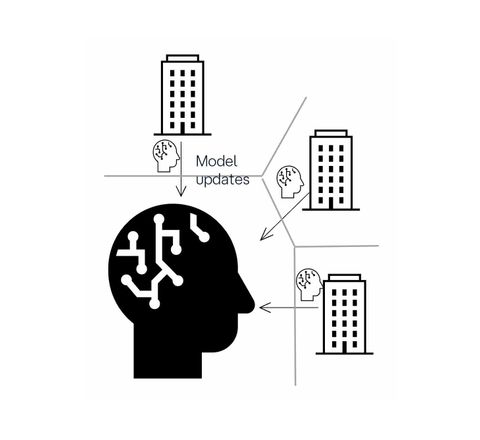
Organizations are reluctant to share operational data across organizational boundaries for several reasons:
- Competitive intelligence: Process parameters, failure modes, and efficiency metrics reflect accumulated expertise and competitive advantage. Sharing raw operational data with vendors or third parties risks exposure to competitors using the same platforms.
- Regulation: General and sector-specific regulations often restrict data sharing beyond organizational boundaries.
- Liability: Responsibility for model-induced failures remains unclear. Risk-averse organizations therefore refuse participation.
- Trust: Contributing proprietary data to vendor-controlled models is often unacceptable.
As a result, many AI models in OT are trained on limited, site-specific data and lack robustness. Federated Learning (FL) addresses this constraint.
From FA to Cross-Organizational Model Development
FA enables controlled data flow from OT to IT, where compute resources for analytics and model training are available. However, a single organization rarely achieves sufficient data diversity for demanding OT use cases.
Federated Learning provides a mechanism for collaboration without sharing raw data [1]. In FL:
- models are trained locally on proprietary data
- only model updates (e.g., gradients or weights) are shared
- techniques such as secure aggregation and differential privacy [2, 3], and other FL techniques are applied to reduce exposure of individual contributions and the risk of reconstructing training data from model updates, depending on the threat model and governance of the FL alliance (Figure 1.)
The aggregated global model benefits from distributed datasets across participants. The model can then be deployed by participating organizations. The alliance might even decide to make some models more openly available to create value for the whole industry, when that aligns with its incentives, liability posture, and regulatory constraints.
Beyond its technical aspects, FL defines participation rules, contribution checks, benchmarks, and controlled model versioning, which supports validation, traceability, and auditability in OT-grade model development. In practice, the alliance can become a governance forum where participating organizations align on use-case specific acceptance criteria, validation procedures, and benchmark datasets, and then jointly improve models without exchanging raw operational data.
FA Organizations as Natural FL Participants
FA and FL address different layers: FA structures IT/OT interaction within an organization, while Federated Learning enables cross-organizational model development. Nevertheless, organizations adopting FA are well positioned to participate in FL:
- Cultural Alignment: Federation Architecture establishes organizational comfort with controlled data sharing: operational telemetry flows upward, but sensitive operational data stays local. Federated Learning operates on the same principle: model insights flow outward, but training data stays local.
- Trust Architecture: If an organization has built systems where “nothing commands in without human approval,” they are more comfortable with “model updates come in, but with control deployment and approval.”
- Regulatory Consistency: Organizations implementing Federation for data sovereignty reasons find Federated Learning solves the same constraints for cross-organizational AI.
- Vendor Independence: FL can be implemented using standardized methods, allowing participation without vendor dependency.
Even organizations that cannot share certain classes of data internally can participate if local compute and governance allow model updates to be produced on premises and shared to an aggregator.
OT-Grade AI Scales Edge Autonomy (Closing the Loop)
Edge autonomy improves resilience but comes at a cost: it requires highly skilled operators on-site. This challenge has long existed in the OT industry regardless of FA, and there are two ways to address it:
- Bidirectional Convergence to enable centralized command and control
- Smarter on-premises operations to reduce the local overhead
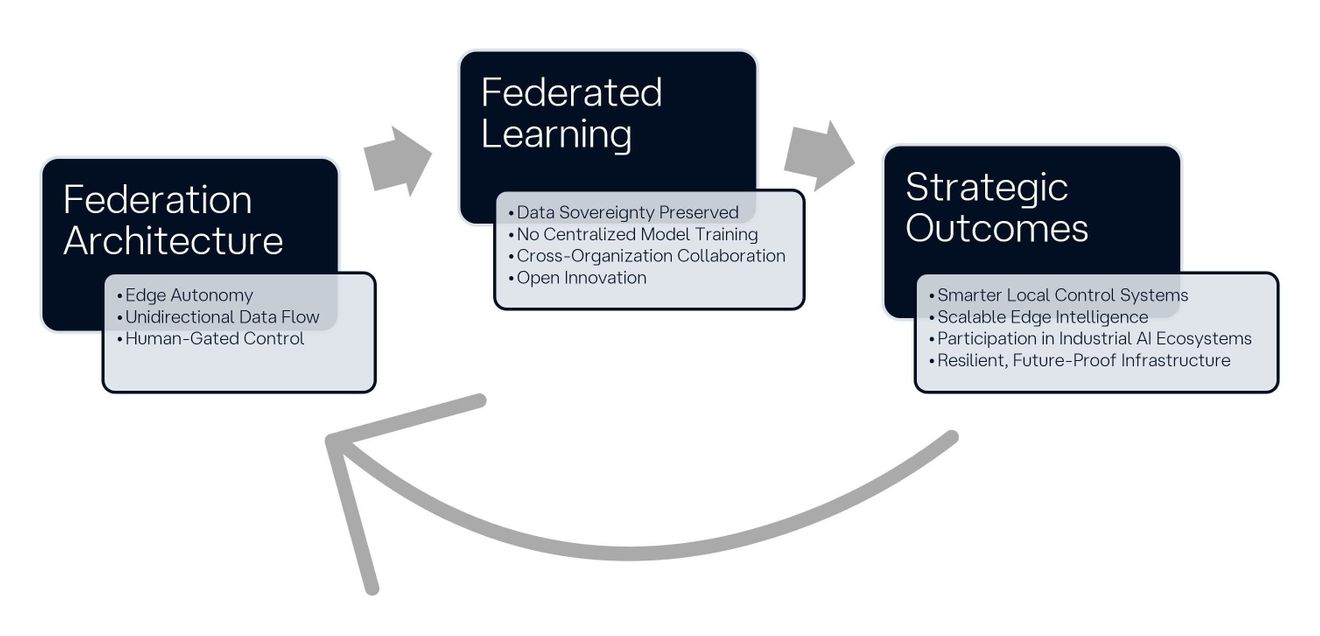
Federation Architecture promotes the second option as the goal or a milestone on the roadmap for those who choose the first option as their goal. Edge autonomy, and with that FA, can scale effectively with responsible AI-automation.
FA and FL form a practical flywheel. FA prepares organizations to use and, in an FL alliance, contribute to building OT-grade AI models. More suitable models come to exist that potentially can be used to reduce local operational overhead and make disciplined edge autonomy easier to sustain. This increases incentives for participation in FL, investment in local data engineering skills and further improves FL model quality. Figure 2 summarizes this cycle from architectural discipline to collaborative learning, then to outcomes that reinforce the architectural discipline.
Final Notes on Federated Learning
FL improves data sovereignty by keeping raw training data local, but does not eliminate risk. Model updates can still leak information without appropriate safeguards, and stronger privacy mechanisms may reduce model performance.
Additional risks include:
- compromised or backdoored updates
- heterogeneous data quality across sites
- reduced transparency due to privacy-preserving techniques

Forming such FL-alliances is itself non-trivial. For OT, FL should therefore be treated not only as a technical method but also as an operating model defined by governance, participation rules, and standards [4, 5].
Conclusion
Federation Architecture reframes IT/OT convergence as a set of explicit architectural commitments rather than an all-or-nothing integration goal. It maintains local control, restricts write access to OT systems, and enforces human review, while still enabling centralized visibility and analytics.
This structure provides a practical foundation for OT-grade AI, ensuring that model development and deployment remain aligned with governance, validation, and operational control requirements. Where cross-organizational learning is required but raw operational data cannot be shared, federated learning extends this approach beyond individual organizations without compromising data sovereignty or safety.


You might also be interested in
"AKIMI" Research Project develops AI for Flexible Robotics
The AKIMI research project is launching at the WZL at RWTH Aachen University. The goal is to develop agent-based AI that simplifies the programming and reconfiguration of robotic systems for small and medium-sized enterprises.
 read more...
Trumpf collaborates with the IPAI AI Network
Trumpf is a new partner of the IPAI AI network in Heilbronn. Together, the two parties plan to develop and test artificial intelligence applications for industry.
read more...Siemens makes 'Sinumerik One' AI-capable
Siemens has unveiled a new generation of hardware for Sinumerik One. The CNC controller offers greater computing power, a 64-bit architecture, AI support, and meets the requirements of the EU Cyber Resilience Act.
read more...Valtech Identifies Shortcomings in Agentic AI
The Valtech study “The Agentic Age” shows that skilled workers are open to agentic AI, while many companies have not yet established integrated AI-supported work processes.
read more...Federation Architecture | Part 2
No Architecture Is Perfect
Having introduced the principles of Federation Architecture in Part 1, this article examines their practical implications. It describes operational effects, limitations and areas of application, and situates FA within existing industrial...
read more...Extended three-member Management Board for Deutsche Messe
Deutsche Messe AG is reorganizing its personnel and consistently focusing its Management Board on the further development of the company and the exhibition grounds in particular. With an expanded three-member Management Board, the company is...
read more...Federation Architecture | Part 1
Rethink IT-OT Convergence in an AI-Driven World
AI is shifting threat models for industrial infrastructures. Federation Architecture proposes a disciplined middle ground between isolation and full integration - with edge autonomy, one-way data flow, and human approval.
read more...AI-enabled rugged mobile workstation
With 'Z14I-HG' Durabook presents an AI-ready Fully Rugged Mobile Workstation with Nvidia RTX 5000/3500 Ada graphics.
read more...Siemens and Nvidia are accelerating Chip Testing
Siemens and Nvidia have significantly accelerated the verification of AI chips. With the help of FPGA-based prototypes, tens of trillions of design cycles could be tested within a few days before production. This should improve the development and...
read more...