
Bosch annual result 2015
Double-digit sales growth through JV acquisitions
Stuttgart-based Robert Bosch GmbH posted a record year in 2015 with a clear double-digit increase in turnover. The technology group expects moderate sales growth of 3 to 5% for the current year.

The Renningen research campus is an important node in the global research and development network with 55,800 employees.
© Bosch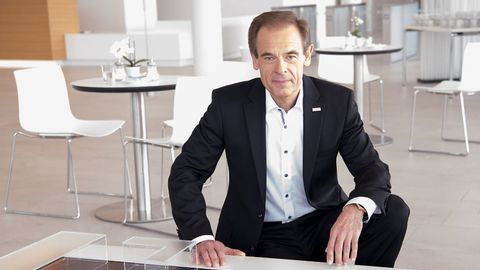
Dr. Volkmar Denner, Chairman of the Board of Management of Robert Bosch GmbH, presenting the figures for the 2015 fiscal year at the Bosch research campus in Renningen.
© BoschThis year, Stuttgart-based Robert Bosch GmbH presented its balance sheet at the new research and development center in Renningen. The technology group is undergoing a transformation: "In the future, we will grow not only with innovative products, but also with innovative services," explained Dr. Volkmar Denner, Chairman of the Bosch Board of Management, at the press conference in Renningen. "We are increasingly building networked services on our broad base in the hardware business," Denner added. The company benefits not only from its technical versatility, but also from its broad industry and domain expertise. "In future, Bosch will not only meet its customers in the car or in the kitchen. With connected services, Bosch will become an everyday companion in many life situations," says Denner, explaining the corporate strategy.
In the 2015 financial year, Bosch achieved an absolute record value of 70.6 billion euros. The main reason for this was the complete takeover of the former joint ventures BSH Hausgeräte GmbH (with Siemens) and Robert Bosch Automotive Steering GmbH (with ZF), which boosted sales by almost 22 billion euros or 44%. However, Bosch was also able to grow organically and achieve an increase in sales of 10%, or 3.8% when adjusted for exchange rate effects. With the exception of 'Industrial Technology', all business sectors achieved double-digit growth and improved their results in 2015. In 2015, the Bosch Group as a whole achieved an EBIT of 4.6 billion euros and thus a return of 6.5%. In a year-on-year comparison, operating EBIT therefore increased by around 0.9 billion euros or 24%.
As at December 31, 2015, the Bosch Group employed around 375,000 associates worldwide. On a comparable basis, the workforce grew by 17,600 associates in 2015. The regional focus of personnel expansion was on Central and Eastern Europe, Germany, Asia-Pacific and the USA. For the current year, Bosch plans to recruit around 14,000 new graduates worldwide. Software expertise is particularly in demand.
Services as a strategic addition to the hardware business


Bosch's strategic goal for the future is not only to offer hardware products for connected life, but also services for connecting these products in the Internet of Things. In the connectivity business, the company is focusing on the so-called '3S': sensors, software and services. "Services will become an integral part of our product business. Every sale of hardware should be followed by sales of complementary services," explained Denner. When developing and implementing services for the connected world, Bosch benefits not only from its expertise in software and sensor technology, but also from its broad technology base. "Cars with houses, even entire cities - Bosch can connect many things from a wide range of domains like no other company," Denner added. Almost 50% of all Bosch electronic product lines are internet-enabled. The company will gradually expand the existing service business of all four business sectors.
In connected production (Industry 4.0), Bosch benefits in particular from the implementation experience gained in its own 250 or so plants. The company is translating its internal experience into external services, such as the 'Production Performance Manager', which visualizes production data in real time and independently triggers maintenance processes. By 2020, Bosch expects networked production to result in cumulative cost savings of one billion euros and additional sales of one billion euros. The newly created 'Bosch Global Service Solutions' division is already experiencing strong growth. Among other things, the division's approximately 6,000 associates support the business processes of many customers in various industries or process eCalls on behalf of car manufacturers. In 2015, the division handled more than 120 million customer contacts for more than 1,000 companies in 30 countries, 30 million more contacts than in 2013. Bosch expects annual sales growth of around 15% for the Service Solutions division.
Increasing connectivity will also provide greater convenience and relief in the smart home. The company has been offering the 'Bosch Smart Home System' since the beginning of the year. Further products for the system are set to follow in the course of the year, including a smoke detector which, in addition to its actual function, also provides greater security during the vacation season, for example. Bosch expects the smart home to have a global market potential of ten billion euros as early as 2017. By 2020, around 230 million or 15% of all households worldwide will be equipped with smart home solutions.
In the top-selling 'Mobility Solutions' segment, Bosch's portfolio already extends beyond the car. For example, Bosch is working with partners on a mobility assistant for intermodal transportation. In the greater Stuttgart area, users can use just one app to plan, book and pay for tickets for various means of transportation such as cars, bicycles, trains or buses. Networked parking systems will also have a strong service component. In 'community-based parking', cars themselves act as sensors. The vehicles recognize parking spaces on the roadside as they drive past and report them to Bosch via the Internet. The company uses this information to create a map in real time, on which free parking spaces are marked. Thanks to data mining, real-time parking maps can already be generated from the sensor data of just 6% of all vehicles in moving traffic.
Own IoT cloud as the basis for the service business
The company's own IoT cloud is an integral part of Bosch's service business. The Bosch IoT Cloud provides the technical infrastructure for connected systems. Around 50 of the company's own applications will be running there as early as 2016. From 2017, external customers will also be able to use the IoT cloud as a service. The central software core of the IoT Cloud is the 'Bosch IoT Suite'. It is the brain of the connected world. The Bosch IoT Suite offers all the functions needed to connect devices, users and companies. Big data management enables the analysis of large volumes of data within the IoT Suite. Rules for automated decisions can be stored in the Bosch IoT Suite - for example, when machine conditions indicate wear patterns so that preventive maintenance can be initiated. More than five million devices and machines are already connected via Bosch IoT Suite components.
Development in the regions and divisions
In Asia-Pacific including Africa, the Bosch Group increased its sales by 17% to 19.2 billion euros in 2015 (adjusted for exchange rate effects: 2.8%). The main reason for business development falling short of expectations was the subdued economic momentum in China and other emerging markets. Bosch sees great long-term potential in Africa. The company further expanded its business activities there in 2015. Bosch now has its own branches in ten African countries.
Business in North America benefited from the positive economic development. Sales there climbed by 25% to 12.7 billion euros (6.7% adjusted for exchange rate effects). In South America, on the other hand, the recession in Brazil left its mark. Overall, sales in the region fell by 13% (3.7% adjusted for exchange rate effects).
Business in Europe developed better than initially expected. The company increased its turnover by 3.8% to 37.3 billion euros in 2015. Turnover also developed positively in the home market of Germany, rising by 1.3%.

Business performance by business sector: The Bosch Group achieved an all-time record of 70.6 billion euros in the 2015 financial year.
© Bosch RenningenMobility and Consumer grows, Industry weakens
The 'Mobility Solutions' business sector significantly increased growth and earnings in 2015. On a comparable basis, turnover increased by around 12% to 41.7 billion euros (4.6% adjusted for exchange rate effects). The division therefore performed significantly better than global automotive production, which only increased by 2% to 92 million units. The operating return on sales increased to 8.4%.
The difficult situation on the mechanical engineering market was reflected in the development of the 'Industrial Technology' division. Overall, sales fell by 1.6% to EUR 6.6 billion (6.5% adjusted for exchange rate effects). The decline in sales was also reflected in the earnings trend. Industrial Technology reported an operating loss of around 100 million euros for 2015. By contrast, business development in packaging machines was positive.
The Consumer Goods business sector performed very well last year. In 2015, Bosch achieved sales of 17.1 billion euros here. BSH Hausgeräte's sales of around 12.6 billion euros were included for the first time. In operational terms, both the household appliances and power tools business also developed favorably. On a comparable basis, sales rose by around 10% compared to the previous year (5.7% adjusted for exchange rate effects). The division's operating return on sales increased to 7.2%.
Last year, the Energy and Building Technology division increased its sales significantly more than in 2014, with revenue rising by 11% to EUR 5.1 billion (7.2% adjusted for exchange rate effects). The continuous improvement in earnings in the division led to a return of 4.4%.


You might also be interested in
ODVA, OPC Foundation, PI and VDMA
Specification for interoperable energy management published
Precise energy consumption data is needed to achieve climate-neutral production. A consortium has now published a specification for interoperable and efficient energy management in industrial automation and process automation.
 read more...
Manage and secure assets
In today's fast-paced industrial environment, it is essential that production processes run smoothly and efficiently. However, one critical aspect that is often overlooked is the importance of PLC backup and restore procedures.
read more...OPC UA from the cloud to the sensor
OPC UA is also establishing itself as a standard for the exchange of process data between controllers. The next step is now to extend the concepts developed for the controller-to-controller use case for the controller-to-device and device-to-device...
read more...Update brings support for TIA V19
Delta Logic has updated the 'Accon OPC UA Server' software to version 1.4.0.0. The new features include support for TIA Portal projects of version V19 and for the latest firmware for CPUs of the Siemens S7-1200 and S7-1500 controllers.
read more...Automation meets innovation
SPS - Smart Production Solutions will take place in Nuremberg from November 12 to 14. Once again this year, organizers and exhibitors will pick up on the trends in the automation industry and present suitable solutions. The introduction of IT into...
read more...The e-paper of issue 9/2024
The hype surrounding AI is inspiring, but the reality requires a sober approach to the technology. Computer&Automation 9/24 looks at topics relating to AI & security, the EU AI Act, secure IIoT projects and OPC UA FX "From the cloud to the...
read more...The e-paper of issue 08/2024
How can data centers be cooled for AI? How successful is malware programmed with WormGPT? And how can virtualized control systems be integrated into production using TSN? Computer&Automation issue 08/2024 provides answers to these questions and...
read more...TSN in combination with EtherCAT
TSN is an important building block for convergent communication in flexible production. Mastering and integrating existing fieldbus technologies such as EtherCAT is an important part of the transition. An inventory of what is already possible.
read more...TSN - backbone for virtualized control systems?
It is currently a major vision: the virtualization of control systems. This and the next article in this series will address this topic. The decisive prerequisite and content of this article is the connectivity of the control system right down to...
read more...