
Sensor/actuator communication
Connecting IO-Link to sercos
IO-Link is emerging as a communication system that ideally interacts with established fieldbuses as a sub-bus. The example of integration in Sercos shows how this can be achieved in practice.

Simple sensors and actuators such as level sensors, proximity switches, temperature sensors, pneumatic valve terminals or signal lights are nowadays often connected to an automation system via a binary or analog connection. Due to the requirements of Industry 4.0 with its vertical integration and faster broadband communication, the trend is towards equipping these devices with more and more intelligence. Proximity switches, for example, are being expanded to include teach functions, while temperature sensors are being expanded to include limit value monitoring.
However, if the sensors have more and more parameters, the complexity of the devices also increases. And if these components are then also required to transmit control or status information in addition to the actual process data, a single interface for the process data on the device is no longer sufficient. In other words, there is an increasing need to extend the existing communication mechanisms to sensor/actuator level.
These requirements typically result in so-called 'sub-buses', which are located topologically and functionally below today's established fieldbuses. The devices connected here are then integrated into the automation landscape via corresponding gateways. This is a significant advantage for sensor manufacturers, as they only have to offer a sensor with a single digital interface.
IO-Link on the advance
As a manufacturer-independent point-to-point connection for connecting intelligent sensors, field devices and actuators, the IO-Link standard (IEC 61131-9) developed in 2009 has now firmly established itself on the market and is receiving strong support, particularly from sensor manufacturers such as Balluff, ifm, Pepperl+Fuchs, Schmalz, Schunk, Sick and Turck - to name just a few.
The special features of IO-Link are its compatibility with previous 3-wire sensors, the low connection and development costs for an analogue input, the stringent focus on IP65/67 for decentralized cabling without control cabinets and sufficient performance for cyclical transmission of the data for the sensors/actuators - together with a correspondingly large address space to map the parameters of more complex devices. Very simple device replacement (no special tools required) and simple configuration round off the most important features.
Other possible sub-buses - for example AS-Interface or CAN - are not performant enough due to their too narrow data interface (4 bits in the case of AS-i) and cannot map somewhat more complex devices with the few possible parameters, or they are very complex and time-consuming to configure the respective master interface due to their power and do not offer simple, tool-free device replacement.
Against this background, a generally valid specification for the integration of IO-Link devices in sercos was specified for sercos. This includes the functionality during operation (cyclical and acyclical data transmission and device replacement), the functionality during bus start-up with device identification of all IO-Link devices, the functionality of the configuration of the IO-Link master ports or the IO-Link devices and the functionality in the event of diagnostics with substitute value behavior or device diagnostics.

Integration in sercos
The specification of the cyclical transmission includes the mapping of the cyclical data, whereby the data of the individual IO-Link devices is mapped transparently into the cyclical data of sercos. This specifies exactly how the data is transferred with the appropriate word alignment. On the other hand, the 'process data qualifier' can be used to signal the 'validity of the data' or be specified by the higher-level controller. Furthermore, the behavior in the event of communication errors is specified, for example if a sub-bus participant fails and no longer participates in IO-Link communication. This can be responded to by means of substitute values in the cyclical data to the higher-level controller. Furthermore, the reaction to the IO-Link device in the event of a communication failure in sercos can be set in sercos. The transmission of acyclic data with IO-Link - the so-called 'On-Request Data Exchange via ISDU transmission' - is mapped with a simple sub-bus protocol in sercos. This allows each IO-Link parameter - described by index and subindex - to be accessed. In this case, a two-level transport layer is used: layer 1 is a sub-bus-independent transport, layer 2 is the sub-bus-dependent protocol content. The sub-bus-independent transport part is handled by a tunnel protocol based on three sercos parameters (IDNs). Parameter requests run in the form of a request/confirmation procedure. Figure 1 illustrates this using an error-free request. The corresponding error handling, request aborts and timeout handling are also specified in the sub-bus tunnel protocol.

Figure 2: Structure of the sub-bus tunnel telegram: The tried and tested 'onion skin' model is used here for Ethernet protocols, in which protocol layers are encapsulated within one another.
© Bosch RexrothFigure 2 shows the structure of a request telegram (Sub-Bus Tunnel PDU). It can be seen here that both individual and total requests are possible with one protocol sequence (using several Command PDUs). The latter can even be addressed to different participants so that, for example, all electronic type plates can be read out 'in one go'. Sum requests to a single subscriber can also be used to optimize the entire parameterization of the subscriber from a PLC program of the higher-level control system in a single process.
The parameter transfer process is mapped by telegrams (command PDUs). This generalized sub-bus tunnel also applies in principle to other tunnel protocols to be specified, such as AS-i, CAN or Profibus, and thus enables similar implementations on the controllers. Layer 1 therefore contains the telegram structures up to the command SDU (request/confirmation/error). The IO-Link-specific transport part (layer 2 of integration) is based on the Command SDU level. An example of a request telegram is shown in Figure 3.
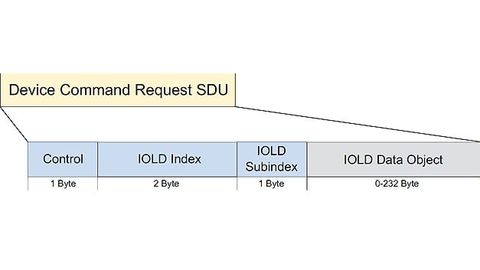
Figure 3: Device Command Request SDU: The IO-Link parameter to be read/written is selected in the 'Index' and 'Subindex' fields.
© Bosch RexrothThe parameter data contents are transferred to/from the device within the respective data object data fields of the IO-Link devices. Errors relating to the data transmission of both the IO-Link master and the IO-Link devices are reported via corresponding error code data fields. For device identification, the identification data of all devices is read out during start-up and stored in a separate sercos parameter. This includes the values of the VendorID, the DeviceID and the FunctionID. This enables simple checking, for example by a PLC program.
The master configuration of the IO-Link ports - the so-called port configuration - corresponds to that of a fieldbus. IO-Link has a very lean or simple port configuration, and most of the setting values are handled by the sercos start-up parameterization. Each port can also be reconfigured at runtime using corresponding telegrams. A separate port diagnosis can also be read out for each port, such as the port operating mode, the diagnostic status with status code, the device identification data (VendorID, DeviceID,...), data storage error codes, the IO-Link revision and much more. Last but not least, device diagnostics are available via the familiar sercos diagnostic mechanisms (readable diagnostics, diagnostic memory, error deletion, etc.). The diagnostic codes specified for IO-Link, such as error numbers and diagnostic classes, are mapped 1:1 in sercos. This automatically results in the extension of the diagnostics in the event that new diagnostic codes are specified for IO-Link.
The functions available in IO-Link for device replacement are also mapped: The data storage mechanism of the devices allows all parameter data of a device to be automatically saved in the IO-Link gateway. If a component fails, the user simply has to replace the device with an identical slave. The gateway automatically detects the new participant and carries out the parameterization during the subsequent start-up, whereby no new parameterization of the slave is necessary. Even if the gateway fails, devices can be replaced without reconfiguration: the sercos master can save the configuration of the gateway, automatically detect the device replacement and carry out the new parameterization independently.
Function blocks for the PLC
In the MLC control system from Bosch Rexroth, for example, the following PLC functions are implemented with the help of function blocks (FB):
- acyclical parameter access (IOL_CALL)
- Device identification
- Device diagnostics, port diagnostics
- Command processing
- Port configuration
- Backup/restore of an IO-Link device
The basic function block for reading/writing an IO-Link parameter is shown in Figure 5. This FB uses the aforementioned tunnel protocol for acyclical transmission. Using the backup FB, all parameters of an IO-Link device can be read out and saved on the PLC; the restore FB is used to write the previously saved parameters. These FBs are valuable, for example, if all IO-Link devices of a machine/system are to be parameterized automatically for the first time from a PLC commissioning program of a series machine after it is switched on for the first time. This means that the user is spared the time-consuming manual loading of the parameters into the devices using a commissioning interface or a separate program, for example via a USB adapter. Finally, the diagnostic FB reads the diagnostic information from a device, so the user only has to evaluate the status information (DeviceStatus/StateDetails).
In total, around 15 function blocks are implemented for the integration of IO-Link in sercos.
Example positioning drive
The advantage of sub-bus integration can be illustrated using the example of the PSE3 positioning drive from Halstrup-Walcher, which is available with both Sercos and IO-Link. The drive with Sercos requires three M12 connectors, while IO-Link only requires one M12 connector. This simplifies installation/commissioning. Due to the smaller number of connectors required, the variant with IO-Link is 13% shorter - i.e. 100 mm compared to 115 mm.
Sercos scores points in terms of performance: Sercos allows cycle times of 1 ms compared to 8 ms with IO-Link. This means that although Sercos is faster for setpoint specification or refresh rates of actual or status values, in positioning applications, for which the PSE3 is designed, this will rarely have an effect in practice.
In conclusion, it can be said that The specification for the integration of sub-buses in sercos offers very convenient options. The two-level nature of the specification makes it easy to integrate other sub-buses in addition to IO-Link in the same way; there is little change for the user at the protocol level. Support in control systems benefits from this architecture, as large program parts can be reused for other sub-buses. The basis for this are standard Sercos mechanisms, which every Sercos controller can handle today. Initial implementations are available and are already being used in prototype applications.
Author:
Dr. Stephan Schultze works at Bosch Rexroth in Automation Systems Motion Logic Control Development.


You might also be interested in
Connecting Wireless Sensors and Analog Control Systems
Hottinger Brüel & Kjær (HBK) has reintroduced the "WSDA-101" wireless gateway to the market. The wireless gateway is particularly well-suited for applications that require predictable analog signals with low latency.
 read more...
esd electronics at the SPS 2025
Gateway connects Ethercat with CAN FD
With the 'CAN-EtherCAT/2-FD', esd electronics presents a stand-alone gateway that allows a direct connection from CAN FD to Ethercat.
read more...Innovation partner for automation
Bihl+Wiedemann is a medium-sized, owner-managed company - founded in 1992 by Jochen Bihl and Bernhard Wiedemann in Mannheim. It develops and manufactures complete solutions for functional safety and data communication in machines and systems.
read more...IIoT gateway or soft PLC
With 'IndustrialPI', Pilz presents an open and modular industrial PC based on the Raspberry Pi with freely available open source software.
read more...Efficient Modbus gateways
Spectra's tGW-700 series Modbus TCP to RTU/ASCII gateways allow Modbus/TCP hosts to easily communicate with Modbus RTU/ASCII serial devices over an Ethernet network.
read more...Lütze Group is acquired by Amphenol Corporation
The international Lütze Group will be acquired by the US-based Amphenol Corporation on October 1, 2024.
read more...Certified according to IRIS Rev.04
Rail technology specialist Lütze Transportation has successfully completed certification in accordance with ISO 22163:2023 / IRIS Rev.04. The certification underlines Lütze's commitment to meeting the highest quality requirements of the rail...
read more...Industrial routers and gateways
Hy-Line Technology is expanding its portfolio of 5G-capable industrial routers and gateways.
read more...Innovation partner for automation
Bihl+Wiedemann is a medium-sized, owner-managed company - founded in 1992 by Jochen Bihl and Bernhard Wiedemann in Mannheim. It develops and manufactures complete solutions for functional safety and data communication in machines and systems.
read more...