

Industrial Internet
A new network architecture
Laying the foundations for the future of the industrial internet - this is the aim of the 'Find' research project. Under the leadership of the DKFI, an intelligent network management system for Industry 4.0 is to be developed.
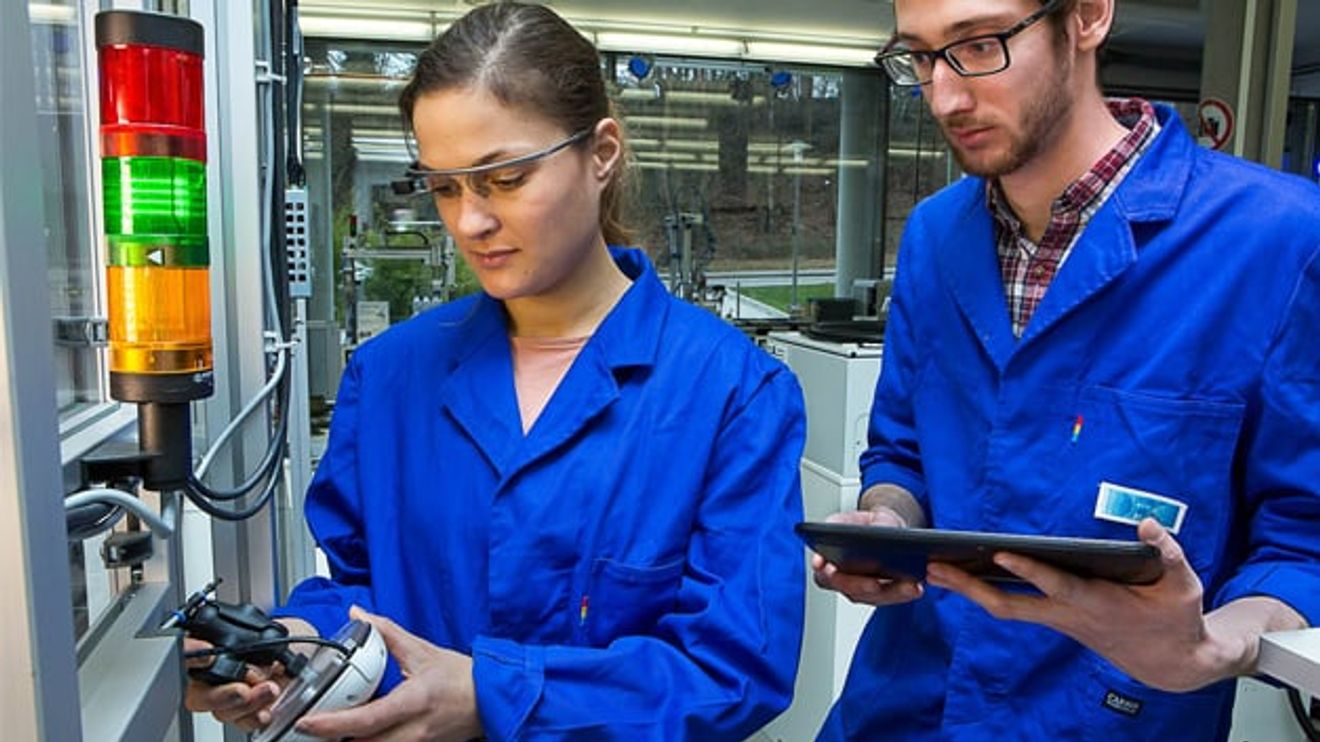
In the 'Find' project - 'Future Industrial Network Architecture' - representatives from industry and science have joined forces to develop the foundations for the future of the industrial Internet based on the latest network technologies from the fields of industrial automation, the Internet and 5G mobile communications. In addition to DFKI as the overall coordinator, the consortium includes Bosch, Festo, the Institute for Industrial Information Technology (inIT) at the Ostwestfalen-Lippe University of Applied Sciences in Lemgo, HMS, Bosch Rexroth, rt-solutions.de, Siemens, the Technical University of Dresden and the University of Passau. The consortium is coordinated by Professor Hans D. Schotten, scientific director at DFKI and head of the Intelligent Networks research department. 'Find' is funded by the Federal Ministry of Education and Research (BMBF) with around 4.3 million euros over a period of three years.
The aim of the 'Find' project is to develop an overall architecture for the future Industrial Internet and, in particular, a network control system that can largely automatically map and monitor the requirements of industrial applications to the various resources and networking options. Manual intervention in the configuration of a network and during operation should be reduced to a minimum. The aim is also to automatically provide defined service qualities across different networking technologies on an end-to-end basis. In this way, complex, distributed control architectures can be implemented flexibly and efficiently, whereby the underlying complexity is largely abstracted from the application developer and factory operator. Failures of individual resources, such as control hardware, can be automatically compensated for in order to reduce unnecessary downtimes of systems or machines and thus increase the effectiveness of the entire production process. In addition to future systems and those currently under development, such as Time-Sensitive Networking (TSN) or 5G, it should also be possible to easily integrate the numerous existing industrial communication technologies and devices in order to enable seamless migration.


You might also be interested in
Nokia and Bosch sound out 5G mobile communications standard
At the Digital Summit in Tallinn, Estonia, Bosch and Nokia are presenting a demonstrator that combines the upcoming 5G mobile communications standard with Industry 4.0 solutions. 5G is set to increase the speed of mobile data transmission tenfold...
 read more...
Software & IT in its own hall for the first time
This year, for the first time, SPS IPC Drives is bundling the topic of software & IT in manufacturing in its own hall - Hall 6 - in response to the increasing convergence of the two sectors in the age of digital transformation.
read more...DFKI professors at the head of the FFPA
The Flexible Factory Partner Alliance (FFPA), an association of major technology companies and research institutions recently founded in Japan, has appointed DFKI professors Andreas Dengel (pictured) and Hans Schotten as its leaders.
read more...SoftMaster available free of charge as open source
According to Sercos International, Bosch Rexroth is now making the Sercos SoftMaster available free of charge as open source software as part of its Sercans XS package.
read more...Nachgehakt bei Prof. Dr. Hans Schotten
Die Funklösungen der Zukunft
Unter Federführung des DFKI will ein Konsortium aus Industrie und Forschung die nächste Generation von WLAN-Funktechnologie entwickeln, die insbesondere den Anforderungen moderner Mensch-Maschine-Schnittstellen gerecht wird. Projektkoordinator...
read more...Data security solutions no longer sufficient
According to a recent study, a majority of companies believe that their current data security solutions will not be sufficient for the future. Action is needed now, as data loss costs companies almost 900,000 euros per year.
read more...International Federation of Robotics
The three top trends in industrial robotics
According to the IFR, two million new robots will be installed in production facilities worldwide by 2022. Three trends stand out in particular.
read more...Grid operators under pressure to act
The high investment costs for the expansion of the 5G network are causing problems for network operators. The technology consultancy BearingPoint assumes that network operators therefore need to reposition themselves - now!
read more...New series: Three questions for ...
What will 2020 bring?
Under the title "Three questions for ...", computer-automation.de is publishing short interviews with the leading figures in the automation industry on a monthly basis this year.
read more...