
MVTec Software
The safe grip in the box
Bin picking is a key process for the robot-supported automation of handling processes in industrial environments. MVTec now offers a new technology for the secure gripping of objects whose shape is not known in advance.
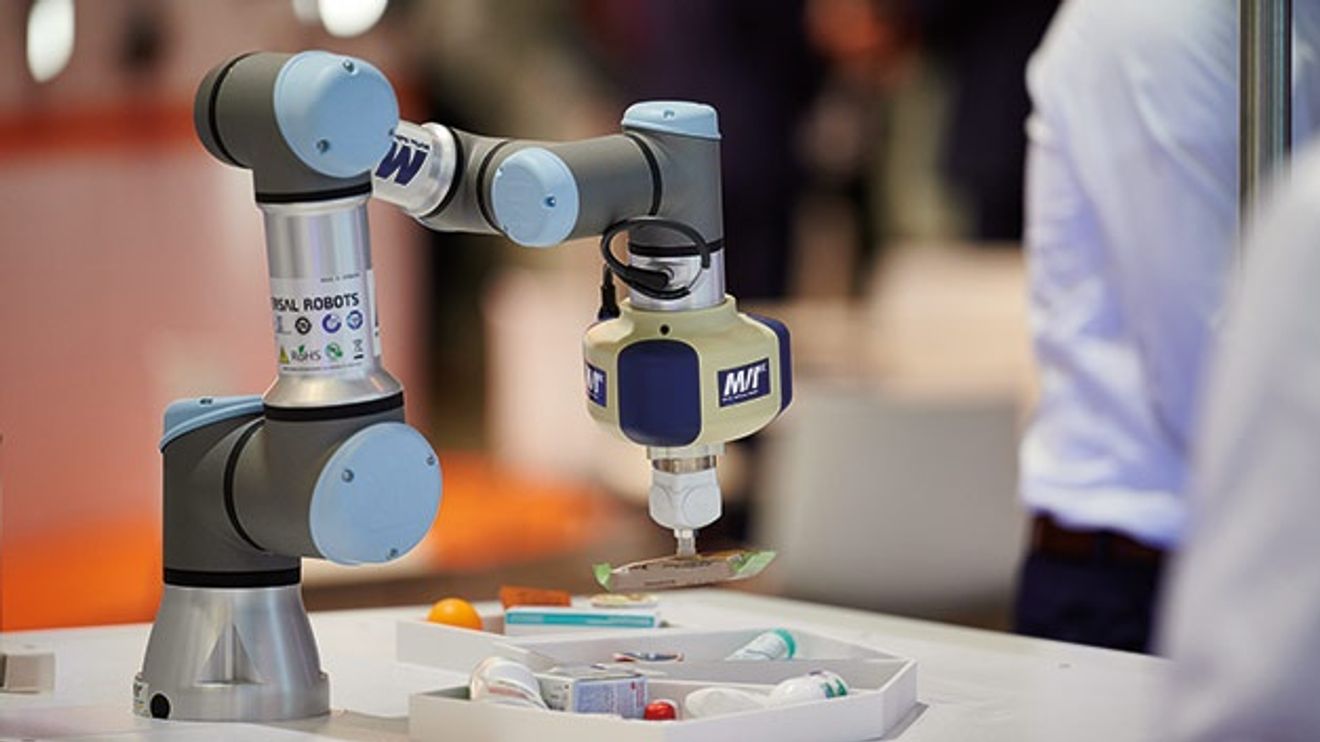
The gripping surfaces on absorbent objects of various unknown geometries are found.
© MVTecIn bin picking, a robot picks specific parts from a bin in order to make them available for processing or for further process steps. This involves placing the items, which are usually lying in the bin in a disorderly manner, in the correct orientation at the new storage location. Bin picking is primarily used in the production workflow, for example in the assembly of individual parts, separation or packaging of finished products.
Another area of application is intralogistics. Here, for example, a wide variety of objects are stored in boxes (bins) in fully automated high-bay warehouses. To pick the parts, autonomous industrial trucks drive to the shelves, load certain bins and transport them to the picking point. There, permanently installed robots remove the relevant items from the bin and prepare them for the rest of the process chain. The robots are connected to 3D cameras and image processing software in order to recognize and pick the objects accurately.
A wide variety of object geometries
The objects to be gripped can have a variety of different geometries and shapes. To ensure good recognition rates, the machine vision system would need a detailed CAD model of each individual object. In many application scenarios, however, CAD models are not available.
CAD model-free approaches

This is why a bin-picking approach is needed that does not require any CAD models. A number of key challenges need to be addressed here: Due to the lack of a model, little or no knowledge is available in advance about the objects to be gripped. In addition, there may be several objects with different geometries in a bin, all of which must be gripped securely. Furthermore, the gripping process can be made even more difficult due to deformable objects. Another challenge lies in the widely varying surface properties of the objects. For example, these can be low in texture, partially transparent or even glossy, which favors reflections. Such properties always lead to massive information gaps during image processing - especially in the 3D point cloud.
In addition, due to the large object variance in warehouses, the bin-picking solution must be able to cope with a variety of geometries, different object sizes and image data from different sensor types. Last but not least, it is important to keep the costs of intralogistics handling processes under control. On the one hand, this is achieved by accelerating the throughput times of the bin-picking application. On the other hand, costs can also be reduced by using hardware with lower performance.
Reliably identify gripping points

MVTec offers the new "3D Gripping Point Detection" feature for these bin-picking applications, which is based on a pre-trained deep learning network. The particular benefit of the technology lies in the extended application possibilities of bin-picking processes: it can be used to grip objects whose shape is not known in advance. The process is able to robustly identify possible gripping surfaces on absorbent objects so that the vacuum cup can safely pick up the object. No CAD model or other knowledge about the shape of the object is required for the gripping process. This means that bin-picking applications can be extended to numerous object categories with different geometries. In addition, the robot can also robustly grip flexible, deformable objects that are not described by a rigid shape.
"3D Gripping Point Detection" is integrated into the current version 22.11 of the standard Halcon machine vision software and is therefore part of the Halcon Toolbox. This includes image acquisition, the HDevelop development environment, various language interfaces and, at its heart, an image processing library. The software also offers the option of running applications on a wide range of embedded platforms. The image processing library contains a bouquet of different methods - from camera calibration, code reading, 2D and 3D measurement, filters and blob analysis to various deep learning methods such as classification and global context anomaly detection. The individual tools from the library can be combined flexibly and efficiently in order to respond to the specific requirements of an image processing application.
The complete machine vision workflow
Halcon covers the complete workflow of any machine vision application. This includes image acquisition, pre-processing, processing, post-processing and results output. This allows the entire bin-picking process to be raised to a high level. For example, the 2D and 3D image data can be prepared using appropriate tools during pre-processing so that the processes in the main part are more robust. The classic steps in pre-processing include noise reduction and suitable background treatment, for example to reduce the image domain to the objects in the bin. In addition, suitable pre-processing is able to increase the speed and robustness of the process. For example, the image domain can be restricted or cropped accordingly. The software also supports dedicated AI hardware accelerators via the AI Accelerator Interface - via TensorRT or OpenVINO - which makes the inference of 3D Gripping Point Detection many times faster.

There are also plans to expand the technology in one of the upcoming versions to include post-training in order to be able to optimize the bin-picking process with regard to certain hardware conditions or environmental situations.


You might also be interested in
The 'eye of production'
Machine vision makes a significant contribution to the end-to-end automation and optimization of production chains. If artificial intelligence methods such as deep learning are used here, process efficiency can be further increased.
 read more...
SWIR hyperspectral camera for industrial high-speed inspection
Teledyne Dalsa launches 'Kaleido', a hyperspectral camera for use in the shortwave infrared (SWIR) range, designed to overcome the existing integration and performance limitations of industrial sorting processes.
read more...IDS and Prophesee intensify partnership
IDS and Prophesee are intensifying their partnership for the next generation of event-based industrial cameras. Together they want to explore new sensor architectures that combine classic imaging with Prophesee's event-based 'Metavision' technology.
read more...Dual leadership in Shanghai
Stefan Becker has been appointed Managing Director of Eckelmann Automation Technology in Shanghai and will manage the subsidiary together with Zhongwei Huang.
read more...IDS Imaging Development Systems
Camera series for streaming, monitoring and event recording
IDS Imaging Development Systems launches the 'uEye Live' camera series with the 'uEye SCP' and 'uEye SLE' product ranges. They specialize in monitoring tasks, deliver various live streams and also enable event recording.
read more...AI and streaming meet robustness
IDS Imaging Development Systems is expanding its range of AI cameras with the 'IDS NXT oslo'. The model combines artificial intelligence with video streaming and recording functions in a compact, industrial-grade housing.
read more...With real-time data against disasters
A digital twin is more than just a two- or three-dimensional digital copy. It combines precise data with intelligent analysis and solves complex challenges. With locations in Paderborn and other cities, Eviden relies on the combination of artificial...
read more...Sold to Exaktera
AutoVimation will be part of Exaktera LLC, a portfolio company of Union Park Capital, based in Boston.
read more...Young Professional Award 2024 announced
The EMVA Young Professional Award is an annual prize worth 1500 euros that recognizes the outstanding and innovative work of a student or young professional in the field of machine vision or image processing.
read more...