
Embedded Vision
The embedded vision system
Smooth communication between the components of an embedded vision system and this system with the automation is a prerequisite for real-time data transmission. This calls for the development of standards.

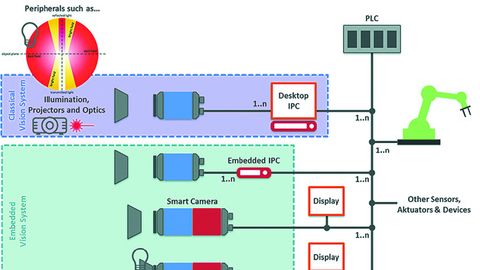
Embedded vision systems are transforming into decentralized, intelligent and autonomous participants in the production and automation environment. In the future, they will be able to automatically log into the network and know which network participant requires their measurement results. The automation network can then retrieve specific information from the device, such as image and signal data.
Thanks to their high computing power and intelligent algorithms, embedded vision systems will make it possible to evaluate data such as product, quality and process information in real time on site, process it for further use and report the results back. The systems therefore not only provide information, but also control processes in order to improve the performance, efficiency and quality of a production process. Preventive maintenance, human-robot collaboration and flexible system control for single-item production can thus be implemented more efficiently.
Parallel data processing in real time
What could an embedded vision system look like that is able to reduce the high load of increasing bandwidths in order to process and evaluate images decentrally in real time and at the same time reduce the load on computers?

Types of embedded vision systems: Embedded camera head consisting of sensor and FPGA (top), embedded vision system as smart sensor with FPGA SoC (middle) and vision SoC, mostly integrated in individualized applications (bottom).
© Embedded Vision Study GroupFPGAs (Field Programmable Gate Arrays), which can be found on frame grabbers as well as in embedded vision systems such as cameras or vision sensors, promise the greatest leaps in increasing process performance. A large number of integrated circuits can be implemented in an FPGA, which take over image processing processes such as image optimization, image evaluation or the generation of control signals. With their ability to process data with very high parallelism, FPGAs offer optimal conditions for the evaluation of image data in real time. This allows not only barcode reading to be implemented in a camera, but also the recognition of barcodes on products and image enhancement by eliminating unwanted reflections, soiling or geometric distortions.
FPGAs control sensors, pixel formatting and processing as well as the transfer to interfaces. They enable pre-processing in order to reduce the bandwidth of the image data or to carry out evaluations in order to obtain meta or control data. This allows many companies to incorporate their application know-how into the devices and address new applications and markets.
Whereas FPGA hardware programming used to be considered complex and expensive, it is now much easier to carry out using a graphical user interface via operators and data flow diagrams and without any hardware programming knowledge.
Since FPGAs are reprogrammable, any number of special applications can also be used in embedded vision systems. FPGAs can be coupled with processors in the form of a hybrid architecture. Such cyber-physical components represent a small computer, often consisting of embedded 'systems on a chip' (SoC) including special processors, special real-time capable microcontrollers and high-tech memories with high performance and minimal power consumption as well as multi-core architectures.
Heterogeneity calls for standards
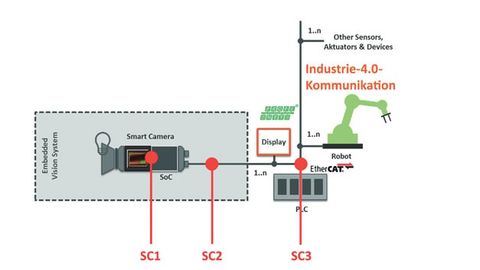
The Embedded Vision Study Group (EVSG) aims to make the heterogeneous system architecture for embedded vision more permeable and has identified three technology fields (SC1, 2 and 3) for which interface standards are to be developed.
© VDMAThe Embedded Vision Study Group (EVSG) has taken up the cause of making this heterogeneous system architecture more permeable. It presented its report at the G3 Future Standards Forum (FSF) in Chicago in summer 2015. By further developing standards such as OPC UA and Gen<I>Cam for embedded vision in several working groups, the EVSG is driving standardization forward so that recorded (image) data can be processed without loss and evaluation results can be transported further.
In the EVSG report, three technology fields were identified as 'Standard Candidates' (SC) for which the working groups will develop interface standards:
- SC1 deals with the modular structure with sensor boards and processor unit/system on a chip (SoC) and their compatibility.
- SC2 concerns the software model (API) for communication with the embedded components and their control.
- SC3 deals with their integration into an automation or processing environment.
Three fields of technology
One specific question in the SC1 technology field is, for example, how a sensor can be connected to processor intelligence so that it automatically feeds its image data into a network. Until now, proprietary software programs have been used to control cameras and sensors or to transfer processing results as well as for device recognition and control. Interface standards must therefore be developed that are compatible with Gen<I>Cam in order to efficiently embed image processing devices in the production environment. The EVSG has evaluated various interfaces between sensor and processor/SoC, in particular MIPI, PCI Express and USB3, but has not yet been able to make a concrete recommendation for one of the technologies for reasons of long-term availability and technical limitations.
An important basis for the SC2 technology field is that embedded vision systems pre-process images internally, in some cases up to the level of result data. This new type of data requires extended generic description models of data formats and structures as well as their semantic information. The EVSG recommends a Gen<I>Cam standard extended to include the requirements of embedded systems, with a focus on supporting generic data formats and the processor modules that process the data. Security mechanisms such as data encryption and IP protection are an additional aspect to be considered here.
In the SC3 technology field, the transfer of pre-processed and compressed image data into concrete information remains a challenge. This requires standardized interfaces between embedded image processing systems and automation technology as well as the control and planning level. RAMI 4.0, the Industry 4.0 reference architecture model, recommends the standardization protocol OPC UA as the sole solution within the framework of a companion standard that offers a tried and tested software model. As a technology candidate, Gen<I>Cam was evaluated as a companion standard with a focus on semantics (adoption of the Gen<I>Cam SFNC - Standard Features Naming Convention), which the EVSG also supports. The image processing systems should then be integrated directly into the PLC software and thus into the production line. As part of a planned OPC UA specification, there will be a real-time extension in the future.
Flexible programming of FPGAs
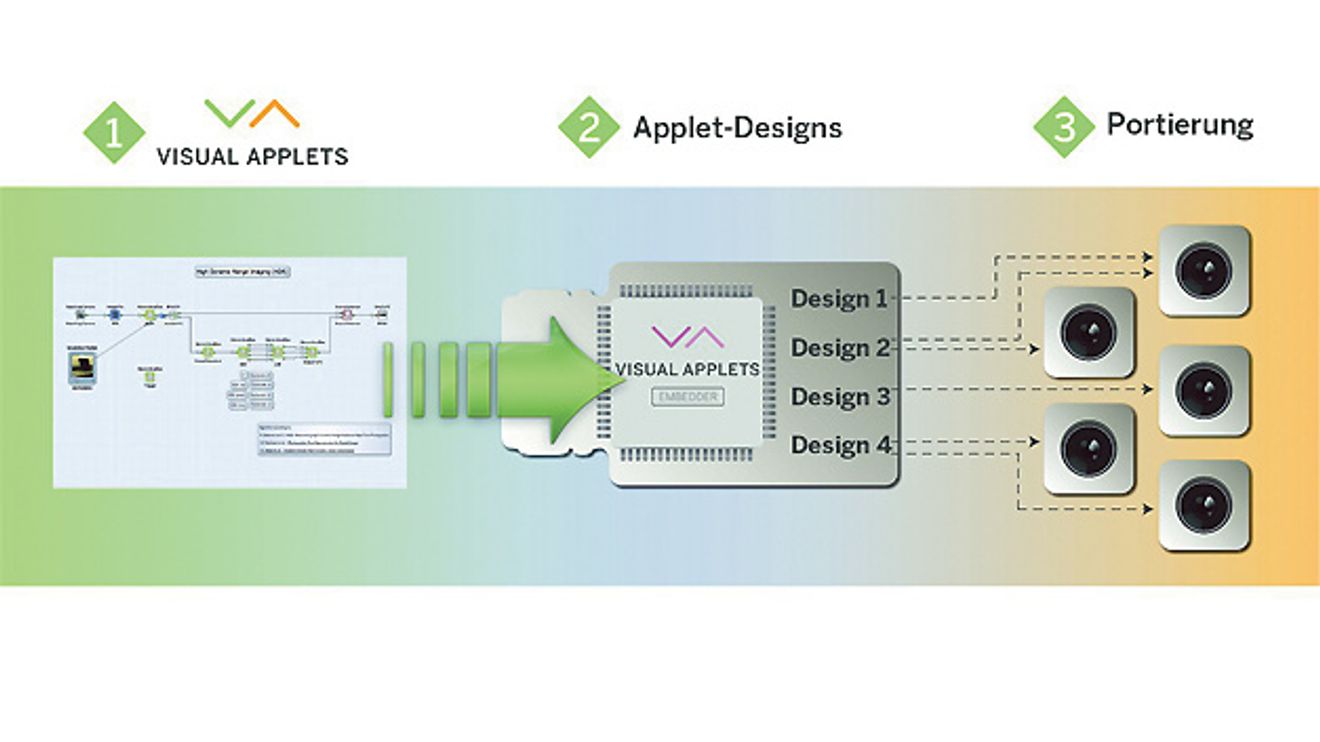
Image processing algorithms on FPGA hardware, for example, can be created via a graphical user interface - without requiring hardware specialists with FPGA programming skills.
© Silicon SoftwareWhile the programming of FPGAs used to be reserved for hardware specialists, today software developers and application engineers are able to create image processing algorithms on FPGA hardware alongside system integrators, component manufacturers and hardware developers - thanks to easy-to-use technology, for example via a graphical user interface. Silicon Software pursues this approach with the 'VisualApplets' development environment, which allows individual applications and control tasks at signal level (e.g. trigger control) to be implemented using over 200 operators and preconfigured example designs. With the 'VisualApplets Expert' extension, experienced users can also take existing hardware code such as image processing modules in VHDL and Verilog and use them as generic operators in VisualApplets. The modules are inserted as pre-synthesized IP core netlists. Each IP core generates exactly one operator.
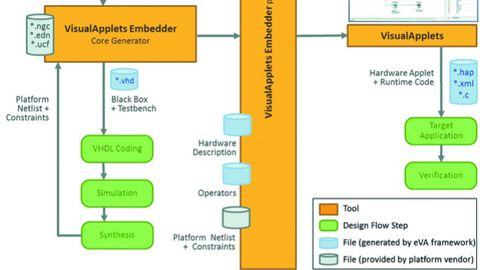
With its programming and integration environment, 'VisualApplets Embedder' enables an automated workflow to implement embedded vision technology in vision devices.
© Silicon SoftwareIn order to program embedded vision systems with FPGAs and SoCs with VisualApplets individually, an intermediate layer such as 'VisualApplets Embedder' is required. This brings together the existing electronics of an image processing device and the VisualApplets interfaces in the FPGA as the central control processor, abstracted via an additional IP core. The implementation of VisualApplets Embedder in an image processing device is carried out in a few steps in a one-off process.
The integration process first requires the definition of the interfaces of the IP core and its integration into the overall FPGA design. In order to be able to use an image processing algorithm created with VisualApplets on embedded systems, an arbitrarily fillable IP core is integrated into the FPGA design of the hardware platform as an empty black box in VHDL. The connection to the external hardware resources, for example to sensor interfaces and memory controllers, is made using 'glue logic'. To do this, manufacturers enter some data (e.g. FPGA used) and specify the ports on the IP core (memory interfaces, image data inputs, image data outputs, register and GPIO interfaces). With VisualApplets Embedder, a flexible combination of freely scalable, configurable interfaces is possible.
A netlist must be generated from the overall FPGA design and the associated constraints file created. Finally, a hardware platform-specific plug-in for VisualApplets is generated to support the device in the programming environment. In addition to the IP core black box, the plug-in contains all the information on the FPGA of the hardware platform that is required to create an FPGA configuration bitstream. For the software-side integration of the new devices under VisualApplets, an installer is generated via the plug-in, which can be distributed to the VisualApplets users and retrofits the programmable image processing devices. After the final installation of VisualApplets and the plug-in, the new hardware platform can be programmed with VisualApplets.
The intermediate layer must be integrated into the FPGA hardware once, after which the resulting open platforms can be programmed as often as required. Applications and functions can also be ported to other FPGA devices, for example to maintain a product family or to carry out cross-product porting, such as from a frame grabber to an intelligent camera. FPGA programming directly in the device allows parts of the image pre-processing to be carried out there, which reduces the amount of data and system costs. New applications - such as in the Industry 4.0 environment - and markets can be addressed
Author:
Martin Cassel is an editor at Silicon Software in Mannheim.


You might also be interested in
SWIR hyperspectral camera for industrial high-speed inspection
Teledyne Dalsa launches 'Kaleido', a hyperspectral camera for use in the shortwave infrared (SWIR) range, designed to overcome the existing integration and performance limitations of industrial sorting processes.
 read more...
IDS and Prophesee intensify partnership
IDS and Prophesee are intensifying their partnership for the next generation of event-based industrial cameras. Together they want to explore new sensor architectures that combine classic imaging with Prophesee's event-based 'Metavision' technology.
read more...Dual leadership in Shanghai
Stefan Becker has been appointed Managing Director of Eckelmann Automation Technology in Shanghai and will manage the subsidiary together with Zhongwei Huang.
read more...IDS Imaging Development Systems
Camera series for streaming, monitoring and event recording
IDS Imaging Development Systems launches the 'uEye Live' camera series with the 'uEye SCP' and 'uEye SLE' product ranges. They specialize in monitoring tasks, deliver various live streams and also enable event recording.
read more...AI and streaming meet robustness
IDS Imaging Development Systems is expanding its range of AI cameras with the 'IDS NXT oslo'. The model combines artificial intelligence with video streaming and recording functions in a compact, industrial-grade housing.
read more...With real-time data against disasters
A digital twin is more than just a two- or three-dimensional digital copy. It combines precise data with intelligent analysis and solves complex challenges. With locations in Paderborn and other cities, Eviden relies on the combination of artificial...
read more...Sold to Exaktera
AutoVimation will be part of Exaktera LLC, a portfolio company of Union Park Capital, based in Boston.
read more...Young Professional Award 2024 announced
The EMVA Young Professional Award is an annual prize worth 1500 euros that recognizes the outstanding and innovative work of a student or young professional in the field of machine vision or image processing.
read more...IDS Imaging Development Systems
Design freedom for board cameras
IDS has developed the 'uEye ACP' series, whose modular design principle makes a wide range of camera variants possible. The online configurator can be used to put together models that are available directly from stock.
read more...