
Artificial intelligence
Real-time object recognition thanks to AI
Fully automated production lines and autonomous transport systems such as AGVs require image processing systems that can implement complex object detections and classifications in real time. Artificial intelligence is proving to be helpful here.
Traditional image processing systems and classic algorithms are rule-based and are therefore often inflexible and complex to implement: Recognition and classification have to be developed manually by experts, which requires a great deal of expertise and time. The large number of possible objects can only be implemented with a great deal of effort or not at all. The result is high costs. It is also often not possible to meet the requirements for automation.
By using artificial intelligence (AI), on the other hand, a large number of individual objects can be reliably recognized and classified. With the deep learning software from Data Spree, for example, the software logic can be easily implemented in the background. The 'Data Spree AI' can handle both 2D and 3D image data - such as images from Becom's ToF 3D camera system. ToF technology makes it possible to generate robust image data even in changing lighting conditions and provides an additional grayscale image for recognition in addition to the 3D information.
Similar to the human brain

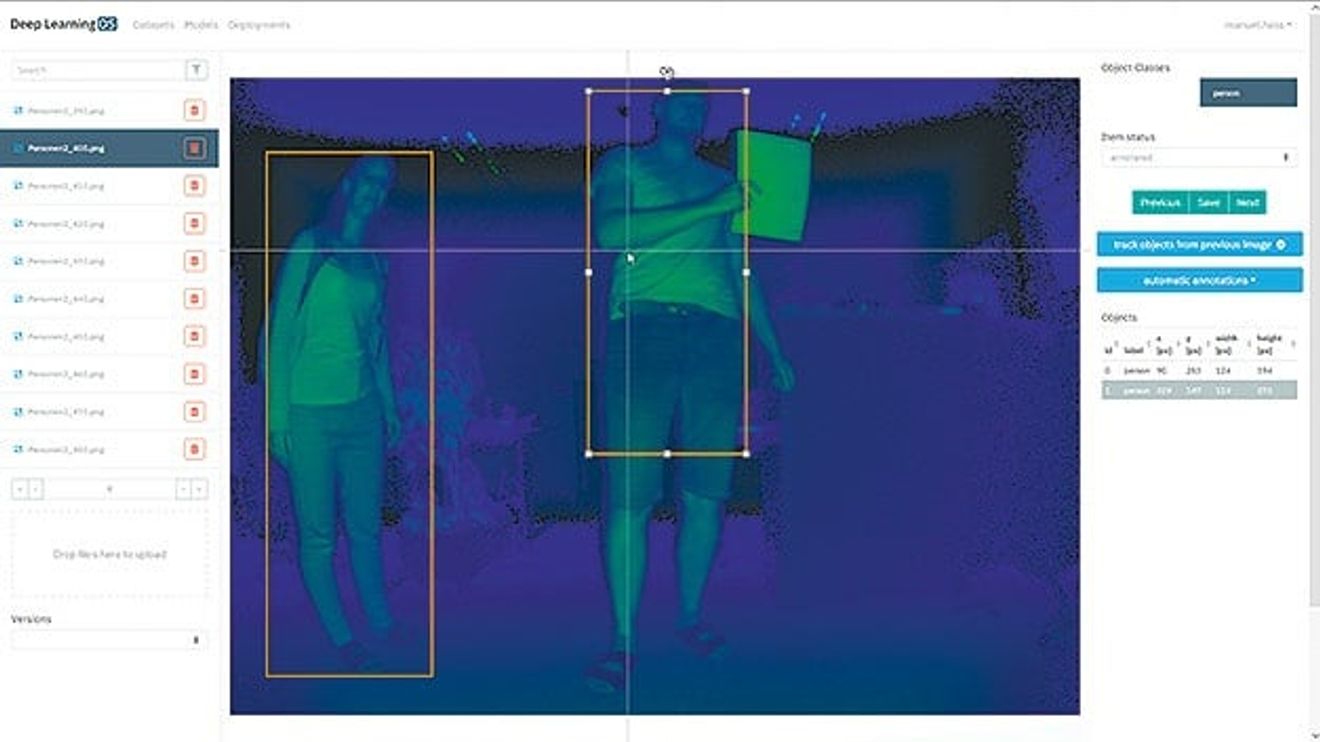
Data Spree's deep learning software is used to train the artificial intelligence and analyze the captured 2D and 3D images.
© Data SpreeTo implement AI-based object recognition, images of the objects to be recognized are first taken from the production or logistics process. The objects are then marked in order to train the AI. This marking of the data is called annotation. After learning or 'training', the AI can reliably detect and classify objects. The AI works in a similar way to the human brain and learns to recognize, assign and localize objects based on the image data - without the need to manually predefine specific features. Users can carry out this learning process themselves with the deep learning software 'Deep Learning DS' or use the complete process up to productive integration into the system as a service from Data Spree.

This method can be used to quickly implement a wide variety of complex automation tasks in production, logistics, robotics or autonomous transport systems - without a single line of programming code. In just a few hours, an operational prototype can be created and expanded into a productive solution.
The trained AI model can be individually integrated into any customer application thanks to the open ONNX standard format. Data Spree's own execution environment 'Inference DS' also offers a simple graphical user interface in which the AI model can be executed on the respective hardware using a drag-and-drop principle, for example on a smart camera or industrial PC.


You might also be interested in
Federal Chancellor praises research into artificial intelligence
During a visit to DFKI, Federal Chancellor Olaf Scholz (SPD) emphasized the importance of artificial intelligence (AI) for Germany as a business location.
 read more...
Interview with Johanna Pingel, Mathworks
How to use AI correctly
Artificial intelligence promises more efficient processes. But what needs to be considered when working with machine learning & co. Where do I start and, above all, how? Johanna Pingel from Mathworks provides answers.
read more...AI research should be geared towards industry
The time for broad-based research into artificial intelligence in Germany is over, says Peter Liggesmeyer. Instead, more attention should be paid to the requirements of industry.
read more...Mechatronics & Automation Cluster
The Mechatronic Joint Initiative
The 'Mechatronic-Joint Initiative' (Mejoin) is a cooperation between German and Japanese SMEs, universities and industry-related institutions. The aim of the project is to strengthen the exchange of knowledge between industry and science.
read more...Vision 2021: BV industry reunited
After a three-year absence, the machine vision industry met again in person at Vision 2021. Over 5,400 trade visitors came to Stuttgart for the restart of the leading trade fair for machine vision.
read more...The e-paper of issue 9/2021 in a new look
With issue 9, we have given ourselves a design upgrade. In terms of content, we remain true to our claim: to present the trends and technologies of the automation industry. Issue 9 features interviews with seven industry experts.
read more...The e-paper for the special issue
SENSOR & VISION 2021
From 5G to AI: The new e-paper presents smart solutions that manufacturers have to offer in the field of sensor technology and image processing. Take a look at the latest special issue and find out all the trends at first hand.
read more...AI platform for machine vision
Basler has announced a new AI platform for machine vision based on the artificial intelligence and machine learning (AI/ML) services from Amazon Web Services (AWS). It enables customers to seamlessly deploy AI-based applications.
read more...IDS Imaging Development Systems
AI-based image processing for the field level
Integrating AI-based machine vision tasks directly into production - no problem thanks to industrial protocols such as OPC UA and prepared function blocks of special inference cameras. And all without expert knowledge of image processing or machine...
read more...